
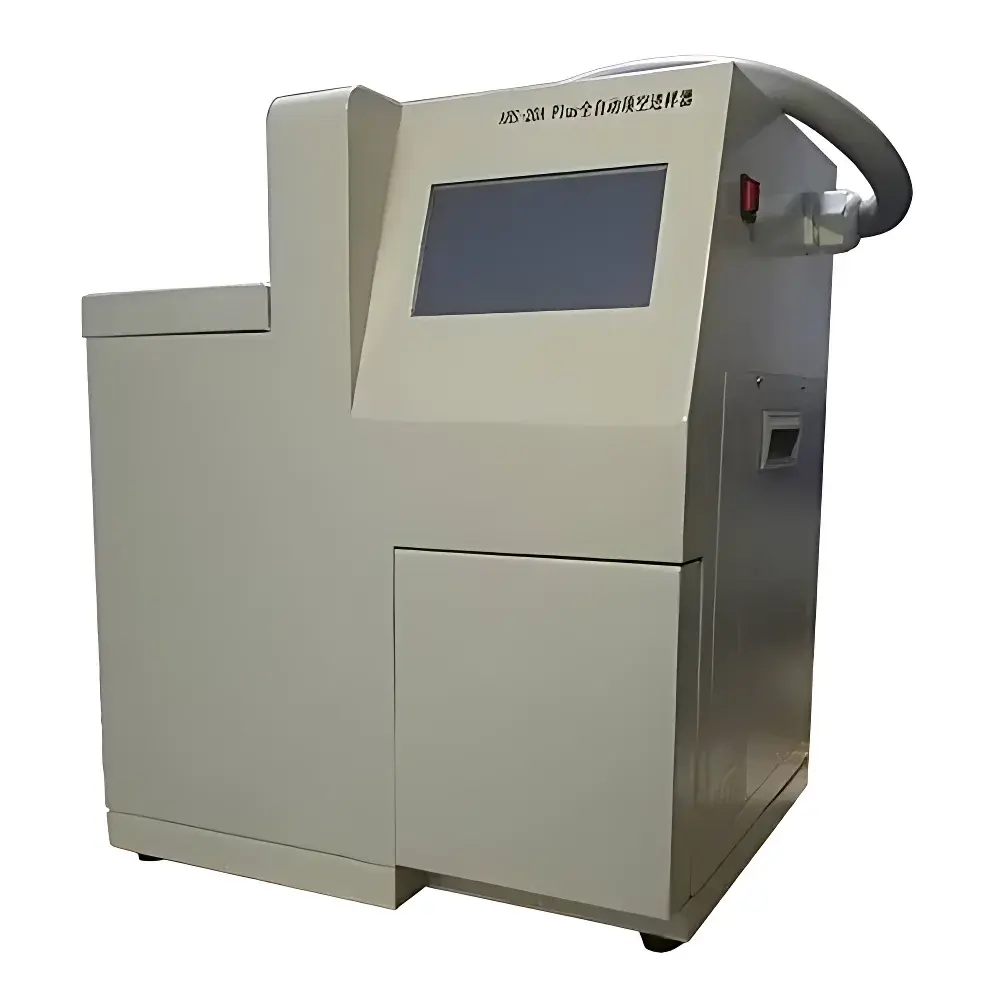
Beifen Sanpu AHSF-20A Plus Fully Automated Headspace Sampler
| Brand | Beifen Sanpu |
|---|---|
| Model | AHSF-20A Plus |
| Origin | Beijing, China |
| Manufacturer Type | Direct Manufacturer |
| Heating Range (Sample/Valve/Transfer Line) | 40–220 °C (configurable up to 300 °C) |
| Temperature Accuracy | ±0.5 °C |
| Temperature Stability | <±0.5 °C |
| Pressure Control Range | 0–0.25 MPa (continuously adjustable) |
| Sampling Time | 0–30 min |
| Injection Time | 0–999 s |
| Pressurization Time | 0–999 s |
| Purge/Clean Time | 0–30 min |
| Time Resolution | 1 ms |
| Quantitative Loop Volume | 1 mL (customizable: 0.5/2/5 mL) |
| Vial Capacity | 10 mL or 20 mL (customizable: 50/100 mL) |
| Sample Positions | 20 |
| Simultaneous Heating | 1 or 2 vials |
| RSD | <1.0% (100 ppm ethanol in water) |
| Purge Flow Rate | 0–100 mL/min (adjustable) |
| Communication Interface | USB |
| Compliance | ASTM D6866, ISO 11843-2, USP <467>, FDA 21 CFR Part 11 (software-controlled audit trail optional) |
Overview
The Beifen Sanpu AHSF-20A Plus Fully Automated Headspace Sampler is an engineered solution for precise, reproducible, and unattended volatile organic compound (VOC) extraction from solid and liquid matrices prior to gas chromatographic analysis. It operates on the principle of equilibrium headspace sampling: a sealed sample vial is heated to a defined temperature, allowing analytes to partition into the vapor phase above the sample; the gaseous headspace is then pressurized and transferred quantitatively via a high-inertness loop and heated six-port valve into the GC inlet. This method eliminates matrix interference, reduces column contamination, and enhances detection sensitivity—particularly critical for residual solvent analysis, environmental monitoring, pharmaceutical quality control (e.g., USP ), and forensic toxicology. Designed for integration into regulated laboratory environments, the AHSF-20A Plus supports method validation requirements under GLP and GMP frameworks, with hardware-level thermal uniformity and software-traceable parameter logging.
Key Features
- 20-position rotary sample carousel with automatic vial recognition and mechanical fault detection—avoids collision during positioning errors or empty slots.
- Triple-zone independent heating (sample oven, valve block, transfer line), all maintained within ±0.5 °C stability and calibrated to 0.5% accuracy; optional upgrade to 300 °C for high-boiling analytes.
- Electronically controlled pressurization (0–0.25 MPa) and purge flow (0–100 mL/min), eliminating reliance on external gas cylinders and ensuring consistent headspace equilibration.
- Deactivated fused-silica capillary tubing and passivated stainless-steel quantitative loops minimize adsorption, carryover, and cross-contamination—validated by <1.0% RSD using 100 ppm ethanol/water standard.
- Heated valve manifold with integrated six-port switching mechanism—zero cold spots ensure full analyte integrity during transfer; dead volume minimized via optimized loop-valve geometry.
- Full automation sequence: thermal equilibration → pressurization → sampling → injection → post-run bake-out → system purge—all programmable and executable without operator intervention.
- 7-inch TFT LCD interface with animated workflow guidance and bilingual (English/Chinese) menu navigation; local control and remote USB configuration supported simultaneously.
Sample Compatibility & Compliance
The AHSF-20A Plus accommodates standard 10 mL and 20 mL crimp-top headspace vials, with custom support for 50 mL and 100 mL formats upon request. It accepts heterogeneous samples—including aqueous solutions, polymers, soils, pharmaceutical tablets, and foodstuffs—without derivatization or solvent extraction. Its performance aligns with internationally recognized analytical standards: ASTM D6866 (biobased content), ISO 11843-2 (detection capability estimation), and pharmacopeial methods such as USP (residual solvents). When paired with compliant chromatography data systems (CDS), the instrument supports 21 CFR Part 11 requirements through optional electronic signature-enabled audit trails, user access controls, and immutable parameter change logs.
Software & Data Management
Control is implemented via dedicated Windows-based software accessible through USB 2.0 interface. All method parameters—including temperature ramps, timing sequences, pressure profiles, and event synchronization—are fully configurable and stored with versioned timestamps. The software enables batch scheduling across all 20 positions, real-time status monitoring (oven temperature, valve position, pressure readings), and automated report generation compliant with ISO/IEC 17025 documentation practices. Raw method files are exportable in XML format for long-term archival and third-party LIMS integration. Optional EPC (Electronic Pressure Control) module provides closed-loop regulation of carrier gas flow during injection, improving retention time reproducibility and reducing inter-run variability.
Applications
- Pharmaceutical QC: Residual solvent testing per ICH Q3C guidelines and USP .
- Environmental analysis: VOC screening in water, soil, and air samples per EPA Methods 502.2 and 8260.
- Food & beverage safety: Ethanol, acetaldehyde, and flavor compound quantification in wines, dairy, and packaged goods.
- Polymers & packaging: Migration testing of monomers and additives from plastics into simulants.
- Clinical toxicology: Blood alcohol concentration (BAC) determination and volatile metabolite profiling.
- Forensic chemistry: Ignitable liquid residue (ILR) identification in arson investigations.
FAQ
What sample formats are supported?
Standard 10 mL and 20 mL headspace vials with aluminum crimp seals; custom vial holders available for 50 mL and 100 mL formats.
Can the instrument be integrated with third-party GC systems?
Yes—it features TTL-level trigger outputs and USB command protocol compatibility with Agilent, Thermo Fisher, Shimadzu, PerkinElmer, and other major GC platforms.
Is validation documentation provided?
Factory calibration certificates (temperature, pressure, timing) and IQ/OQ templates are supplied; PQ support materials available upon request.
What maintenance intervals are recommended?
Quarterly inspection of sealing o-rings, annual verification of thermal uniformity across all zones, and routine cleaning of the quantitative loop using methanol or acetone.
Does it support multiple injection modes?
Yes—programmable configurations include single-vial multi-injection, single-vial single-injection, and multi-vial sequential single-injection per run.




