
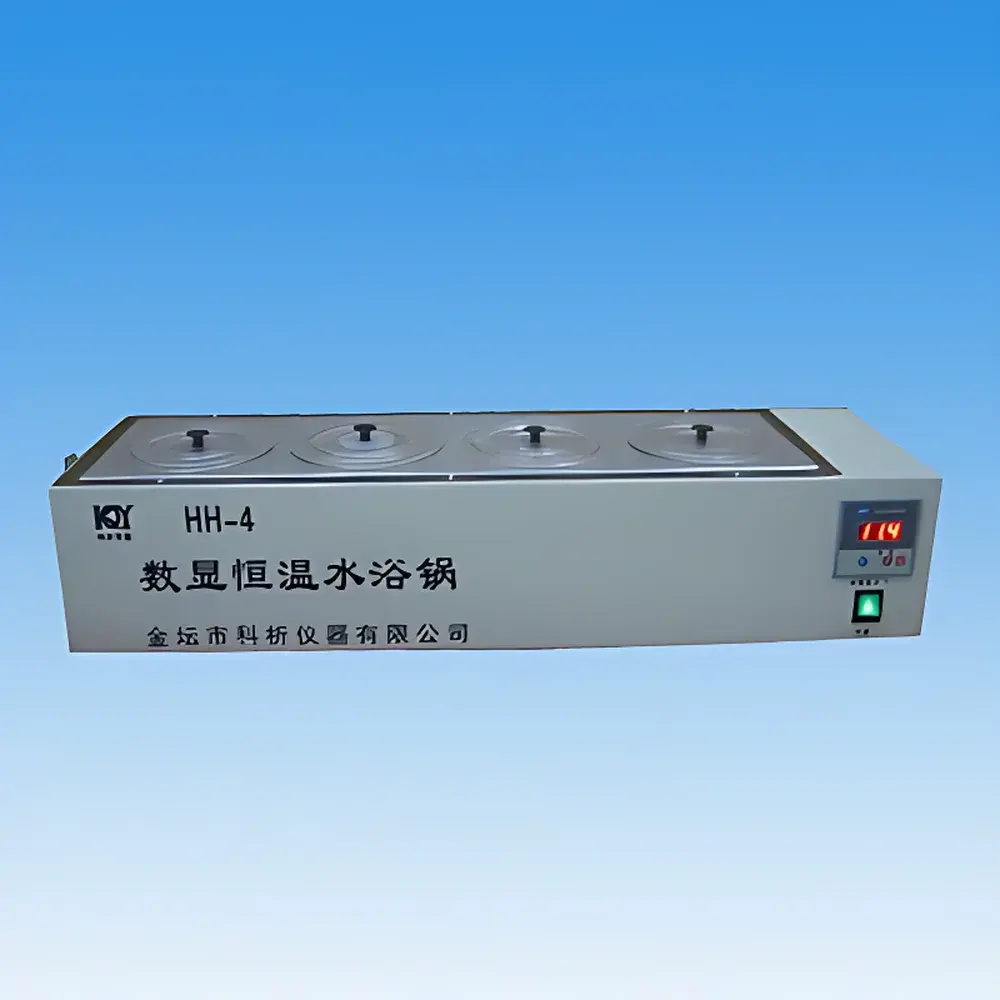
Beifen Sanpu HH-4 Single-Row Digital Constant-Temperature Water Bath
| Brand | Beifen Sanpu |
|---|---|
| Model | HH-4 |
| Type | Single-Row Digital Water Bath |
| Heating Capacity | 1000 W |
| Chamber Dimensions (per well) | Ø125 mm × 95 mm depth |
| Temperature Range | 0–100 °C |
| Temperature Accuracy | ±1.5 °C |
| Construction | Stainless steel inner tank, powder-coated mild steel outer casing |
| Power Supply | 220 V AC, 50 Hz, grounded three-pin input |
| Compliance | Designed for GLP-compliant laboratory environments |
| Control System | KW-1000DC digital PID temperature controller |
Overview
The Beifen Sanpu HH-4 Single-Row Digital Constant-Temperature Water Bath is a precision-engineered thermal platform designed for reproducible, stable heating of samples in standard laboratory workflows. Utilizing immersion-based convection heating via submerged tubular heating elements, the HH-4 maintains uniform thermal distribution across its four independent stainless steel wells—each with a nominal diameter of 125 mm and depth of 95 mm. The unit operates on a robust 1000 W heating system, enabling rapid thermal equilibration from ambient to 100 °C while minimizing energy consumption. Its core function centers on providing a stable, controllable aqueous thermal environment for applications including solvent evaporation, sample incubation, enzymatic reactions, reagent pre-warming, and gentle concentration of heat-sensitive compounds. Unlike dry-block or oil baths, water baths deliver superior temperature homogeneity (< ±0.3 °C spatial variation within the bath volume) and reduced thermal overshoot due to water’s high specific heat capacity and natural convective circulation.
Key Features
- Four independently accessible wells with standardized Ø125 mm × 95 mm geometry—compatible with common glassware including 100–500 mL beakers, Erlenmeyer flasks, and test tube racks.
- Digital PID temperature controller (KW-1000DC) with intuitive push-button interface, real-time display, and adjustable setpoint range from 0 to 100 °C.
- Stainless steel inner tank formed via deep-drawn stamping—eliminates weld seams that may harbor corrosion or biofilm accumulation.
- Externally mounted power switch and grounded three-conductor 220 V AC input—meets IEC 61010-1 safety requirements for laboratory electrical equipment.
- Integrated PT100-type temperature sensor housed in a protective metal sheath—positioned centrally to ensure representative feedback without direct contact with vessels.
- Over-temperature protection circuitry with automatic cut-off at 105 °C—prevents dry-run damage and complies with basic thermal hazard mitigation protocols.
Sample Compatibility & Compliance
The HH-4 accommodates a wide range of sample containers and volumes without requiring custom adapters. Its open-bath architecture supports simultaneous processing of multiple vessel types—including round-bottom flasks (with clamps), volumetric flasks, culture tubes, and sealed reaction vials—provided external insulation or lids are used where evaporation control is critical. All wetted surfaces are electropolished 304 stainless steel, ensuring resistance to mild acids, alkalis, and organic solvents commonly used in extraction and hydrolysis procedures. The device is manufactured in accordance with China’s GB/T 28001 occupational health and safety standards and conforms structurally to ISO/IEC 17025-recommended practices for calibration traceability of auxiliary lab equipment. While not certified for medical device use, it is routinely deployed in QC labs operating under ISO 9001 and GLP frameworks where documented thermal stability and operator safety are mandated.
Software & Data Management
The HH-4 operates as a standalone analog-digital hybrid instrument with no embedded firmware logging or network connectivity. Temperature setpoints and real-time readings are displayed locally on the KW-1000DC controller’s LED screen. For laboratories requiring audit-ready records, integration with external data loggers (e.g., Omega OM-DAQPRO-5300 or Testo 176 T4) is supported via the controller’s 0–5 V analog output signal (optional configuration). This enables time-stamped acquisition of bath temperature profiles aligned with LIMS timestamps, satisfying basic FDA 21 CFR Part 11 requirements when paired with validated electronic signatures and secure storage protocols. No proprietary software installation is required; configuration remains fully manual and deterministic—minimizing cybersecurity exposure and validation overhead.
Applications
- Controlled-rate drying of filter papers, chromatography plates, or precipitated solids under low-thermal-stress conditions.
- Pre-incubation of microbial culture media prior to pour-plating or broth enrichment steps.
- Standardized warming of viscosity reference oils and calibration standards before rheometer testing.
- Accelerated solvent removal from HPLC fractions using gentle, non-boiling evaporation at 60–80 °C.
- Hydrolysis kinetics studies requiring precise thermal hold periods (e.g., ester cleavage, glycosidic bond scission).
- Calibration verification of handheld thermometers and probe-based temperature sensors against NIST-traceable bath references.
FAQ
What is the maximum recommended fill level for safe operation?
The water level must always remain ≥20 mm above the top surface of the heating element—typically corresponding to ~75 mm depth from the rim. Never operate the unit with less than 5 L total volume across all wells.
Can the HH-4 be used with non-aqueous liquids such as silicone oil or glycerol?
No. The unit is engineered exclusively for water-based media. Use of viscous or low-conductivity fluids risks uneven heating, sensor drift, and premature heater failure.
Is the temperature accuracy verified at point-of-use or at the sensor location?
The ±1.5 °C specification reflects deviation between setpoint and measured value at the PT100 sensor location. Actual well-to-well uniformity is typically ±0.5 °C under steady-state conditions with proper water circulation.
Does the HH-4 support external temperature probes for vessel-specific monitoring?
Yes—via the optional analog output port. A calibrated external probe can be placed directly in a sample vessel, and its signal routed to a secondary recorder while the bath maintains ambient thermal stability.
How often should the stainless steel tank be passivated or cleaned to prevent scale buildup?
In hard-water regions, descaling with 5% citric acid solution is recommended every 2–3 months. After cleaning, rinse thoroughly with deionized water and dry the interior before reuse to preserve surface integrity.



