
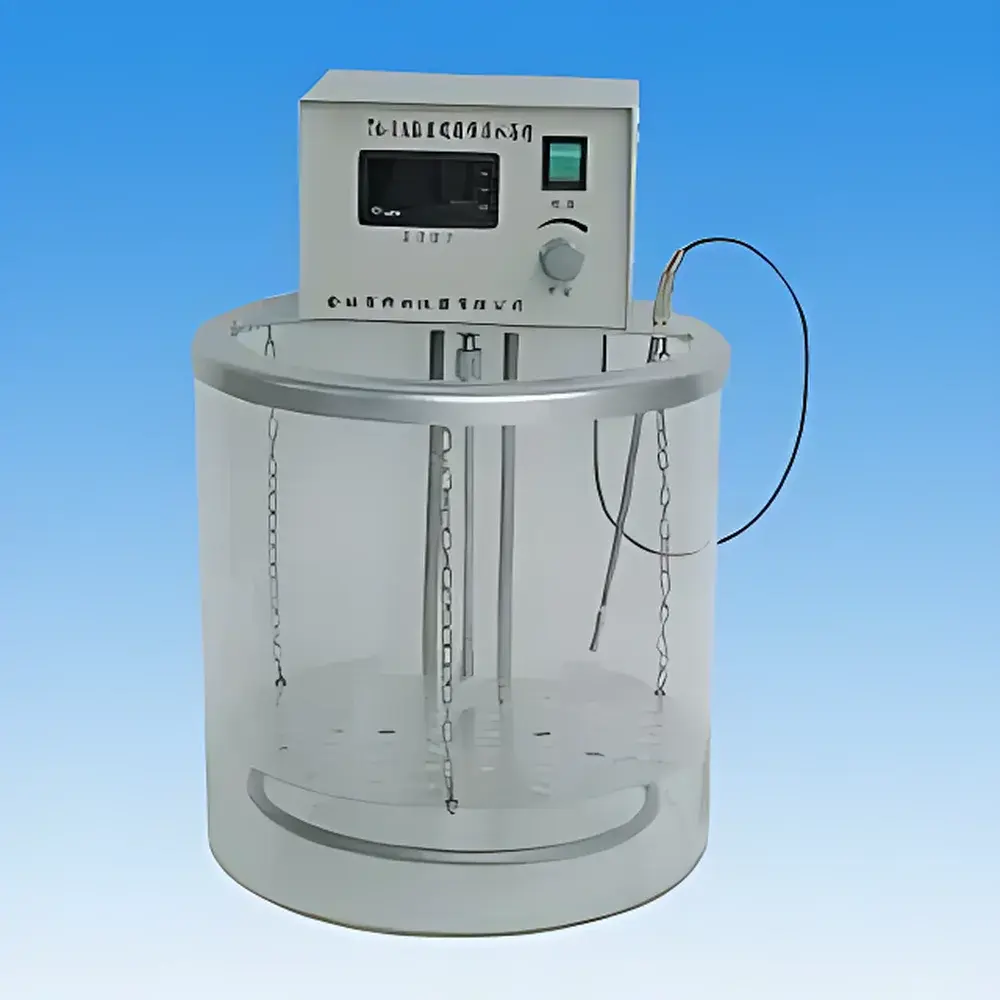
Beifen Sanpu 76-1(A) Digital Display Glass Water Bath Circulator
| Brand | Beifen Sanpu |
|---|---|
| Origin | Beijing, China |
| Manufacturer Type | Direct Manufacturer |
| Model | 76-1(A) |
| Power Supply | 220 V ±10 V, 50 Hz |
| Heating Power | 1000 W |
| Stirring Motor Power | 60 W |
| Temperature Control Accuracy | ±0.5 °C |
| Temperature Range | Ambient to 100 °C |
| Adjustable Stirring Speed | 0–2000 rpm |
| Chamber Dimensions | Ø300 × 300 mm |
Overview
The Beifen Sanpu 76-1(A) Digital Display Glass Water Bath Circulator is a precision-engineered laboratory thermal platform designed for stable temperature maintenance and simultaneous magnetic or mechanical stirring in aqueous media. Built upon the proven architecture of the legacy 76-1 series, this upgraded variant integrates a high-stability digital PID temperature controller with an integrated stirrer motor—enabling concurrent thermal regulation and homogeneous sample agitation within a single transparent glass vessel. Its operational principle relies on resistive heating elements immersed in the water bath medium, coupled with real-time feedback from a calibrated Pt100 or NTC sensor (typical configuration), ensuring closed-loop thermal control across the full 0–100 °C range. The unit is engineered for continuous-duty operation in analytical, quality control, and teaching laboratories where reproducible thermal conditions—combined with active mixing—are critical for reaction kinetics studies, enzyme assays, dissolution testing, and sample pre-conditioning prior to chromatographic or spectroscopic analysis.
Key Features
- Digital LED display with intuitive keypad interface for precise temperature setpoint entry (resolution: 0.1 °C) and real-time bath temperature readout
- PID-based temperature control algorithm delivering ±0.5 °C stability under steady-state conditions, verified per ASTM E2429-18 guidelines for liquid bath uniformity
- Integrated 60 W DC stirring motor with infinitely variable speed control (0–2000 rpm), enabling consistent vortex formation or gentle suspension without external stir bars
- Robust borosilicate glass tank (Ø300 × 300 mm internal dimensions) offering optical clarity, chemical resistance to common aqueous reagents, and thermal shock tolerance
- 1000 W high-efficiency heating system with overtemperature cut-off protection and grounded metal chassis compliant with IEC 61010-1 safety standards
- Modular design with detachable motor support column and universal clamp mount—facilitating rapid setup and compatibility with standard labware (e.g., 50–1000 mL beakers, Erlenmeyer flasks, and reaction vessels)
Sample Compatibility & Compliance
The 76-1(A) accommodates standard glassware up to 1000 mL volume and supports both static immersion and dynamic stirring protocols. It is suitable for aqueous buffers, saline solutions, low-viscosity organic solvents (e.g., ethanol/water mixtures), and biological media—provided operating temperatures remain below solvent boiling points and material compatibility limits. The unit meets general-purpose laboratory safety requirements under GB/T 22985–2008 (Chinese national standard for electrically heated baths) and conforms to electromagnetic compatibility (EMC) Class B limits per CISPR 11. While not certified for GMP environments out-of-the-box, its digital logging-capable controller (with optional RS232/USB interface add-on) supports audit-ready operation when paired with validated software—enabling compliance with GLP documentation practices and FDA 21 CFR Part 11 data integrity expectations in regulated QC workflows.
Software & Data Management
The embedded microcontroller supports manual operation without external software; however, optional firmware upgrades enable serial communication (RS232 or TTL-level UART) for integration into centralized lab management systems. When connected to a host PC via USB-to-serial adapter, third-party applications—including LabVIEW-compatible drivers and Python-based PySerial scripts—can acquire real-time temperature and RPM telemetry at configurable intervals (1–10 s). All setpoints, actual readings, and event timestamps (e.g., power-on, setpoint change, alarm trigger) are retained in non-volatile memory for post-experiment traceability. Audit trail functionality—including user ID tagging and electronic signature prompts—may be implemented through middleware layers compliant with ISO/IEC 17025 clause 7.7 on result reporting.
Applications
- Temperature-controlled enzymatic reactions and protein denaturation studies in biochemistry labs
- Dissolution rate testing of pharmaceutical tablets per USP in QC departments
- Calibration of thermometers and RTDs using fixed-point reference baths
- Pre-heating and equilibration of samples prior to GC, HPLC, or UV-Vis analysis
- Standardized microbial growth assays requiring uniform thermal profiles across replicate cultures
- Teaching laboratory demonstrations of Arrhenius kinetics, heat transfer principles, and PID control theory
FAQ
What is the maximum recommended fill level for the glass bath chamber?
Fill the chamber to approximately two-thirds capacity (≈7 L) to ensure adequate heat distribution and prevent overflow during vigorous stirring.
Can the unit operate continuously at 100 °C for extended periods?
Yes—continuous operation at 100 °C is supported, provided ambient ventilation is sufficient and the water level is monitored regularly to avoid dry-heating conditions.
Is the temperature sensor user-replaceable?
The sensor is factory-calibrated and sealed within the bath base; replacement requires recalibration by authorized service personnel to maintain ±0.5 °C accuracy specification.
Does the device support external temperature probe input for sample-specific monitoring?
No—the standard configuration uses only the built-in bath sensor; external probe integration requires custom firmware and hardware modification, not covered under warranty.
How often should preventive maintenance be performed?
Inspect heater elements and stirrer coupling every 6 months; descale the glass chamber quarterly if used with hard water, using dilute acetic acid (5%) followed by deionized water rinse.



