
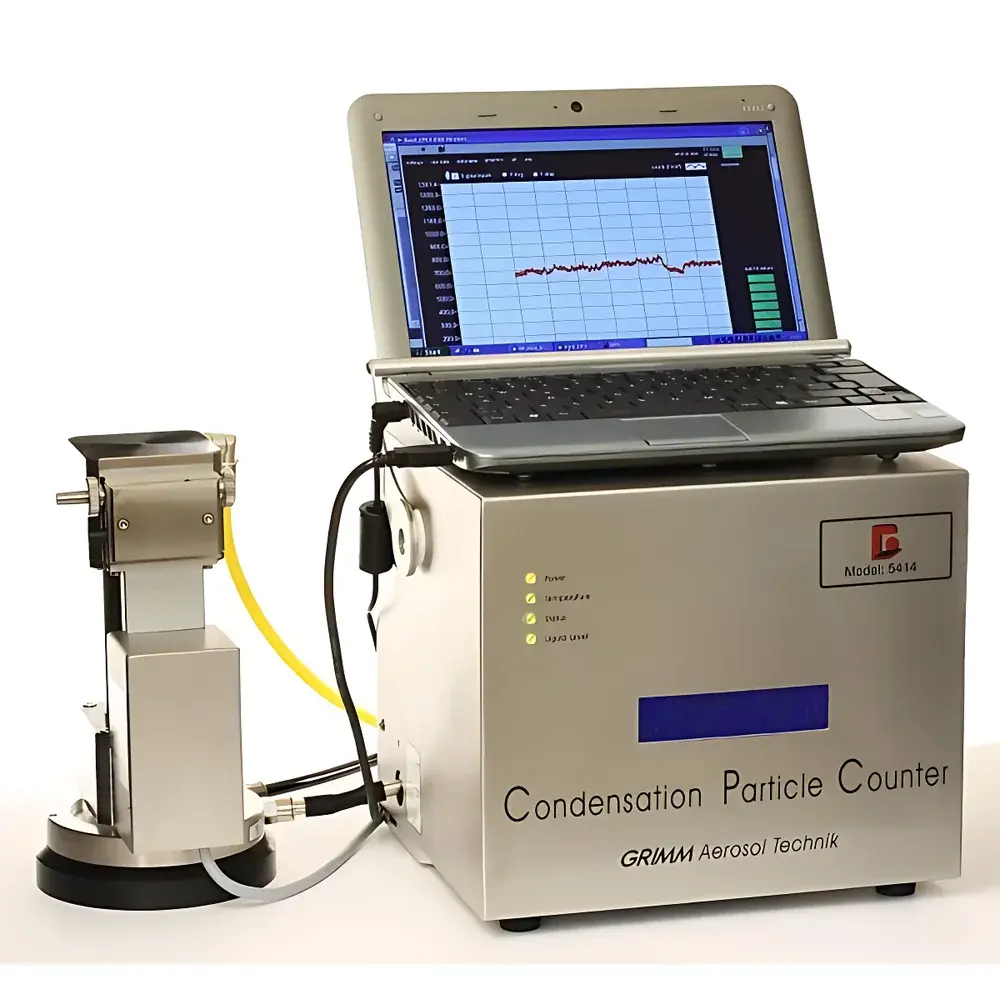
GRIMM SMPS+C Scanning Mobility Particle Sizer System
| Brand | GRIMM |
|---|---|
| Origin | Germany |
| Model | SMPS+C |
| Principle | Scanning Mobility Particle Sizing |
| Sample Flow Rate | 0.3 L/min |
| Particle Size Range | 5 nm – 1100 nm |
| Counting Range | 1 – 3,000,000 particles/L |
| Size Channels | Standard 44, up to 255 logarithmically spaced channels |
| Particle Number Concentration Range | 1 – 10⁷ particles/cm³ |
Overview
The GRIMM SMPS+C Scanning Mobility Particle Sizer System is a high-precision, laboratory- and rack-mounted aerosol instrumentation platform engineered for quantitative size-resolved analysis of airborne nanoparticles. It operates on the fundamental principle of differential mobility analysis (DMA), coupled with condensation particle counting (CPC), enabling traceable, metrologically robust classification and enumeration of charged submicron particles in real time. The system implements the Vienna-type DMA design—characterized by concentric cylindrical electrodes, laminar sheath gas flow, and precise electrostatic field control—to achieve optimal resolution for particles as small as 5 nm while minimizing diffusion losses and charging artifacts. Particles are first conditioned via a non-radioactive corona discharge neutralizer to establish a Boltzmann charge distribution; subsequently, they enter the DMA where an adjustable high-voltage field (5–10,000 V) separates them by electrical mobility. Only particles with a specific mobility—corresponding to a defined size at given temperature, pressure, and sheath-to-sample flow ratio—exit through the classification slit and are transported to the CPC (model 5416 for benchtop or 5420 for 19″ rack-mount configuration) for optical detection after butanol-based condensational growth. This dual-stage architecture ensures compliance with ISO 15900:2020 (“Determination of particle size distribution — Electrical mobility analysis for particles in the nanometer size range”), making the SMPS+C suitable for GLP-compliant research, regulatory reference measurements, and method validation studies.
Key Features
- Vienna-type DMA with interchangeable L-DMA (10–1094 nm) and M-DMA (5–350 nm) electrode modules for application-specific resolution and dynamic range optimization
- Integrated butanol-based CPC with D50 = 4 nm detection threshold, <3 s response time, and dual-mode operation (single-particle counting up to 150,000 cm⁻³; photometric mode up to 10⁷ cm⁻³)
- Automated self-calibration sequence at power-on, including flow verification, voltage ramp diagnostics, and thermal sensor validation
- Robust fluidic architecture: thermally stabilized laminar flow control via differential pressure sensing across precision orifices; insensitive to ambient T/P fluctuations
- Non-radioactive ring-type corona neutralizer ensuring stable, repeatable charge equilibration without licensing or disposal constraints
- U-shaped top inlet with integrated laminarizer to minimize particle deposition losses during sample introduction
- Grounded outer electrode and positively biased central rod enable precise field gradient control; automatic high-voltage interlock disengages upon DMA access
- Onboard analog inputs (3 channels) for synchronized meteorological or gas sensor integration (e.g., RH, T, P, CO₂)
Sample Compatibility & Compliance
The SMPS+C accommodates ambient air, filtered laboratory air, inert carrier gases (N₂, Ar), and controlled chamber effluents. Its 0.3 L/min sample flow rate and 3.0 L/min sheath flow support stable classification across the full 5–1100 nm range without requiring dilution for most urban or indoor aerosols. All hardware and firmware adhere to IEC 61000-6-3 (EMC emission) and IEC 61010-1 (safety for measurement equipment). Data acquisition and instrument control comply with FDA 21 CFR Part 11 requirements when used with validated software configurations—including electronic signatures, audit trails, and role-based access control. The system meets ISO/IEC 17025 criteria for testing laboratories when deployed in accredited aerosol metrology workflows and supports traceability to NIST-traceable mobility standards via documented calibration protocols.
Software & Data Management
GRIMM’s proprietary SMPS Control Software—developed in collaboration with Prof. Reischl (University of Vienna)—implements real-time inversion algorithms aligned with ISO 15900 Annex B. It acquires raw CPC counts and DMA voltage ramps, computes number-size distributions (dN/dlogDp), and derives secondary metrics including surface area concentration (µm²/cm³), volume concentration (µm³/cm³), and mass concentration (µg/m³) using user-defined density and shape assumptions. Data are visualized in interactive plots (log-normal fits, time-series overlays, cumulative distributions) and exportable in CSV, ASCII, and HDF5 formats. The software maintains full instrument metadata (flow rates, voltages, temperatures, neutralizer status) alongside each dataset, enabling retrospective uncertainty analysis. For mobile deployments, optional PCMCIA SRAM memory cards (4 MB) provide local data buffering independent of host PC connectivity.
Applications
- Fundamental aerosol science: nucleation, coagulation, and vapor condensation kinetics in smog chambers and flow reactors
- Inhalation toxicology: dose–response characterization of engineered nanomaterials (ENMs) and combustion-generated particles
- Environmental monitoring: source apportionment of ultrafine particles (UFPs) in urban, roadside, and background sites
- Climate research: CCN-active fraction estimation and hygroscopic growth factor correlation studies
- Industrial hygiene: real-time workplace exposure assessment near 3D printing, welding, and nanopowder handling operations
- Filter and scrubber efficiency testing: penetration curve generation across HEPA, ULPA, and electrostatic precipitator media
- Regulatory method development: supporting EPA OTM-40, EU CEN/TS 17218, and WHO Air Quality Guidelines refinement
FAQ
What particle charging mechanism does the SMPS+C use, and is it compliant with ISO 15900?
The system employs a non-radioactive corona discharge neutralizer to establish a Boltzmann equilibrium charge distribution, fully satisfying the charging requirements specified in ISO 15900:2020 Clause 6.2.
Can the SMPS+C operate unattended for extended periods?
Yes—its automated startup sequence, continuous flow and voltage monitoring, and fail-safe high-voltage interlocks enable reliable 72+ hour unattended operation in fixed-site monitoring applications.
How is size calibration performed, and what standards are supported?
Calibration uses monodisperse polystyrene latex (PSL) or silver nanoparticles with NIST-traceable diameters; GRIMM provides documented procedures for multi-point mobility calibration across the full operating range.
Is the butanol handling system safe for continuous lab use?
The CPC features a sealed, micro-pump–driven saturation chamber with leak-tight fluid path, condensate recovery, and overfill protection—meeting German TRGS 510 requirements for hazardous substance handling.
Does the software support remote diagnostics and firmware updates?
Yes—via RS-232 serial interface or optional Ethernet adapter, authorized service personnel can perform secure remote health checks, parameter adjustments, and version-controlled firmware upgrades.







