
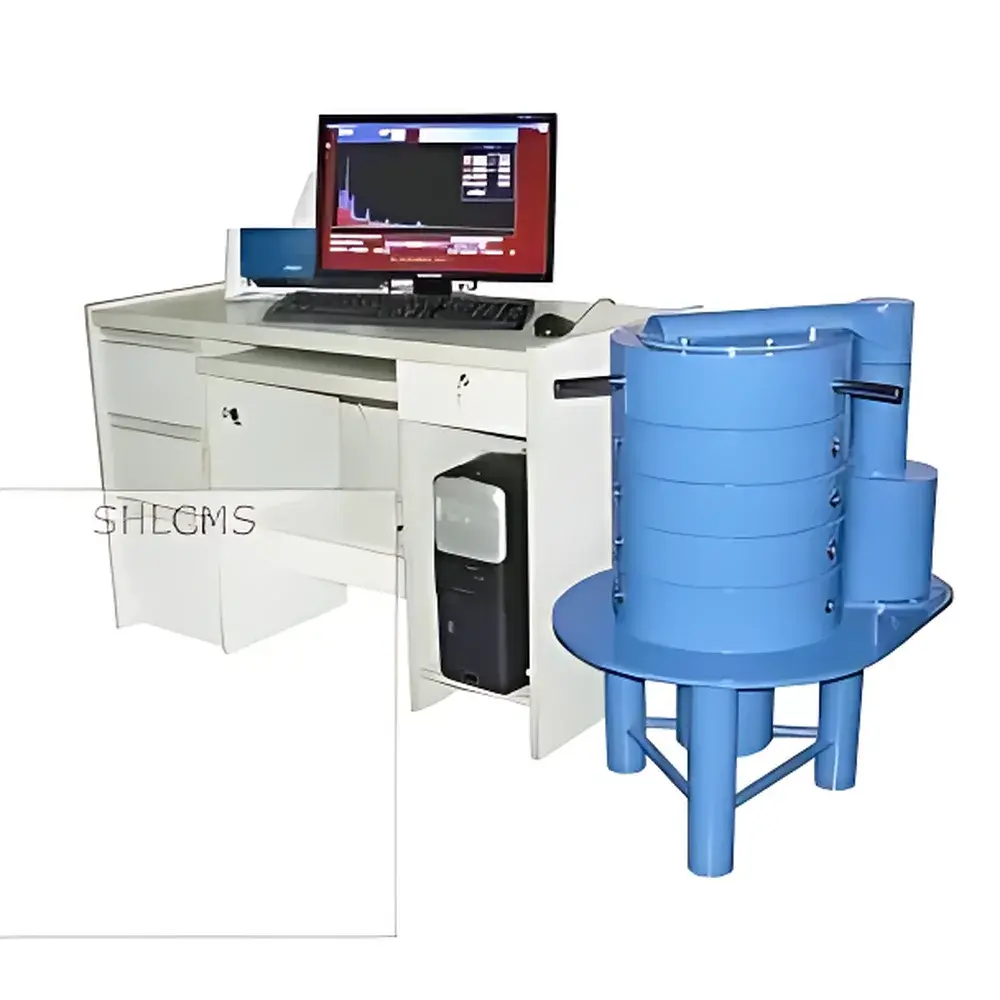
Beifen Sanpu HD-2001 Low-Background Multi-Channel Gamma Spectrometer
| Brand | Beifen Sanpu |
|---|---|
| Origin | Beijing, China |
| Manufacturer Type | Manufacturer |
| Product Origin | Domestic (China) |
| Model | HD-2001 |
| Pricing | Upon Request |
Overview
The Beifen Sanpu HD-2001 Low-Background Multi-Channel Gamma Spectrometer is a high-resolution, laboratory-grade gamma-ray spectrometry system engineered for quantitative radionuclide analysis in environmental, construction, geological, and biological matrices. It operates on the principle of scintillation detection using a thallium-doped sodium iodide [NaI(Tl)] crystal coupled to a photomultiplier tube and digital pulse processing electronics. The system performs energy-dispersive spectroscopy by converting incident gamma photons into proportional light pulses, which are digitized and sorted into a multichannel pulse-height spectrum—enabling identification and quantification of gamma-emitting radionuclides based on characteristic photopeak energies. Designed to meet stringent regulatory requirements—including GB 6566–2010 (Limitation of Radioactive Nuclides in Building Materials) and GB 50325–2010 (Control Standard for Indoor Environmental Pollution in Civil Construction Projects)—the HD-2001 supports trace-level activity measurements with low background interference, high spectral fidelity, and robust long-term stability.
Key Features
- 2048-channel real-time acquisition capability—the highest practical channel count among commercially deployed NaI(Tl)-based gamma spectrometers in China.
- Four integrated measurement modes: powdered sample analysis, non-destructive bulk sample assay, airborne radon (²²²Rn) monitoring, and soil radon exhalation rate determination.
- Full-waveform digitization architecture eliminates pulse pile-up and counting loss; includes real-time baseline restoration and automatic interference peak recognition.
- High throughput performance: >333 kcps system dead-time-corrected count rate, enabling accurate analysis across low-, medium-, and high-activity samples without saturation.
- Oscilloscope-mode display for live waveform visualization, facilitating signal integrity verification and baseline drift assessment during acquisition.
- Dynamic peak-position monitoring ensures spectral calibration stability over extended runs—critical for multi-day environmental monitoring campaigns.
- Comprehensive spectral deconvolution using region-of-interest (ROI) integration, full-spectrum validation, and multi-isotope simultaneous fitting algorithms.
- Multi-spectrum overlay and comparative analysis tools support method development, inter-laboratory proficiency testing, and academic instruction in nuclear instrumentation.
Sample Compatibility & Compliance
The HD-2001 accommodates heterogeneous solid samples—including crushed rock, dried soil, cementitious materials, plant ash, and building material composites—via standardized geometry protocols. Air and soil radon modules comply with ISO 11665 series methodologies for radon gas measurement. All analytical procedures align with national metrological verification requirements as certified by the National Institute of Metrology (NIM), China. System stability (<1% energy drift over 24 h) and measurement uncertainty (37 Bq/kg) satisfy GLP-aligned quality assurance frameworks. While not inherently 21 CFR Part 11 compliant, audit trails, user access logs, and raw data archiving can be implemented via optional software configuration to support regulated environments.
Software & Data Management
The proprietary acquisition and analysis suite provides intuitive control of HV bias, gain, shaping time, and ROI definition. Raw spectra are stored in standard binary formats (e.g., .cnf, .mca) compatible with third-party libraries including Genie™ 2000, GammaVision®, and custom Python-based analysis pipelines. Embedded spectral libraries include nuclide-specific gamma lines for ²³⁸U, ²²⁶Ra, ²³²Th, and ⁴⁰K, with customizable calibration curves for matrix-matched standards. Data export supports CSV, XML, and PDF report generation with embedded metadata (date/time, operator ID, detector conditions). Firmware updates and spectral library expansions are delivered through secure manufacturer portals.
Applications
- Regulatory compliance testing of construction materials for natural radioactivity (e.g., granite, fly ash, gypsum board).
- Environmental radiation baseline surveys in soil, sediment, and agricultural products.
- Indoor air quality assessment in residential and commercial buildings per GB 50325–2010.
- Radiological characterization of NORM/TENORM waste streams in oil & gas and mining sectors.
- Academic research in environmental radiochemistry, geochronology, and low-background physics education.
- Calibration and validation of field-portable gamma survey instruments.
FAQ
What is the effective energy resolution of the HD-2001 at 662 keV (¹³⁷Cs)?
The system achieves ≤7.5% full-width-at-half-maximum (FWHM) resolution under standard operating conditions with the φ75×75 mm NaI(Tl) detector.
Can the HD-2001 perform absolute activity quantification without reference standards?
No—quantitative analysis requires energy- and geometry-matched certified reference materials (CRMs) traceable to NIM or IAEA standards.
Is the lead shielding chamber included in the base configuration?
Yes—the 900 kg, 100 mm-thick cylindrical Pb shield (Φ580×850 mm) is integral to the system and contributes directly to its low-background performance.
Does the system support automated batch processing of multiple samples?
The software permits sequential acquisition scheduling and post-run batch spectral analysis, though robotic sample changers are not natively integrated.
What maintenance intervals are recommended for long-term calibration stability?
Annual verification against ¹³⁷Cs and ⁶⁰Co point sources is advised; detector PMT voltage and amplifier gain should be validated quarterly in high-usage laboratories.




