
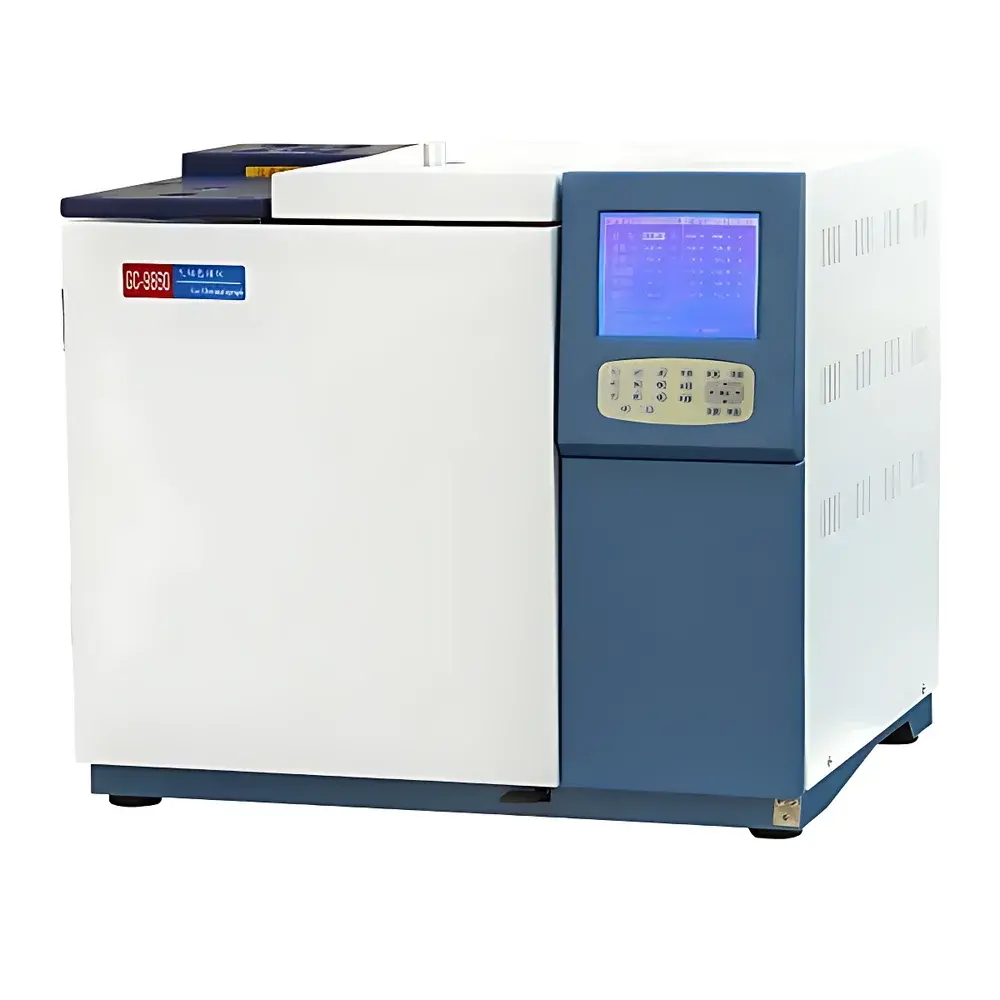
Beifen Sanpu GC-9860 High-Performance Laboratory Gas Chromatograph
| Brand | Beifen Sanpu |
|---|---|
| Origin | Beijing, China |
| Manufacturer Type | Direct Manufacturer |
| Model | GC-9860 |
| Instrument Type | Benchtop Laboratory Gas Chromatograph |
| Application Scope | Universal (Environmental, Petrochemical, Pharmaceutical, Food & Safety, Public Health, Research) |
| Oven Temperature Range | +5 °C to 450 °C |
| Temperature Programming | 8-step linear ramp |
| 升温 Rate | 0.1–40 °C/min (0.1 °C increment) |
| Cooling Rate | 450 °C → 50 °C (with dual rear doors) |
| Carrier Gas Flow Control Range | 0–1200 mL/min |
| Carrier Gas Pressure Control Range | 0–970 kPa |
| Injector Maximum Temperature | 450 °C |
| Injector Pressure Setpoint Range | 0–970 kPa |
| Injector Total Flow Setpoint Range | 0–1200 mL/min |
| Column Compatibility | Packed columns (3–5 mm OD), Capillary columns (standard 6-inch mounting span) |
| Detector Capacity | Up to 4 detectors simultaneously (e.g., dual FID, dual TCD, dual ECD, or mixed configurations) |
| FID Detection Limit | ≤2×10⁻¹² g/s (n-hexadecane) |
| TCD Sensitivity | ≥10,000 mV·mL/mg (n-hexadecane) |
| ECD Detection Limit | ≤1×10⁻¹⁴ g/mL (γ-BHC) |
| Data Storage | 20 method/data sets on internal FLASH memory |
| Display | 5.7″ LCD (320×240), bilingual Chinese/English interface |
Overview
The Beifen Sanpu GC-9860 is a high-stability, multi-detector-capable laboratory gas chromatograph engineered for precision separation and quantitative analysis of volatile and semi-volatile organic compounds in complex matrices. Based on proven packed- and capillary-column gas chromatography principles, the GC-9860 implements robust temperature-programmed elution, digitally stabilized carrier gas flow control, and modular detector architecture—enabling simultaneous operation of up to four independent detection systems. Its column oven employs an intelligent dual rear-door design with active air cooling, achieving rapid thermal equilibration from 450 °C to 50 °C and precise near-ambient temperature control (as low as +5 °C above ambient). The instrument adheres to fundamental GC operational requirements defined in ASTM D3606, ISO 10301, USP , and EPA Methods 502.2, 624, and 8021B—making it suitable for regulated environmental water testing, residual solvent analysis in pharmaceuticals, hydrocarbon profiling in fuels, and pesticide residue screening in food and drinking water.
Key Features
- Modular detector configuration supporting concurrent use of up to four detectors—including dual FID, dual TCD, dual ECD, or hybrid combinations (e.g., FID + ECD + NPD)—without hardware reconfiguration.
- Eight-stage programmable temperature ramping with 0.1 °C/min minimum increment and ±0.1 °C oven temperature accuracy across the full operating range (5–450 °C).
- Dual independent rear-door cooling system enabling rapid oven cooldown and stable sub-ambient retention time reproducibility.
- Bilingual (Chinese/English) 5.7″ graphical LCD interface with 20 customizable display screens and embedded FLASH-based data storage—eliminating reliance on volatile battery-backed memory.
- Microprocessor-controlled gas delivery system with digital mass flow and pressure regulation (0–1200 mL/min, 0–970 kPa) for carrier, make-up, and detector gases—ensuring long-term baseline stability and retention time repeatability (RSD < 0.05% over 24 h).
- Integrated fault diagnostics with real-time Chinese/English error prompts, automatic flame-out detection for FID, and platinum RTD-based open/short-circuit protection for temperature sensors.
- Universal inlet design accommodating split/splitless, on-column, and programmed temperature vaporization (PTV) modes; compatible with 3–5 mm OD packed columns and standard 0.1–0.53 mm ID capillaries (6-inch mounting span).
- Expandable front-end compatibility with commercial autosamplers, headspace samplers, thermal desorbers, pyrolyzers, and methanizer reactors—enabling unattended online monitoring of aqueous samples per EPA Method 524.4 or ISO 15681-2.
Sample Compatibility & Compliance
The GC-9860 is routinely deployed for trace-level analysis of priority pollutants in surface water, groundwater, wastewater, and drinking water—particularly organochlorine pesticides (e.g., DDT, lindane), polycyclic aromatic hydrocarbons (PAHs), volatile organic compounds (VOCs), trihalomethanes (THMs), and halogenated solvents. Its detector sensitivity meets or exceeds performance criteria specified in ISO 10301 (TCD), ASTM D5504 (FPD), and USP (residual solvents). All firmware and data handling modules comply with ALCOA+ data integrity principles. Audit trail functionality—including user login timestamps, method change logs, and raw signal export—supports GLP and GMP environments under FDA 21 CFR Part 11 when paired with validated LIMS integration.
Software & Data Management
The GC-9860 operates standalone via its embedded controller but fully integrates with third-party chromatography data systems (CDS) including Chromeleon™, OpenLab CDS, and Empower™ via RS-232 or optional Ethernet interface. Raw chromatograms are stored in vendor-neutral .CDF format (compatible with NIST MS Search and AMDIS). Internal FLASH memory retains 20 complete method files—including temperature programs, detector settings, and calibration curves—with password-protected access levels for operator, supervisor, and administrator roles. All data exports include embedded metadata (instrument ID, date/time stamp, analyst ID, sequence number) to satisfy ISO/IEC 17025 documentation requirements.
Applications
- Regulatory compliance testing for EPA Method 524.4 (purge-and-trap GC/MS screening of VOCs in drinking water)
- Residual solvent quantification in APIs per ICH Q2(R2) and USP
- Hydrocarbon group-type analysis (HTGA) in petroleum products using dual-TCD configuration
- Organophosphate and carbamate pesticide screening in agricultural runoff using FPD/NPD dual detection
- Disinfection by-product (DBP) monitoring (chloroform, bromodichloromethane) in municipal water treatment facilities
- Environmental forensics of chlorinated benzenes and PCB congeners via ECD-selective detection
- Method development and validation in academic and contract research laboratories requiring flexible detector interchangeability
FAQ
Does the GC-9860 support compliance with 21 CFR Part 11?
Yes—when operated with validated third-party CDS software that implements electronic signatures, audit trails, and role-based access control. The instrument’s internal firmware provides timestamped event logging and non-editable raw data output.
Can the GC-9860 run both packed and capillary columns simultaneously?
No—it supports either packed or capillary configurations per run, but its dual-inlet option (optional accessory) allows sequential analysis without manual column swapping.
What is the maximum allowable carrier gas pressure for split/splitless injection?
The pressure control module is rated for 0–970 kPa absolute; however, optimal performance for most capillary applications is achieved at 20–150 kPa, depending on column dimensions and flow requirements.
Is remote instrument monitoring supported?
Yes—via optional Ethernet module and TCP/IP-enabled communication protocol, enabling real-time status checks, method uploads, and alarm notifications through standard network infrastructure.
How often does the FID require maintenance under routine use?
With clean carrier gas and proper septum purge, the FID jet and collector electrode typically require cleaning every 2–3 months in high-throughput labs; automatic ignition reduces manual intervention frequency by >70% compared to manual lighting.





