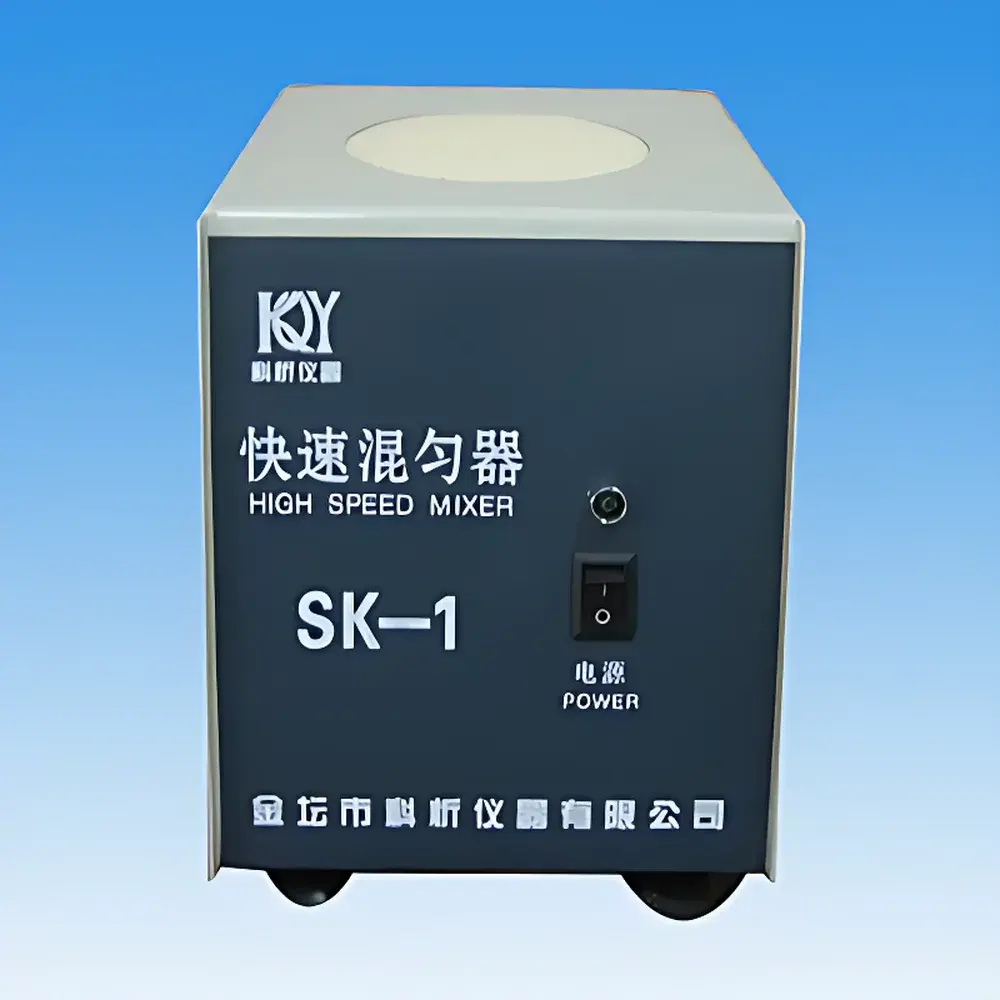
Beifen Sanpu SK-1 Vortex Mixer
| Brand | Beifen Sanpu |
|---|---|
| Model | SK-1 |
| Type | Vortex Mixer |
| Power Supply | 220 V ±10%, 50 Hz |
| Power Consumption | 40 W |
| Operating Mode | Orbital (Circular) Motion |
| Oscillation Frequency | 3000 rpm |
| Amplitude | 5 mm |
| Timer Range | 5–120 s |
| Tray Configuration | Single Platform |
| Sample Holder Compatibility | Test Tubes, Colorimetric Tubes, Small Erlenmeyer Flasks (≤100 mL) |
| Origin | Hebei, China |
| Manufacturer Status | Direct Manufacturer |
| Regulatory Classification | Domestic Instrument for Academic & General Laboratory Use |
| Price Range | USD 140–700 (FOB) |
Overview
The Beifen Sanpu SK-1 Vortex Mixer is a compact, manually activated orbital mixing device engineered for rapid, reproducible homogenization of small-volume liquid samples in academic and general-purpose life science laboratories. Unlike magnetic stirrers or overhead shakers, the SK-1 employs a high-frequency eccentric drive mechanism to generate controlled circular motion—commonly referred to as “vortexing”—at the base of vertically oriented tubes. This principle relies on inertial coupling between the oscillating platform and sample container, inducing turbulent fluid motion within the tube without requiring internal components (e.g., stir bars) or external attachments. Designed specifically for institutions including colleges, universities, public health labs, and industrial R&D units, the SK-1 delivers consistent mixing performance for applications where speed, simplicity, and minimal sample handling are critical—such as reagent resuspension, cell suspension preparation, enzyme reaction initiation, and pre-PCR sample homogenization.
Key Features
- High-speed orbital actuation at a fixed frequency of 3000 rpm, optimized for rapid vortex formation in standard 12–18 mm diameter test tubes and colorimetric tubes
- 5 mm horizontal displacement amplitude ensures effective fluid agitation while minimizing splashing or aerosol generation under recommended fill levels (≤50% tube capacity)
- Integrated mechanical timer with adjustable range from 5 to 120 seconds, enabling repeatable, hands-free operation cycles
- Single-platform design with non-slip rubber mat surface; compatible with common glass and polypropylene tubes (10–50 mL), microcentrifuge tubes (1.5–2.0 mL), and small conical flasks (up to 100 mL)
- Low-power 40 W motor with robust brush-type DC drive architecture, delivering stable rotational output across voltage fluctuations (220 V ±10%, 50 Hz)
- Compact footprint (approx. 130 × 130 × 140 mm) and lightweight construction (≤2.5 kg), facilitating benchtop deployment in teaching labs and shared core facilities
Sample Compatibility & Compliance
The SK-1 is validated for use with standard laboratory consumables including borosilicate glass test tubes, polycarbonate colorimetric cuvettes, and polypropylene centrifuge tubes. It does not support temperature-controlled operation, water bath integration, or sealed-vessel mixing; therefore, it is not classified as a water-bath shaker or incubator shaker. As a Class I electrical appliance, the instrument complies with basic safety requirements per GB 4793.1–2007 (equivalent to IEC 61010-1) for laboratory equipment. Grounding is mandatory during operation. The device is not intended for use in GMP-regulated environments requiring audit trails, electronic records, or 21 CFR Part 11 compliance. It meets general educational and research lab standards under ISO/IEC 17025 supporting documentation frameworks when used within defined procedural SOPs.
Software & Data Management
The SK-1 operates as a standalone analog instrument with no embedded microcontroller, digital interface, or software connectivity. All operational parameters—including timer activation and motor engagement—are controlled via front-panel mechanical switches. No firmware, drivers, or data logging capabilities are included. Users record mixing duration and conditions manually within lab notebooks or LIMS-compatible entry forms. For institutions requiring traceable mixing protocols, integration with external timing systems (e.g., smartphone stopwatch apps or networked lab timers) is recommended. No calibration certificate or factory verification report is supplied by default; periodic functional verification using a handheld tachometer (for rpm validation) and stopwatch (for timer accuracy) is advised per institutional QA policies.
Applications
- Routine resuspension of lyophilized reagents, bacterial pellets, and precipitated nucleic acids in molecular biology workflows
- Homogenization of immunoassay diluents, ELISA coating buffers, and antigen-antibody mixtures prior to incubation
- Pre-analytical sample preparation for environmental testing (e.g., soil extract homogenization, waterborne pathogen suspension)
- Teaching laboratory demonstrations of fluid dynamics, mixing efficiency, and kinetic parameter estimation
- QC/QA procedures requiring standardized agitation steps in food safety, pharmaceutical excipient testing, and clinical chemistry screening
FAQ
Is the SK-1 suitable for mixing viscous or high-density solutions?
The SK-1 is optimized for low-to-medium viscosity aqueous solutions (e.g., PBS, Tris-HCl, sucrose gradients). Viscosities exceeding ~50 mPa·s may reduce vortex depth and mixing uniformity; users should verify homogeneity visually or via downstream assay consistency.
Can the SK-1 be used with sealed tubes?
Yes—provided pressure buildup is not expected. Avoid use with volatile solvents or reactions generating gas; always orient tubes vertically and ensure caps are securely tightened.
Does the SK-1 include a calibration certificate?
No. Calibration is user-performed using external reference instruments. A yearly functional check is recommended for academic QA programs.
What maintenance is required?
Wipe the platform and housing with 70% ethanol after each use. Inspect the rubber mat for compression set or cracking every 6 months; replace if flattened or brittle.
Is the SK-1 compatible with international power standards (e.g., 110 V/60 Hz)?
No. The unit is configured exclusively for 220 V ±10%, 50 Hz input. Voltage conversion or transformer use is not supported and may damage the motor.