
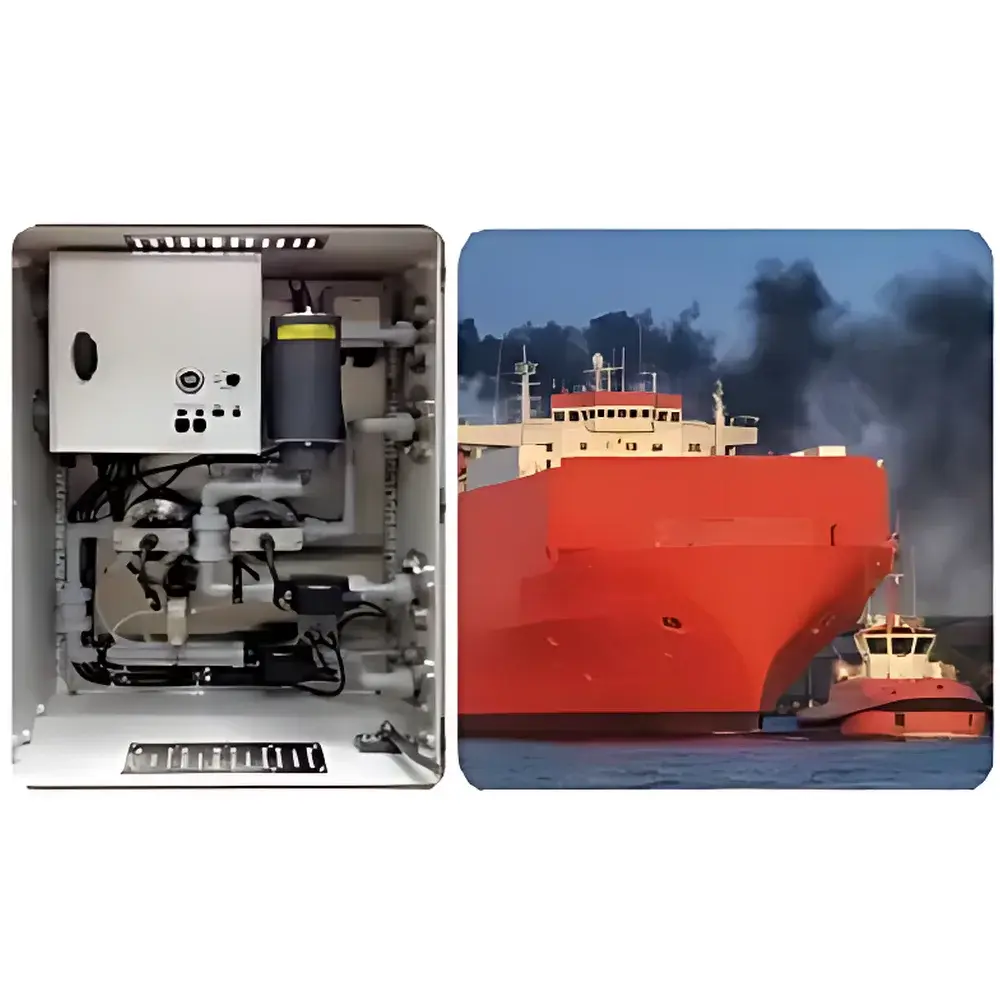
Chelsea Technology Group Seasentry Online PAH & Turbidity Monitoring System for Exhaust Gas Cleaning Systems (EGCS)
| Brand | Chelsea Technology Group |
|---|---|
| Model | Seasentry |
| Origin | United Kingdom |
| Application | Real-time inlet/outlet seawater monitoring for marine scrubbers |
| Compliance | ISO 7027:1999 (turbidity), PAH detection optimized for EGCS washwater discharge verification |
| Connectivity | Ethernet (TCP/IP), Modbus TCP support |
| Sensor Integration | Dual-stream UviLux optical sensors (PAH + turbidity), pH, temperature, flow switch |
| Media Compatibility | Seawater and freshwater |
| Cabinet | IP65-rated sensor enclosure with internal air purge system |
| Target Users | EGCS OEMs, shipbuilders, class societies, flag state auditors |
Overview
The Chelsea Technology Group Seasentry Online PAH & Turbidity Monitoring System is an engineered solution designed specifically for continuous, regulatory-compliant water quality assessment in marine Exhaust Gas Cleaning Systems (EGCS). It operates on the principle of dual-wavelength ultraviolet fluorescence spectroscopy (UviLux platform) for selective polycyclic aromatic hydrocarbon (PAH) detection, combined with near-infrared (NIR) light scattering calibrated to ISO 7027:1999 for turbidity quantification. Unlike generic water analyzers, Seasentry is purpose-built for the dynamic operational envelope of open-loop, closed-loop, and hybrid scrubber configurations—where inlet seawater, recirculated washwater, and final discharge streams must be monitored simultaneously to verify compliance with IMO MARPOL Annex VI, EU Sulphur Directive 2016/802, and US EPA Vessel General Permit (VGP) requirements. The system delivers real-time, trace-level PAH detection (ng/L range) and high-stability turbidity measurement (0–4000 NTU) under variable salinity, temperature, and pressure conditions typical of engine room environments.
Key Features
- Dual-stream UviLux optical sensor architecture: Independent flow cells for simultaneous inlet and outlet monitoring, eliminating cross-contamination risk and enabling direct delta analysis
- PAH-selective fluorescence detection: Optimized excitation/emission bandpass filtering to distinguish combustion-derived PAHs (e.g., phenanthrene, pyrene) from natural organic matter interference
- ISO 7027:1999-compliant turbidity measurement: NIR-based 90° scattered light detection with automatic zero calibration and fouling-compensation algorithm
- Integrated multi-parameter cabinet: pH electrode (glass body, gel-filled reference), Pt100 temperature sensor, mechanical flow switch with dry-run protection, and internal air-purge system to prevent salt deposition on optical windows
- Industrial-grade electronics: IP65-rated stainless-steel enclosure, -20°C to +55°C operating range, CE/UKCA marked, EMC compliant per EN 61326-1
- Protocol-flexible communication: Native Ethernet (TCP/IP), optional Modbus TCP or OPC UA server for integration into vessel automation systems (VAS) and Class-approved data loggers
Sample Compatibility & Compliance
Seasentry is validated for continuous operation in both seawater (salinity 30–38 g/kg) and freshwater (0–1 g/kg), with automatic salinity compensation applied to pH and conductivity-derived corrections where applicable. All wetted materials—including flow cell quartz windows, EPDM gaskets, and titanium sensor housings—are certified to ISO 15156-3 for sour service compatibility and resistant to chlorinated seawater exposure. Regulatory alignment includes: verification methodology referenced in IMO MEPC.259(68) Guidelines for EGCS Monitoring; turbidity traceability to NIST-traceable standards; PAH detection sensitivity aligned with Baltic Marine Environment Protection Commission (HELCOM) Recommendation 23/7 thresholds for harbor discharge. Data integrity meets GLP principles with full audit trail, user access control, and timestamped event logging.
Software & Data Management
The Seasentry system interfaces with Chelsea’s proprietary SeaView™ configuration and diagnostics software (Windows-based, offline setup) and supports seamless integration into third-party SCADA platforms via standardized protocols. Raw sensor outputs—including PAH fluorescence intensity (mV), turbidity (NTU), pH (unitless), temperature (°C), and flow status (binary)—are timestamped at 1 Hz and transmitted with millisecond-accurate synchronization. Data packets include CRC-32 checksums and support cyclic redundancy validation. For regulatory reporting, the system generates automated CSV/Excel exports compliant with IMO DCS (Data Collection System) format requirements, including mandatory fields: vessel ID, scrubber mode (open/closed/hybrid), location (GPS-coordinates), and pass/fail flags per parameter against defined limits (e.g., PAH < 50 µg/L, turbidity < 25 NTU above inlet baseline).
Applications
- Real-time washwater discharge verification for Class-approved EGCS installations during sea trials and commercial operation
- Commissioning support for scrubber retrofits: baseline inlet characterization, scrubber efficiency calculation (PAH removal %, turbidity reduction ratio)
- Auditable compliance evidence for Port State Control (PSC) inspections and Flag Administration annual reporting
- Integration with onboard emission monitoring systems (EMS) for combined SOx/NOx/PAH reporting under Tier III and ECA enforcement regimes
- Long-term trend analysis of scrubber performance degradation, including fouling onset detection via turbidity drift rate monitoring
FAQ
Does Seasentry require reagent addition or consumables?**
No. The UviLux optical sensors are reagent-free and maintenance-free for ≥12 months under normal operation. Only periodic optical window cleaning (quarterly) and pH electrode replacement (annually) are recommended.
Can it distinguish between pyrolytic and petrogenic PAH sources?**
Not quantitatively. Seasentry detects total PAH fluorescence signal correlated to combustion-derived compounds. Source apportionment requires GC-MS lab analysis; Seasentry provides screening-level compliance indication.
Is calibration traceable to national standards?**
Yes. Turbidity calibration uses formazin-based standards certified to ISO 7027. PAH response is verified using naphthalene and phenanthrene reference solutions traceable to NPL (UK) and BAM (Germany).
How is data security ensured for IMO DCS submission?**
All communications use TLS 1.2 encryption when interfacing with cloud-based DCS gateways. Local storage retains 30 days of raw data with SHA-256 hash-verified integrity logs, meeting IMO DCS Regulation 13.3 requirements.
What certifications does the system hold for marine use?**
LR Type Approval (Lloyd’s Register), DNVGL-BEM-0334 (Scrubber Monitoring Systems), and UK MCA MSN 1863 (EGCS Monitoring Guidance) compliance documentation available upon request.
Related Products







