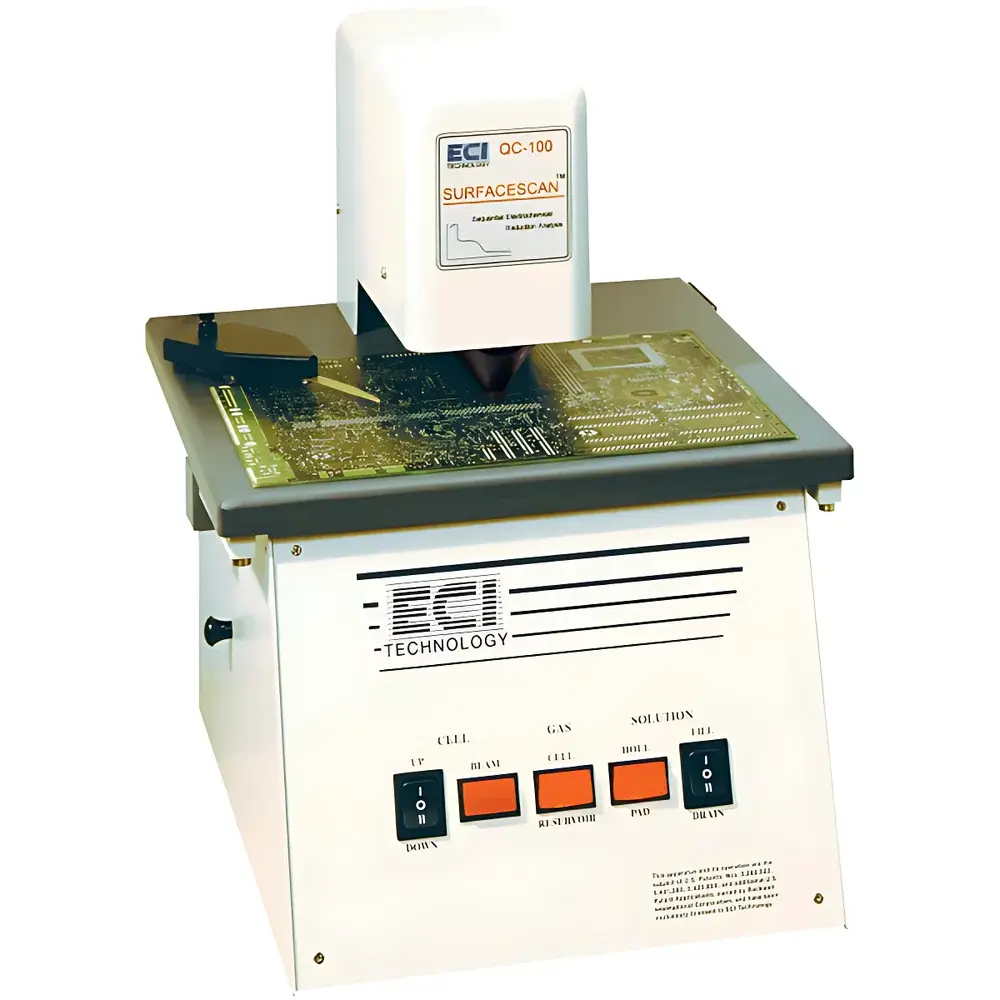
ECI QC-100 Sequential Electrochemical Reduction Analyzer
| Brand | ECI / ECI TECHNOLOGY |
|---|---|
| Origin | USA |
| Manufacturer Type | Authorized Distributor |
| Origin Category | Imported |
| Model | QC-100 |
| Pricing | Upon Request |
Overview
The ECI QC-100 Sequential Electrochemical Reduction Analyzer is a precision surface metrology instrument engineered for quantitative assessment of solderability, interfacial adhesion, and metallic coating integrity on printed circuit board (PCB) substrates and semiconductor packaging substrates. It implements Sequential Electrochemical Reduction Analysis (SERA), a standardized potentiostatic technique that quantitatively measures the electrochemical reduction charge required to reduce surface metal species—such as Sn, Pb, Ag, Cu, Ni, Co, Au, In, Sb, and Bi—in controlled, stepwise potential sweeps. Unlike qualitative wetting balance or visual solder spread tests, SERA delivers traceable, reproducible metrics correlated to surface oxidation state, contamination level, and native oxide thickness. The QC-100 is purpose-built for high-mix, low-volume PCB fabrication lines and advanced packaging R&D labs where process control of final finish metallurgies—including ENIG (Electroless Nickel Immersion Gold), ENEPIG, OSP (Organic Solderability Preservative), and immersion tin—is critical to first-pass yield and long-term reliability.
Key Features
- Non-destructive, in-situ SERA measurement with <1 nm equivalent oxide thickness resolution via charge integration under NIST-traceable potential protocols
- Integrated sealed electrolyte cell with low-maintenance Ag/AgCl reference electrode and inert gas purging capability to minimize solution drift and CO₂ absorption
- Large-format sample handling: accommodates substrates up to 381 mm × 610 mm (15″ × 24″) with motorized X-Y stage and auto-alignment fiducial recognition
- Modular electrode configuration supporting both macro-area (10–50 mm²) and micro-spot (≤100 µm diameter) analysis modes
- Rugged industrial enclosure rated IP54 for cleanroom-compatible operation in Class 1000–10,000 environments
- Fully compliant with IPC-J-STD-003C Annex B and ASTM B808-22 for solderability evaluation of surface finishes
Sample Compatibility & Compliance
The QC-100 supports bare copper, immersion tin (ImSn), electroless nickel immersion gold (ENIG), electroless nickel electroless palladium immersion gold (ENEPIG), organic solderability preservatives (OSP), and silver (Ag) finishes. It is validated for use on FR-4, polyimide, ceramic (Al₂O₃, AlN), and silicon-based substrates used in flip-chip, fan-out wafer-level packaging (FOWLP), and embedded die applications. All SERA test sequences adhere to IPC-TM-650 2.6.25.1 and ISO 9001:2015-compliant calibration workflows. Instrument firmware includes audit trail logging per FDA 21 CFR Part 11 requirements when operated in GMP-regulated environments.
Software & Data Management
The QC-100 runs ECI SurfaceFinger™ v4.2 software on Windows 10 IoT Enterprise LTSB, providing full GLP/GMP data integrity support including electronic signatures, role-based access control, and immutable raw-data archiving in HDF5 format. Each measurement generates a “surface fingerprint” comprising reduction peak potentials, integrated charge densities (µC/cm²), and kinetic parameters derived from Tafel analysis. Data export supports CSV, XML, and direct SQL Server integration for MES/SPC linkage. Calibration certificates, method templates, and IPC-compliant reporting modules are preloaded and configurable per customer-defined acceptance criteria.
Applications
- Quantitative monitoring of ENIG surface oxidation during storage and reflow cycling
- Detection of sulfur-induced tarnish on immersion silver finishes prior to assembly
- Verification of OSP film uniformity and thermal stability across panel zones
- Root-cause analysis of solder joint voiding linked to intermetallic compound (IMC) formation kinetics
- Qualification of lead-free finish alternatives (e.g., Sn-Bi, Sn-Cu) against legacy Sn-Pb benchmarks
- Process validation for plasma desmear and micro-etch optimization in HDI manufacturing
FAQ
What standards does the QC-100 comply with for solderability testing?
It conforms to IPC-J-STD-003C Annex B, ASTM B808-22, and IPC-TM-650 2.6.25.1 for electrochemical solderability assessment.
Can the QC-100 analyze multi-layer stack-ups or buried vias?
No—it evaluates only exposed surface metallization; subsurface features require complementary techniques such as cross-section SEM-EDS.
Is the electrolyte solution hazardous or regulated?
The proprietary non-cyanide, pH-buffered chloride-based electrolyte is classified as non-hazardous under OSHA HCS and REACH Annex XVII; SDS available upon request.
How frequently does the reference electrode require recalibration?
Calibration is verified daily using certified Ag/AgCl reference standard; typical service interval is 12 months under continuous operation.
Does the system support automated recipe-driven testing for high-throughput production?
Yes—SurfaceFinger™ supports batch mode execution with barcode-triggered method selection, pass/fail logic, and real-time SPC charting via integrated Minitab-compatible output.