
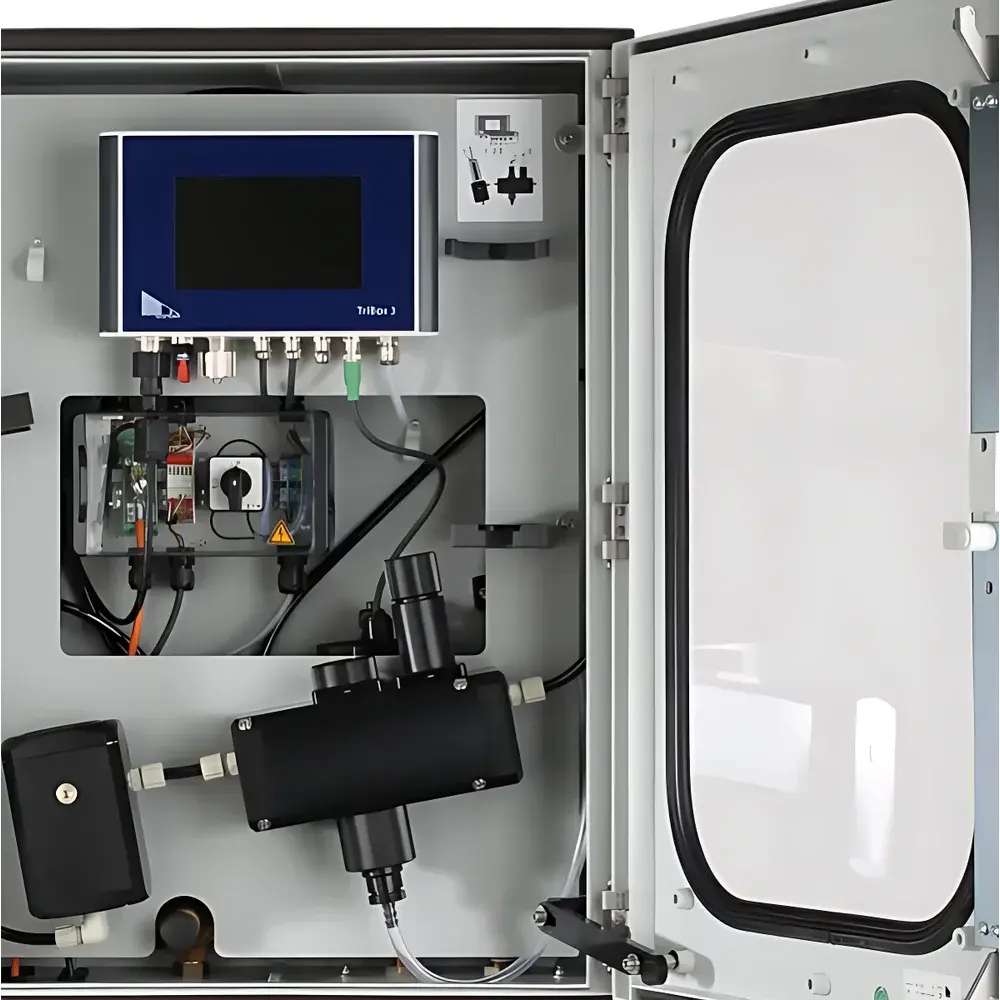
TriOS EGCWA Exhaust Gas Cleaning System (EGC) Water Quality Monitor
| Brand | TriOS |
|---|---|
| Origin | Germany |
| Manufacturer Type | Authorized Distributor |
| Origin Category | Imported |
| Model | EGCWA |
| Pricing | Upon Request |
| Instrument Type | Online Water Quality Analyzer |
| Measured Parameters | PAH, Turbidity, pH |
Overview
The TriOS EGCWA Exhaust Gas Cleaning System (EGC) Water Quality Monitor is an integrated, marine-certified online analytical platform engineered for continuous, real-time monitoring of scrubber washwater discharged from shipboard exhaust gas cleaning systems. Designed in strict compliance with IMO MEPC.184(59) and subsequent regulatory frameworks—including the 2023 IMO Guidelines for Exhaust Gas Cleaning Systems—this system delivers trace-level detection of polycyclic aromatic hydrocarbons (PAH), alongside concurrent measurement of turbidity and pH. Its operational principle relies on UV-induced fluorescence spectroscopy (for PAH), near-infrared (NIR) transmission (for turbidity), and glass-electrode potentiometry (for pH), all synchronized via a centralized TriBox3 controller. The system is purpose-built to verify that washwater effluent meets statutory discharge limits before release into the marine environment—ensuring regulatory adherence during both open-loop and closed-loop scrubber operations.
Key Features
- Triple-sensor architecture: enviroFlu (PAH fluorescence sensor), TTurb (turbidity sensor per DIN EN ISO 7027:1999), and TpH-D (combined pH/temperature sensor per BS EN 60746-2:2003)
- Automatic turbidity-corrected PAH quantification: outputs both raw PAHphe (μg/L) and turbidity-compensated PAH-tc values in real time; also supports PAH-p and PAH-p-tc reporting modes
- Integrated flow compensation: synchronizes PAH and turbidity readings with internal flow rate (2–5 L/min) to enable mass-based emission assessment
- TriBox3 controller with embedded Modbus TCP/IP Ethernet interface and six isolated 4–20 mA analog outputs (max. 500 Ω load) for seamless integration into vessel automation systems (e.g., NMEA 2000, CAN bus gateways, or SCADA)
- Self-cleaning air purge system mitigates biofouling and particulate deposition on optical windows—critical for long-term stability in high-salinity, high-turbidity washwater
- Modular calibration support: dedicated calibration kits available for field verification of enviroFlu and TTurb sensors, traceable to NIST-traceable standards
Sample Compatibility & Compliance
The EGCWA is validated for use with seawater-based scrubber effluents across open-loop, closed-loop, and hybrid EGC configurations. It operates reliably within a sample temperature range of +2 °C to +40 °C and withstands inlet pressures up to 25 bar (typical scrubber pump discharge conditions). All sensors are housed in IP65-rated stainless-steel enclosures rated for marine environments (IEC 60529), with chemical resistance verified against typical washwater constituents including sulfuric acid, heavy metals, and suspended solids. Regulatory certifications include DNV GL Type Approval, ClassNK Certification, KR Marine Equipment Certificate, and ABS Statement of Compliance—each confirming conformity with IMO MEPC.184(59), MEPC.259(67), and EU Directive 2015/2032. Data integrity meets GLP-aligned audit requirements, with timestamped, non-erasable measurement logs stored locally and exportable via Ethernet.
Software & Data Management
The TriBox3 controller runs firmware v3.2+ with embedded web server access (HTTPS-enabled), supporting remote configuration, diagnostics, and data export in CSV or XML format. All measurements—including PAHphe, PAH-tc, NTU, pH, temperature, and flow—are logged at user-configurable intervals (1 s to 15 min resolution) with automatic timestamping and UTC synchronization. The system supports full audit trail functionality: every parameter change, calibration event, or alarm condition is recorded with operator ID, timestamp, and pre-/post-values. For fleet-wide deployment, TriOS provides optional TriOS Cloud Connect—a secure, encrypted MQTT-based telemetry service compliant with ISO/IEC 27001 information security standards—enabling centralized monitoring, predictive maintenance alerts, and automated report generation aligned with flag-state inspection protocols.
Applications
- Continuous compliance monitoring of scrubber washwater discharge on commercial vessels (container ships, tankers, bulk carriers, cruise liners)
- Verification of washwater treatment efficacy during commissioning and periodic performance audits
- Integration into newbuild EGC system design packages or retrofit projects on existing fleets
- Supporting Port State Control (PSC) inspections through certified, tamper-evident data logging and onboard calibration verification
- Enabling environmental impact assessments by correlating PAH concentrations with engine load, fuel sulfur content, and scrubber operating mode
FAQ
Does the EGCWA meet IMO MEPC.184(59) requirements for PAH measurement?
Yes—the enviroFlu sensor is calibrated and validated specifically to report PAHphe in μg/L as defined in Annex 3 of MEPC.184(59), with turbidity correction applied per Section 4.2.2.
Can the system operate in high-pressure scrubber recirculation loops?
Yes—its pressure-rated flow cell and sensor housings support inlet pressures up to 25 bar, making it suitable for both low-pressure overboard discharge lines and high-pressure recirculation circuits.
Is third-party calibration documentation provided with each unit?
Each delivered system includes a factory calibration certificate traceable to national metrology institutes (PTB, NPL), listing uncertainty budgets for all measured parameters per ISO/IEC 17025.
How often does the system require maintenance or recalibration?
Under normal operation, scheduled verification is recommended every 6 months; air-purge intervals and sensor window inspections should occur quarterly per TriOS Maintenance Schedule TR-EGC-MNT-001.
Does the EGCWA support integration with vessel-specific automation platforms such as Kongsberg K-Pos or Wärtsilä Nacos?
Yes—Modbus TCP/IP implementation complies fully with IEC 61850-7-420 and is pre-tested with major maritime automation vendors; custom protocol mapping services are available upon request.







