
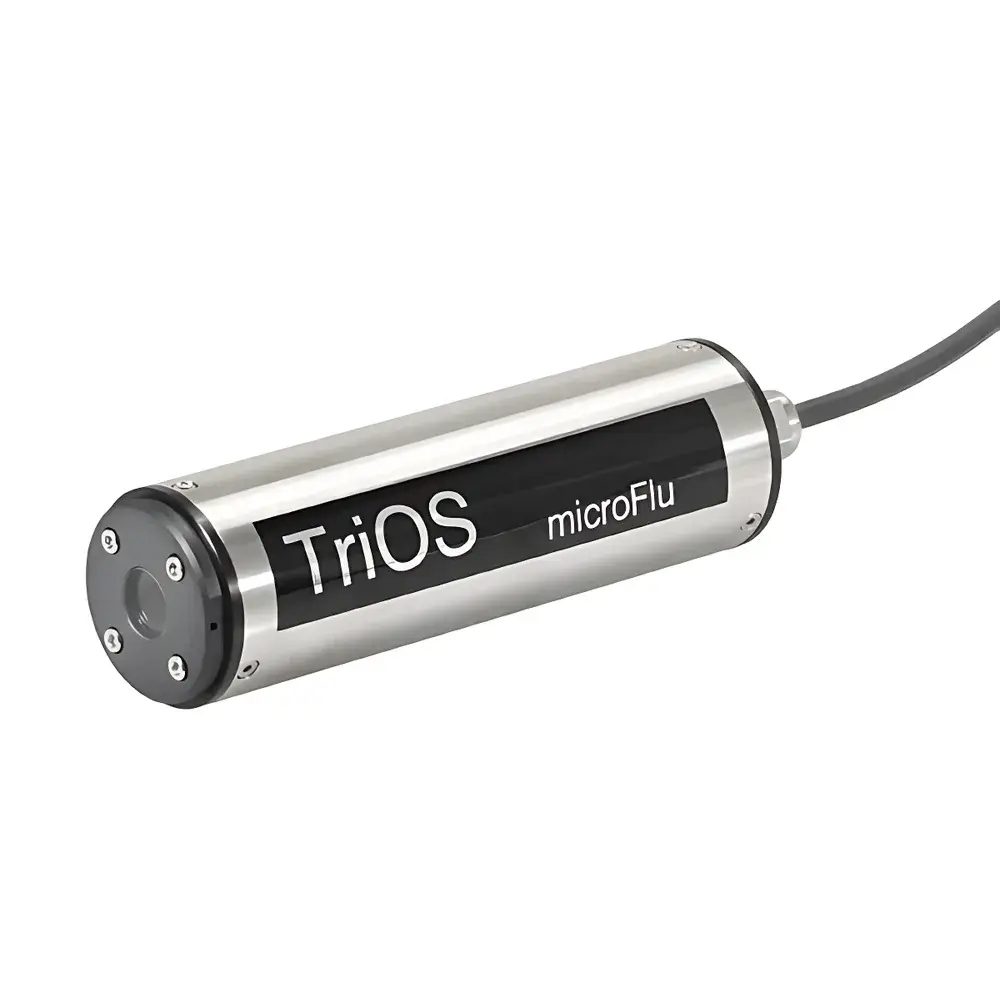
TriOS microFlu V2 Submersible Fluorometer
| Brand | TriOS |
|---|---|
| Origin | Germany |
| Model | microFlu V2 |
| Excitation/Emission Wavelengths | Chl-a (470/685 nm), Blue-Green Algae (620/655 nm), CDOM (375/460 nm), TRP (275/360 nm) |
| Measurement Range | 0–500 ppb (varies by analyte) |
| Detection Limit | 0.05–3 ppb (analyte-dependent) |
| Accuracy | ±(5% + detection limit) |
| T90 Response Time | 6 s |
| Minimum Measurement Interval | 3 s |
| Digital Interface | RS-485, Modbus RTU |
| Analog Outputs | 4–20 mA (default), 0–5 V, 0–10 V |
| Power Supply | 12–24 VDC (±10%) |
| Typical Power Consumption | 0.6 W |
| Housing Material | Stainless Steel 1.4571/1.4404 or Titanium Grade 3.7035 |
| Dimensions | 162 mm × 48 mm |
| Weight | ~650 g (stainless), ~510 g (titanium) |
| Pressure Rating | SubConn version: 30 bar |
| Fixed-cable version | 3 bar |
| Flow-cell version | 1 bar |
| IP Rating | IP68 |
| Operating Temperature | +2 to +40 °C |
| Storage Temperature | −20 to +80 °C |
| Flow Rate Compatibility | 0.1–10 m/s |
Overview
The TriOS microFlu V2 Submersible Fluorometer is an optical sensor engineered for in-situ, real-time quantification of fluorescent dissolved and particulate biomarkers in natural and engineered water systems. It operates on the principle of selective excitation-emission fluorescence spectroscopy—employing high-stability LEDs paired with narrow-band optical filters to isolate characteristic fluorescence signatures of target analytes. The instrument simultaneously detects chlorophyll-a (Chl-a), phycocyanin (PC) as a proxy for cyanobacteria, colored dissolved organic matter (CDOM), and tryptophan-like fluorescence (TRP), each resolved via dedicated excitation/emission channel pairs. Its submersible design enables direct deployment in open water bodies, intake channels, distribution networks, and wastewater streams—eliminating sampling lag, chemical reagent dependency, and laboratory turnaround delays. The microFlu V2 integrates nanoscale anti-fouling optical window coating and internal LED reference monitoring to ensure long-term signal stability under variable biofouling pressure and thermal drift—critical for unattended operation in coastal, fluvial, and potable water environments.
Key Features
- True in-situ measurement: No sample extraction, no filtration, no chemical addition required
- Nano-coated optical window: Reduces biofilm adhesion and maintains optical transmission integrity over extended immersion periods
- Internal LED reference channel: Compensates for LED aging and temperature-induced intensity drift in real time
- Multi-analyte capability: Simultaneous quantification of Chl-a, PC, CDOM, and TRP using four independent excitation/emission pathways
- Low-power architecture: Typical consumption of 0.6 W enables solar- or battery-powered deployments in remote locations
- Robust mechanical design: Pressure-rated housing in marine-grade stainless steel (1.4571/1.4404) or titanium (3.7035), certified IP68 for continuous submersion
- Configurable output interface: RS-485 with Modbus RTU protocol for seamless integration into SCADA, PLC, or third-party data loggers
Sample Compatibility & Compliance
The microFlu V2 is validated for use across diverse aqueous matrices—including seawater, brackish estuaries, freshwater lakes and rivers, drinking water distribution systems, raw water intakes, and secondary/tertiary effluent streams. Its optical design inherently mitigates interference from turbidity up to 100 NTU (though not compensated algorithmically), and its spectral resolution minimizes cross-talk between overlapping fluorophores (e.g., CDOM and TRP). While not certified to ISO 10523 or ASTM D3370 per se—as those standards pertain to grab-sample lab analysis—the sensor’s performance aligns with field validation protocols referenced in EPA Method 445.0 (Chl-a), ISO 17284 (cyanobacterial toxins screening support), and EU Bathing Water Directive (2006/7/EC) Annex I monitoring requirements. Data traceability supports GLP-aligned operational logging when integrated with compliant data acquisition systems.
Software & Data Management
Configuration and calibration are performed via Modbus register mapping using standard industrial configuration tools (e.g., TriOS SensorControl, Modbus Poll, or custom HMI interfaces). The device supports factory-calibrated slope/offset coefficients stored in non-volatile memory, with optional user-defined calibration tables for site-specific matrix corrections. Raw fluorescence intensities and temperature-compensated concentration outputs (μg/L or ppb) are transmitted at configurable intervals (minimum 3 s). Though onboard data storage is not implemented—consistent with its role as a process sensor—the RS-485 interface enables deterministic timestamped streaming to external recorders supporting Modbus TCP gateways or edge-computing nodes. For regulatory applications requiring audit trails, integration with FDA 21 CFR Part 11–compliant SCADA platforms (e.g., Ignition SCADA with electronic signature modules) ensures secure, attributable data handling.
Applications
- Early-warning detection of cyanobacterial blooms in reservoirs and recreational lakes
- Real-time assessment of organic loading and microbial activity in drinking water treatment plants
- Monitoring CDOM dynamics as a proxy for terrestrial runoff and watershed health in riverine systems
- Process control feedback in UV disinfection and ozone oxidation units where tryptophan fluorescence correlates with assimilable organic carbon (AOC)
- Long-term ecological studies of phytoplankton phenology in coastal zones and oligotrophic seas
- Compliance reporting for bathing water quality under national transposition of EU Directive 2006/7/EC
FAQ
Does the microFlu V2 require periodic recalibration in the field?
Field recalibration is not routinely required due to the built-in LED reference channel and stable optical path. However, annual verification against certified reference standards (e.g., NIST-traceable fluorescein solutions or phytoplankton cultures) is recommended for regulatory or research-grade deployments.
Can the sensor be deployed in high-turbidity wastewater effluents?
Yes—the optical design tolerates suspended solids up to ~100 NTU without signal saturation, though extreme sediment loads (>200 NTU) may necessitate periodic manual cleaning or protective flow-through housings.
Is temperature compensation applied automatically?
Yes—internal thermistor readings feed real-time correction algorithms for both LED output and photodiode responsivity, ensuring consistent sensitivity across the full operating range (+2 to +40 °C).
What is the expected service life of the LEDs under continuous operation?
Based on accelerated lifetime testing, the excitation LEDs maintain >90% initial intensity after 50,000 hours (~5.7 years) of continuous operation at 25 °C ambient—extended further by the reference-based drift compensation.
How is biofouling mitigation validated?
TriOS provides accelerated fouling test reports per ASTM D3370 Annex A3 methodology, demonstrating <5% signal drift over 30-day immersion in eutrophic freshwater mesocosms—validated using parallel microscopy and ATP assays.
Related Products







