
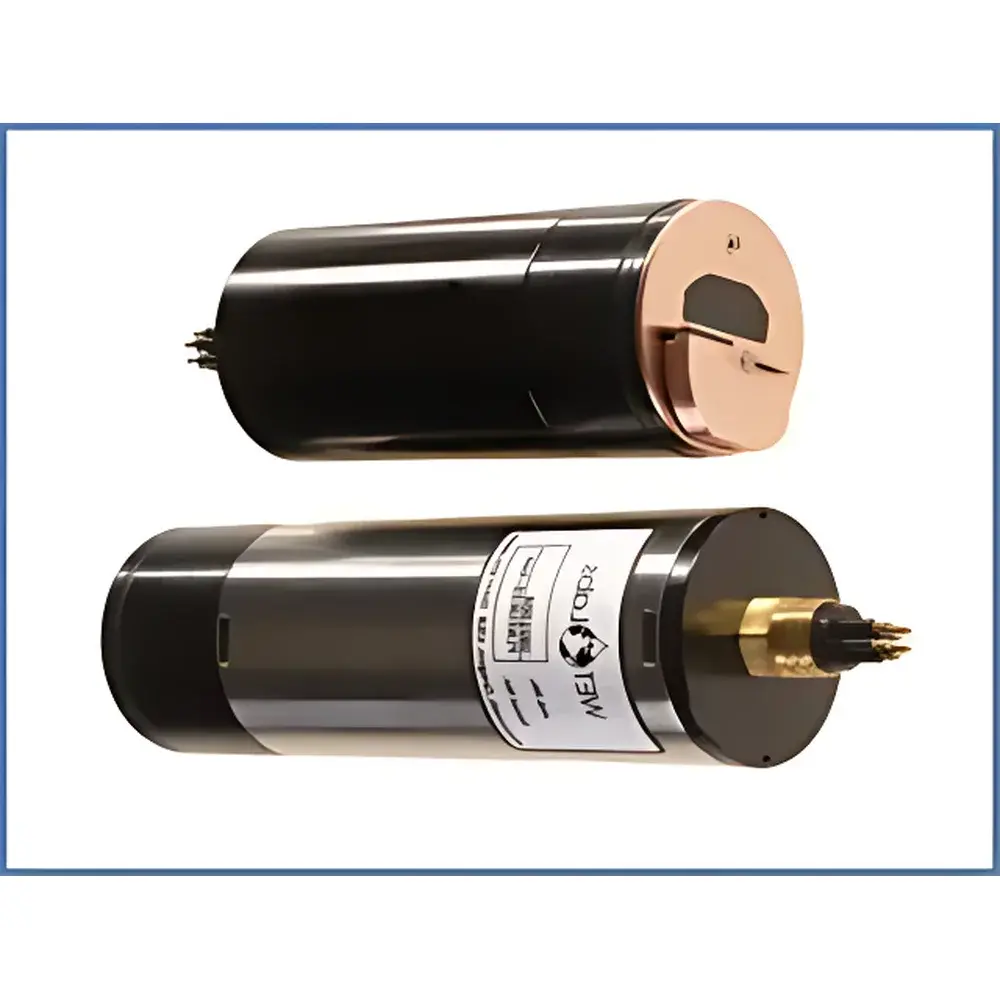
Wetlabs ECO-Fl Chlorophyll-a Fluorometer
| Brand | Wetlabs |
|---|---|
| Origin | USA |
| Model | ECO-Fl |
| Measurement Principle | In-situ optical fluorescence detection at 470 nm excitation / 695 nm emission |
| Detection Range | 0–60, 0–125, or 0–250 µg/L (user-selectable) |
| Sensitivity | 0.02 µg/L |
| Housing Material | Acetal polymer (seawater-corrosion resistant) |
| Dimensions | Ø63 × 127 mm |
| Depth Rating | 600 m standard, optional 6000 m |
| Weight | 0.4 kg in air / 0.02 kg in water |
| Digital Output | RS-232, 19200 baud, 12-bit resolution |
| Analog Output | 0–5 V |
| Internal Data Logging | Optional, up to 65,000 samples |
| Power Input | 7–15 VDC |
| Current Draw | 80 mA (active), 85 µA (sleep mode) |
| Sampling Rate | 8 Hz |
| Anti-fouling | Optional copper-brush wiper with programmable cycle |
| Connector | SUBCONN Micro 5-pin male |
| Optional Accessories | Handheld terminal, biofouling barrier, integrated battery pack |
Overview
The Wetlabs ECO-Fl Chlorophyll-a Fluorometer is a field-deployable, submersible optical sensor engineered for high-sensitivity, real-time quantification of chlorophyll-a concentration in natural and engineered aquatic systems. It operates on the principle of in-situ fluorescence spectroscopy: a high-efficiency blue LED (470 nm) excites chlorophyll-a molecules within phytoplankton cells, and the resulting red fluorescence emission (centered at 695 nm) is detected by a calibrated photodiode. This method eliminates the need for sample extraction, filtration, or solvent extraction—enabling continuous, non-invasive monitoring with minimal disturbance to the measurement environment. Designed for long-term deployment in demanding marine, estuarine, freshwater, and wastewater contexts, the ECO-Fl delivers stable, reproducible data under variable temperature, pressure, and biofouling conditions. Its compact acetal housing provides inherent resistance to seawater corrosion and mechanical abrasion, while its low-power architecture supports extended operation on battery or CTD-integrated power buses.
Key Features
- Three user-selectable linear measurement ranges (0–60, 0–125, or 0–250 µg/L chlorophyll-a), optimized for oligotrophic to eutrophic conditions
- High-resolution 12-bit digital output via RS-232 interface (19200 baud), compatible with standard oceanographic data acquisition systems including Sea-Bird Electronics CTDs
- Optional analog output (0–5 V) for direct integration into SCADA or PLC-based environmental control infrastructure
- Optional internal data logger storing up to 65,000 timestamped samples with configurable sampling intervals
- Programmable anti-fouling copper-brush wiper system, enabling reliable multi-month deployments without manual servicing
- Depth-rated to 600 m as standard; optionally certified to 6000 m for abyssal and deep-ocean observatory applications
- Ultra-low power consumption: 80 mA during active measurement; 85 µA in sleep mode—ideal for solar- or battery-powered remote stations
- Modular design supporting optional accessories: biofouling barrier, handheld terminal for field calibration checks, and integrated lithium-thionyl chloride battery pack
Sample Compatibility & Compliance
The ECO-Fl is validated for direct in-situ use in seawater, brackish water, freshwater lakes and rivers, groundwater wells, and secondary/tertiary effluent streams. Its optical path is insensitive to common interferents such as suspended sediments (within typical turbidity ranges < 50 NTU) and colored dissolved organic matter (CDOM), though co-deployment with optional CDOM and turbidity channels (available in ECO-FL series variants) enables algorithmic correction where required. The sensor complies with ASTM D3731–22 (Standard Practice for In-Situ Fluorometric Measurement of Chlorophyll-a) and supports GLP-compliant data workflows when paired with timestamped logging and audit-trail-capable host software. Its materials meet ISO 16750-4 (road vehicles—environmental conditions) for mechanical robustness and MIL-STD-810G for shock/vibration resilience—standards widely adopted in marine instrumentation qualification.
Software & Data Management
Data from the ECO-Fl is natively supported by Wetlabs’ ECO Utility software (Windows/macOS), which enables configuration, real-time telemetry visualization, firmware updates, and batch export to CSV or NetCDF formats. When integrated into larger observatory networks (e.g., NOAA IOOS, EMSO, or regional watershed monitoring programs), the sensor’s ASCII-based output protocol ensures compatibility with open-source platforms including PySerial, Node-RED, and Python-based data ingestion pipelines. All logged datasets include embedded metadata (sensor ID, firmware version, temperature, voltage, and diagnostic flags), satisfying FAIR (Findable, Accessible, Interoperable, Reusable) data principles. For regulated environments—such as wastewater discharge compliance reporting—the instrument’s stable calibration traceability (NIST-traceable factory calibration) and optional time-stamped audit logs support adherence to EPA Method 445.0 and EU Water Framework Directive Annex V requirements.
Applications
- Oceanographic time-series stations (e.g., moored buoys, gliders, AUVs) tracking phytoplankton bloom dynamics and primary productivity
- Coastal and estuarine nutrient loading studies correlating chlorophyll-a with nitrogen/phosphorus speciation
- Drinking water source protection monitoring—early detection of cyanobacterial proliferation in reservoirs and intakes
- Wastewater treatment plant effluent compliance verification against regulatory chlorophyll-a thresholds
- Groundwater-surface water interaction studies using high-spatial-resolution vertical profiling
- Ecological risk assessment in aquaculture zones, where algal biomass directly impacts dissolved oxygen and fish health
- Long-term ecological research (LTER) sites requiring autonomous, low-maintenance biogeochemical sensing
FAQ
Is the ECO-Fl suitable for freshwater applications with low conductivity?
Yes—the sensor’s optical detection mechanism is independent of water conductivity or salinity. Calibration coefficients are empirically verified across freshwater, brackish, and full-strength seawater matrices.
How often does the ECO-Fl require recalibration in the field?
Factory calibration remains stable for ≥12 months under typical deployment conditions. Field verification using reference standards (e.g., preserved phytoplankton suspensions or certified chlorophyll-a solutions) is recommended prior to critical campaigns or after exposure to extreme fouling events.
Can the ECO-Fl be deployed alongside other ECO-series sensors (e.g., ECO-Turb, ECO-CDOM)?
Yes—ECO-Fl shares identical mechanical form factor, electrical interface, and communication protocol with other ECO-series instruments, enabling synchronized multi-parameter profiling on a single frame or CTD carousel.
Does the internal data logger retain data during power loss?
Yes—the non-volatile memory preserves all logged samples and configuration settings indefinitely, even if external power is interrupted.
What maintenance is required between deployments?
Rinsing with deionized water, visual inspection of the optical window and wiper mechanism, and verification of O-ring integrity per Wetlabs’ Maintenance Manual (Rev. 4.2). No optical alignment or internal servicing is user-performed.







