
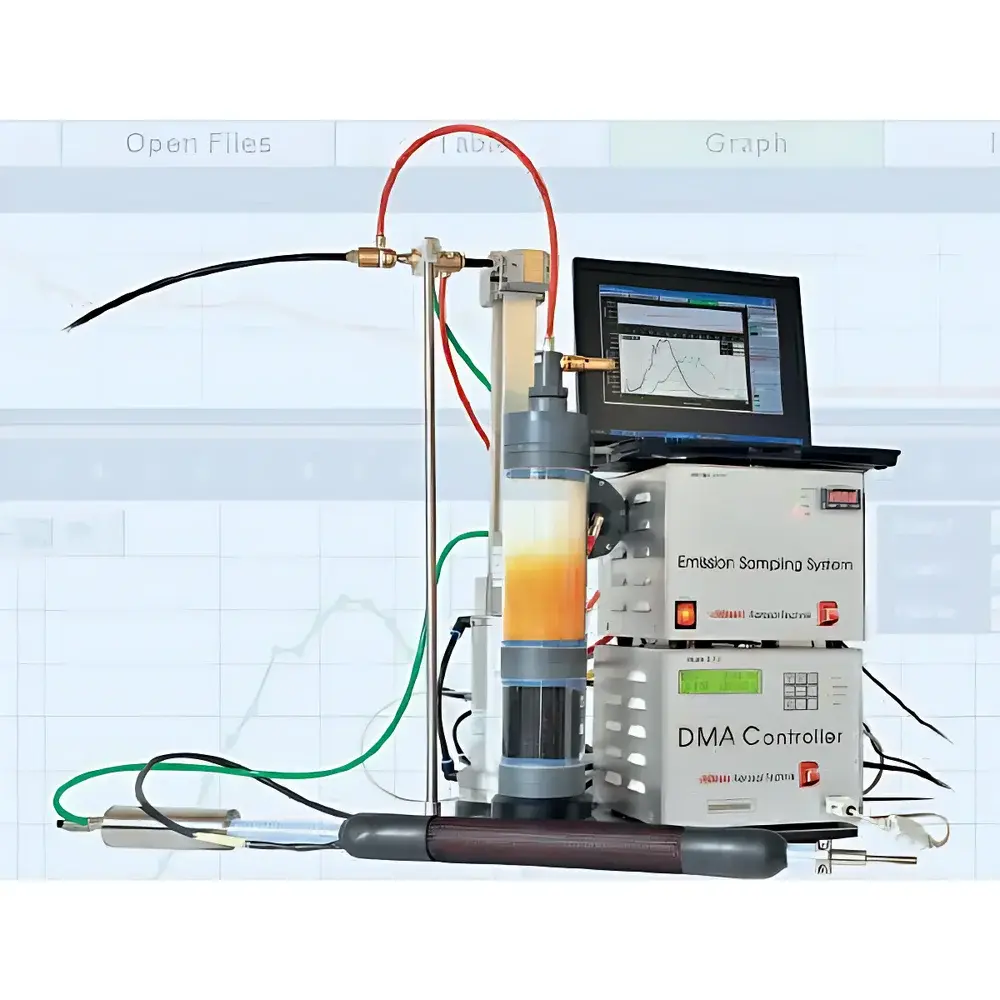
GRIMM ESS Exhaust Emission Sampling System
| Brand | GRIMM |
|---|---|
| Origin | Germany |
| Model | ESS |
| Instrument Type | Aerosol Sampling and Dilution System |
| Sample Gas Max Temperature | 500 °C |
| Probe Outer Diameter | 8 mm |
| Hot Dilution Air Flow Rate | 9 L/min (per stage) |
| Cold Dilution Air Flow Rate | 9 L/min |
| Primary Dilution Ratio (SMPS+E mode, 1 L/min sample flow) | 1:10 |
| Secondary Dilution Ratio (SMPS+E mode, 1 L/min sample flow) | 1:10 |
| Total Dilution Ratio (SMPS+E mode, 1 L/min sample flow) | 1:100 |
| Primary Dilution Ratio (SMPS+E mode, 0.3 L/min sample flow) | 1:31 |
| Secondary Dilution Ratio (SMPS+E mode, 0.3 L/min sample flow) | 1:31 |
| Total Dilution Ratio (SMPS+E mode, 0.3 L/min sample flow) | 1:961 |
| Heater Max Temperature | 200 °C |
| Pressure Tolerance | ±100 mbar (vs. ambient) |
| Dilution Air Specification | Particle-free, hydrocarbon-free, dry |
Overview
The GRIMM ESS Exhaust Emission Sampling System is a high-temperature, dual-stage aerosol dilution system engineered for representative sampling and conditioning of hot, undiluted exhaust streams from internal combustion engines, stationary combustion sources, and industrial thermal processes. Operating on the principle of controlled thermophoretic and diffusional particle stabilization, the ESS enables real-time, isokinetic acquisition of particulate matter (PM) at source temperatures up to 500 °C—without condensation artifacts or volatile loss. Its integrated probe design incorporates two sequential, independently regulated dilution stages: a pre-heated, dry, particle- and VOC-free air stream for primary dilution (to suppress nucleation and coagulation), followed by a secondary cold-air dilution stage for downstream compatibility with mobility-based analyzers such as SMPS (Scanning Mobility Particle Sizers) and CPCs (Condensation Particle Counters). This architecture ensures metrologically traceable particle size distribution (PSD) data under transient and steady-state emission conditions, meeting the physical sampling requirements defined in ISO 8573-1, VDI 2066, and EPA Method 5B.
Key Features
- High-temperature sampling probe with 8 mm outer diameter stainless steel construction, rated for continuous operation at 500 °C sample gas temperature and ±100 mbar differential pressure.
- Dual-stage dilution architecture: first-stage dilution uses heated (up to 200 °C), filtered, dried, and hydrocarbon-scrubbed air; second-stage employs clean, ambient-temperature, particle-free air.
- Precision mass flow control via thermostatically stabilized critical orifices, ensuring stable sample flow rates of 0.3 L/min or 1.0 L/min across both dilution stages.
- Configurable total dilution ratios of 1:100 (at 1 L/min sample flow) or 1:961 (at 0.3 L/min sample flow), optimized for coupling with SMPS+E systems and other high-sensitivity aerosol spectrometers.
- Integrated flow conditioning components: PTFE-coated filters, Nafion™ membrane dryers, and activated carbon/charcoal adsorbent beds to remove water vapor, semi-volatile organics, and acidic gases prior to analysis.
- Modular, rack-mountable control unit with digital flow monitoring, heater status indicators, and analog/digital I/O for synchronization with host analyzers and data acquisition platforms.
Sample Compatibility & Compliance
The ESS supports sampling of raw exhaust from gasoline direct injection (GDI), diesel, natural gas, and biofuel-powered engines, as well as flue gases from boilers, incinerators, and catalytic test benches. It complies with the sampling interface specifications required by ISO 8178-4 (non-road engine emissions), ISO 29463 (high-efficiency filter testing), and EU Regulation (EC) No 715/2007 Annex VI (light-duty vehicle type approval). The system’s dilution protocol aligns with the recommendations of the Particle Measurement Programme (PMP) and the Joint Research Centre (JRC) guidelines for solid particle number (SPN) measurement. All wetted materials are chemically inert (316L SS, FEP, PTFE, quartz), minimizing adsorption and catalytic interference. Optional calibration ports support traceable flow verification per ISO/IEC 17025-accredited procedures.
Software & Data Management
The ESS operates as a hardware-integrated subsystem rather than a standalone instrument; it does not include embedded firmware or proprietary software. Instead, it interfaces seamlessly with third-party analyzer control platforms—including TSI’s Aerosol Instrument Manager (AIM), GRIMM’s GRIMMsoft, and LabVIEW-based DAQ environments—via standardized 0–10 V analog signals and RS-232/RS-485 serial protocols. All flow, temperature, and pressure parameters are logged with timestamped metadata, supporting full audit trails required under GLP and GMP frameworks. When deployed in regulated testing laboratories, the ESS configuration and operational logs can be incorporated into 21 CFR Part 11-compliant electronic records through validated middleware solutions.
Applications
- Regulatory exhaust certification testing (e.g., WLTP, RDE, Tier 4, China 6)
- Engine development and aftertreatment system evaluation (DPF, GPF, SCR)
- Real-world driving emissions (RDE) mobile laboratory integration
- Combustion research on alternative fuels and low-temperature ignition phenomena
- Source apportionment studies requiring size-resolved particle number concentration (PNC) and volatility characterization
- Validation of computational fluid dynamics (CFD) models for particle transport in hot exhaust ducts
FAQ
Can the ESS be used with SMPS systems from vendors other than TSI?
Yes—the ESS delivers standardized dilution ratios and conditioned sample flow rates compatible with all commercially available SMPS platforms, including those from Cambustion and DMT, provided inlet flow and pressure specifications are met.
Is the heated dilution air supply integrated or external?
The heated dilution air is generated internally via a dedicated GRIMM-certified air dryer and heater module; no external compressed air or nitrogen supply is required.
What maintenance intervals are recommended for the adsorbent and dryer cartridges?
Under typical heavy-duty testing conditions, activated carbon and Nafion™ cartridges should be replaced every 200 operational hours or per manufacturer’s moisture breakthrough validation protocol.
Does the ESS meet requirements for PEMS (Portable Emission Measurement Systems) deployment?
While the ESS itself is not a portable analyzer, its modular design and robust thermal management make it suitable for integration into certified PEMS configurations when paired with appropriate transportable analyzers and power systems.
Can the system accommodate simultaneous sampling for multiple analyzers (e.g., CPC + APS + AMS)?
Yes—custom splitter manifolds and flow-balanced multi-outlet configurations are available upon request, maintaining isokinetic integrity and dilution fidelity across all branches.
Related Products







