
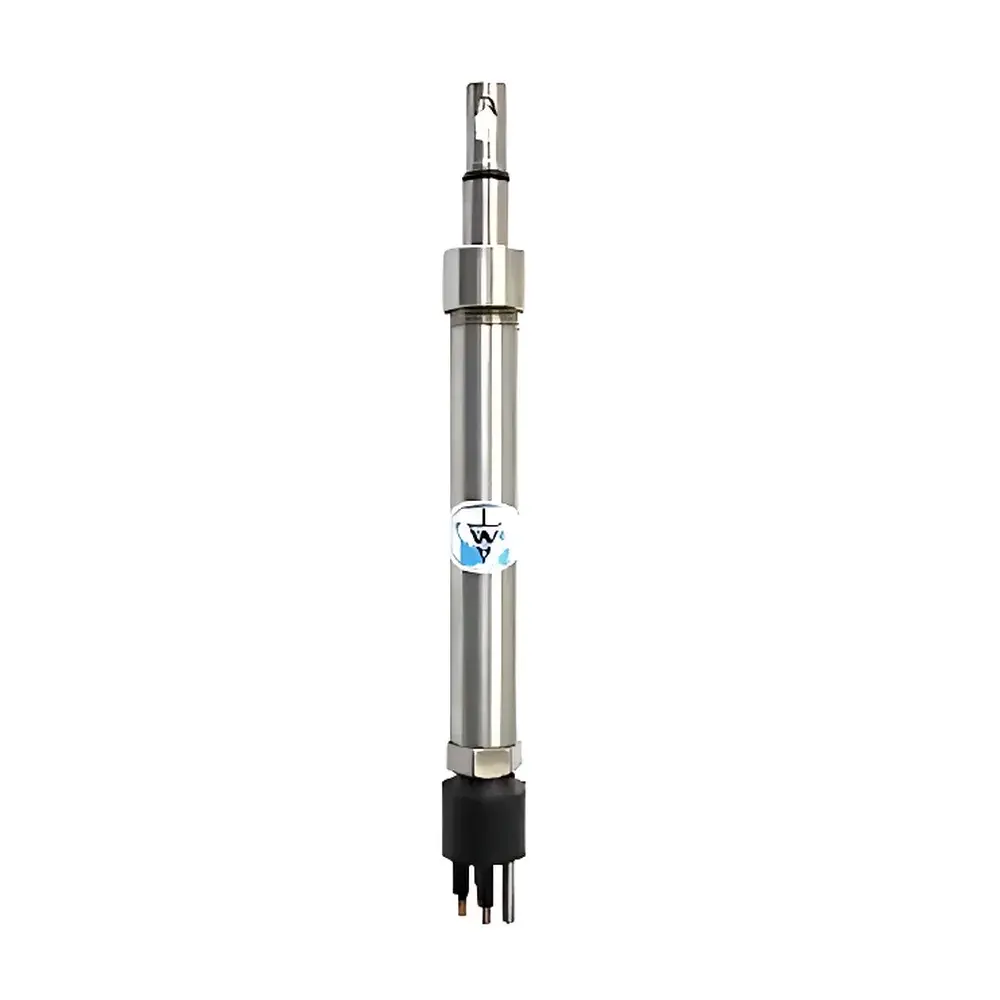
AMT AMT-O3 Submersible Ozone Sensor
| Brand | AMT |
|---|---|
| Origin | Germany |
| Manufacturer Type | Authorized Distributor |
| Origin Category | Imported |
| Model | AMT-O3 |
| Pricing | Upon Request |
Overview
The AMT AMT-O3 Submersible Ozone Sensor is an electrochemical analytical instrument engineered for continuous, in-situ measurement of dissolved ozone (O₃) concentration in aqueous environments. It operates on the principle of membrane-covered amperometric detection — a well-established method for trace-level oxidant monitoring in water quality applications. A gas-permeable silicone membrane isolates the internal sensing chamber from hydrostatic pressure and direct contact with water, while allowing selective diffusion of ozone molecules based on partial pressure gradients. Inside the chamber, a three-electrode electrochemical cell — comprising working, counter, and reference electrodes immersed in electrolyte — generates a current proportional to the partial pressure of dissolved ozone. This analog signal is linearly correlated to concentration across the operational range, enabling real-time quantification without reagent addition or sample extraction.
Key Features
- Three-electrode amperometric design ensures high stability and long-term baseline reproducibility under variable flow and temperature conditions.
- Replaceable sensor head with field-serviceable electrodes extends operational lifetime and reduces total cost of ownership.
- Pressure-rated titanium housing rated for continuous operation up to 10 bar (equivalent to ~100 m water column), validated for deep-water deployment.
- Rapid response kinetics: t90% ≤ 4.5 seconds, supporting dynamic process monitoring in ozonation reactors, ballast water treatment systems, and recirculating aquaculture units.
- Integrated temperature compensation via built-in Pt1000 thermistor; automatic correction applied within the sensor’s firmware across the full operating range (–2 °C to +30 °C).
- Low detection limit (<2 µg/L per digit) and linear measurement range from 20 µg/L to 10 mg/L O₃ — covering regulatory thresholds for disinfection validation and residual control.
Sample Compatibility & Compliance
The AMT-O3 sensor is compatible with freshwater, seawater, wastewater effluent, and ultrapure process water — provided turbidity remains below 100 NTU and suspended solids do not mechanically foul the membrane surface. Its silicone membrane exhibits low interference from chlorine, hydrogen peroxide, and nitrate under typical municipal and industrial water matrices. The device complies with ISO 7888 (water quality — determination of ozone) methodology principles and supports GLP-compliant data acquisition when paired with certified logging systems. For regulated environments (e.g., pharmaceutical water systems or drinking water utilities), the sensor output can be integrated into SCADA or LIMS platforms meeting FDA 21 CFR Part 11 requirements for electronic records and signatures.
Software & Data Management
The AMT-O3 is available in three configurations: (1) Laboratory version — standalone unit with integrated display, temperature probe, and analog/digital outputs (4–20 mA, RS-485); (2) Shallow-water version — submersible housing rated to 70 m depth, compatible with standard CTD telemetry interfaces and third-party data loggers; (3) Deep-water hydrogen-compatible system — 100 m rated, optionally configurable with co-located pH, pressure, and conductivity sensors via modular bus architecture. All versions support ASCII-based serial protocol for seamless integration with LabVIEW, MATLAB, or custom Python-based acquisition software. Firmware includes configurable averaging intervals, alarm thresholds, and audit-trail-enabled calibration logging.
Applications
- Real-time monitoring of ozone dosage and decay kinetics in municipal drinking water treatment plants.
- In-line verification of ozone residual in pharmaceutical purified water (PW) and water-for-injection (WFI) distribution loops.
- Process control in advanced oxidation processes (AOPs) combining ozone with UV or H₂O₂.
- Environmental research: profiling ozone dynamics in marine mesocosms, coral reef studies, and ballast water management systems.
- Validation of ozone-based sterilization efficacy in food processing and biotech clean-in-place (CIP) cycles.
FAQ
What is the expected service life of the sensor head under continuous operation?
Typical functional lifespan is 5–10 months depending on exposure frequency, water chemistry (e.g., bromide content), and mechanical abrasion at deployment sites.
Can the sensor be calibrated in-situ without removal from water?
Yes — zero-point calibration is achievable using nitrogen-purged deionized water; span calibration requires certified ozone gas standard or iodometric titration reference.
Is temperature compensation automatic or user-configurable?
Fully automatic; the integrated Pt1000 sensor feeds real-time temperature data to the onboard microcontroller for Nernstian correction of electrode kinetics.
Does the sensor require periodic electrolyte replenishment?
No — the internal electrolyte is sealed and non-refillable; replacement of the entire sensor module is recommended upon end-of-life indication.
How is pressure compensation handled during deep-water deployment?
The silicone membrane and titanium housing are mechanically engineered to maintain constant diffusion kinetics up to 10 bar; no software-based pressure compensation is required.
Related Products







