
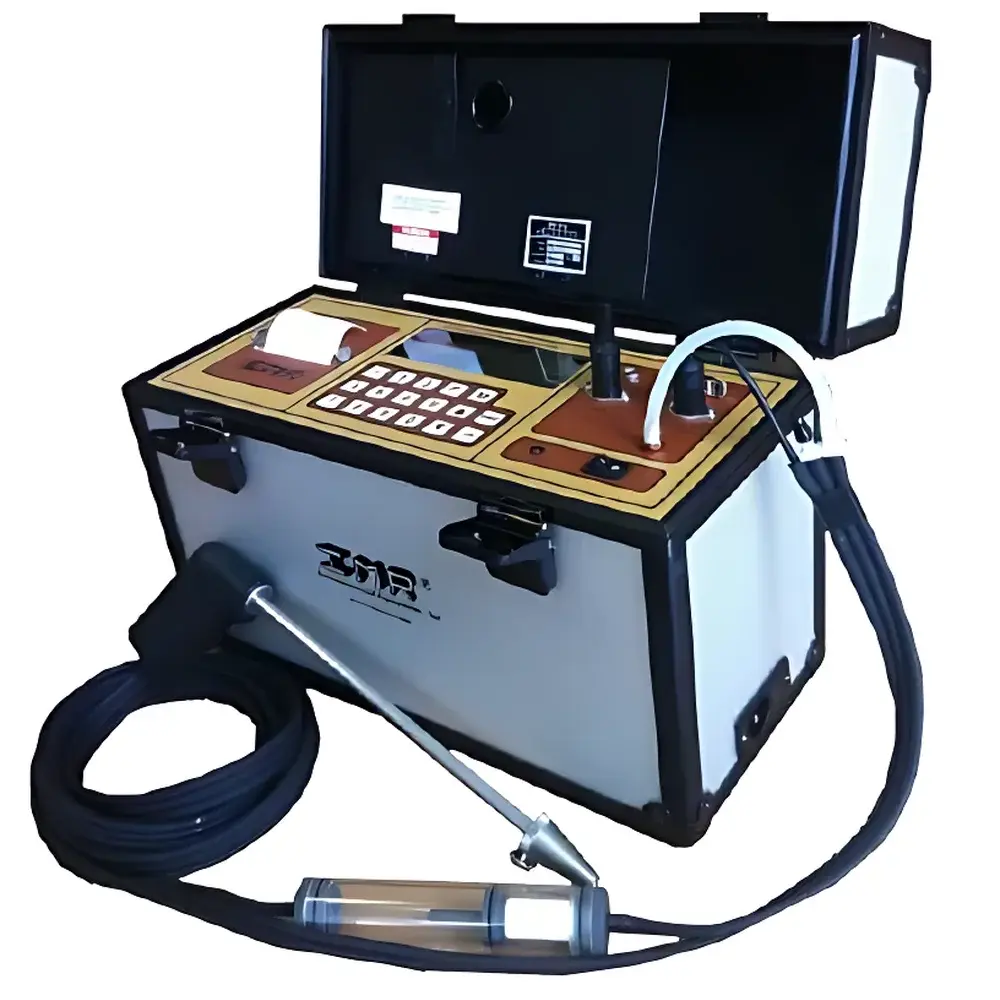
IMR IMR5000 Continuous Emission Monitoring System (CEMS)
| Brand | IMR |
|---|---|
| Origin | USA |
| Model | IMR5000 |
| Instrument Type | Flue Gas CEMS |
| Measurement Accuracy | <2% FS |
| Repeatability | <2% FS |
| Stability | <2% FS |
| Response Time | Real-time |
| Measured Parameters | O₂, NO, NO₂, CO, SO₂, HC, CH₄, H₂S, HCl, NH₃, N₂O, O₃, PM |
| Sensor Technologies | Electrochemical (O₂, NO, NO₂, CO, SO₂, H₂S, NH₃, HCl, N₂O, O₃), NDIR (CH₄, CO₂*), Catalytic Bead (HC), Optional Paramagnetic (O₂), Thermal Conductivity (H₂), Optical Scattering (PM) |
Overview
The IMR IMR5000 Continuous Emission Monitoring System (CEMS) is an engineered solution for regulatory-compliant, real-time flue gas analysis in stationary source emission monitoring applications. Designed in accordance with EN 15267-3, EN 14181, and US EPA Performance Specification 2 (PS-2) for gas analyzers and PS-11 for particulate matter, the system employs a hybrid sensor architecture—integrating electrochemical cells for reactive gases (NO, NO₂, SO₂, H₂S, NH₃, HCl, N₂O, O₃), non-dispersive infrared (NDIR) detection for hydrocarbons (CH₄) and optional CO₂, catalytic bead sensors for combustible gas (HC), and optical scattering-based particulate measurement (PM). All measurements are synchronized, time-stamped, and processed using embedded firmware calibrated to traceable NIST standards. The system supports both extractive sampling (with integrated heated sample line, condensate trap, and permeation dryer) and in-situ configurations via optional probe modules, enabling multi-point sampling across up to six ducts or stacks.
Key Features
- Real-time simultaneous quantification of 13 regulated parameters: O₂, NO, NO₂, CO, SO₂, HC, CH₄, H₂S, HCl, NH₃, N₂O, O₃, and PM — all displayed concurrently on a high-resolution 10.1″ TFT capacitive touchscreen
- Onboard combustion calculation engine compliant with ASME PTC 19.10–2017: automatic derivation of excess air (λ), adiabatic flame temperature (qA), stoichiometric CO₂, thermal efficiency (η), flue gas loss, and oxygen-corrected emission rates
- Modular hardware architecture: hot-swappable sensor cartridges with individual calibration memory (EEPROM), field-replaceable without system shutdown
- Integrated environmental conditioning: built-in sample drying unit (dew point ≤ −5°C), particle filtration (≤0.3 µm), and flow-controlled purge system with programmable timer cycles
- Multi-protocol digital interfacing: RS-232/RS-485 (Modbus RTU), 10/100 Mbps Ethernet (TCP/IP, HTTP, SNMP), plus isolated 4–20 mA and 0–10 V analog outputs per measured parameter
- Comprehensive data integrity: audit-trail enabled logging (ISO/IEC 17025-aligned), 16 GB internal flash storage (≥12 months at 1-min resolution), and optional SD card backup
Sample Compatibility & Compliance
The IMR5000 is validated for use with flue gases from coal-fired power plants, waste-to-energy incinerators, cement kilns, petrochemical crackers, and metallurgical furnaces. It accommodates sample temperatures up to 200°C (with optional high-temp probe), moisture content ≤40 vol.% (post-drying), and particulate loading ≤5 g/Nm³. All gas measurements meet EU Directive 2010/75/EU (IED) and German TA Luft requirements for certified CEMS. Particulate module complies with EN 13284-1 for low-concentration dust monitoring. System-level validation includes QAL1 (Quality Assurance Level 1) certification per EN 14181, with full documentation package available for regulatory submission. Firmware supports 21 CFR Part 11-compliant electronic signatures and user-role access control (admin/operator/maintainer).
Software & Data Management
The IMR5000 operates under embedded Linux-based firmware with dual-mode operation: standalone local control or networked supervision via IMR OBSERVER workstation software (Windows/Linux/macOS). OBSERVER provides remote configuration, live trend visualization, automated report generation (PDF/CSV), alarm management (email/SMS via SMTP/GSM), and historical data reconciliation against reference methods (e.g., ASTM D6522 for NOx, ISO 7933 for CO). All raw sensor outputs, diagnostic flags (e.g., sensor drift, flow fault, zero/span deviation), and calculated parameters are stored with UTC timestamps and retained for ≥36 months when paired with external NAS or cloud archive (AWS S3 or Azure Blob compatible). Data export supports EPA CDX, EMAS, and national ETS reporting formats.
Applications
- Regulatory compliance monitoring for coal-, gas-, and biomass-fired power generation units subject to NSPS Subpart UU, MATS, or EU IED Annex II reporting
- Combustion optimization in industrial boilers and thermal oxidizers through real-time lambda and efficiency feedback
- Emission factor validation and stack testing support for Tier 2/Tier 3 GHG inventories (IPCC 2006 Guidelines)
- R&D applications in engine test cells and aftertreatment development labs requiring multi-gas transient profiling
- Continuous process monitoring in chlorine-alkali plants, sulfuric acid production, and coke oven battery operations
- Pre-compliance screening for municipal solid waste incinerators prior to formal QAL2 certification
FAQ
Does the IMR5000 support automatic zero and span calibration?
Yes — the system includes programmable auto-calibration sequences using certified span gases (NIST-traceable) and zero air; calibration events are logged with full metadata and trigger configurable alarms if tolerance limits are exceeded.
Can the IMR5000 be integrated into existing DCS/SCADA systems?
Yes — native Modbus TCP and OPC UA (via optional gateway) enable bidirectional integration with Siemens Desigo, Honeywell Experion, ABB 800xA, and Emerson DeltaV platforms.
Is PM measurement certified to EN 13284-1?
Yes — the optical scattering PM module carries full EN 13284-1 type approval for concentrations ≥0.5 mg/Nm³, with factory verification against gravimetric reference methods.
What is the recommended maintenance interval for sensor modules?
Electrochemical sensors require replacement every 18–24 months depending on exposure profile; NDIR cells have a nominal service life of ≥5 years; all modules include built-in health diagnostics and end-of-life prediction algorithms.
Does the system comply with cybersecurity requirements for industrial IoT deployment?
Yes — firmware implements TLS 1.2 encryption, secure boot, role-based authentication, disabled default credentials, and regular security patching aligned with IEC 62443-4-2 SL2 requirements.
Related Products







