
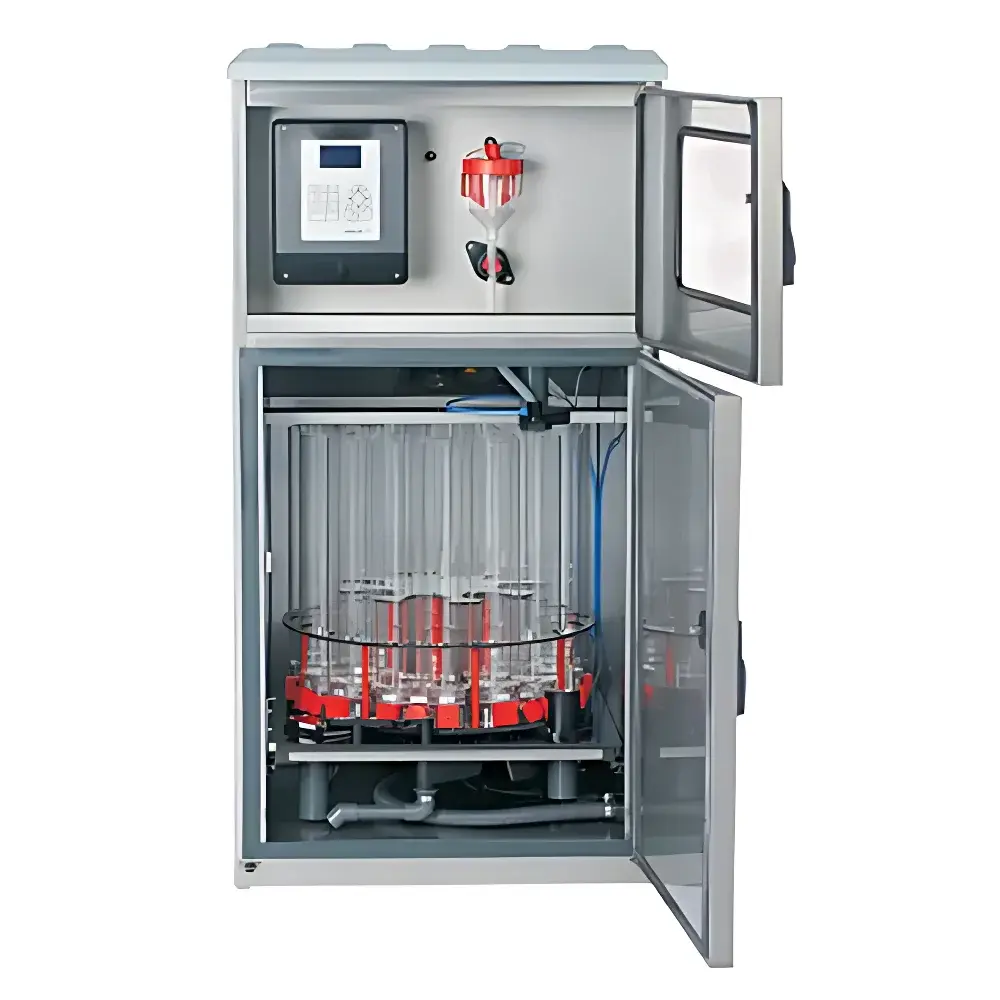
MAXX SP5 A Enrichment Water Sampler
| Origin | Germany |
|---|---|
| Manufacturer Type | Authorized Distributor |
| Origin Category | Imported |
| Model Variants | SP5 A / SP5 B / SP5 S / SP5 Zone2 |
| Instrument Class | Automated Online Water Sampler |
| Sampling Method | Vacuum-Driven Enrichment with Dual-Stage Filtration |
| Instrument Type | Online Enrichment Water Sampler |
Overview
The MAXX SP5 A Enrichment Water Sampler is an engineered solution for the quantitative, in-situ enrichment of trace-level contaminants from natural and engineered water systems. Unlike conventional grab or composite samplers, the SP5 A operates on a vacuum-driven volumetric dosing principle—precisely drawing large-volume water samples (up to several hundred liters per cycle) through user-selectable adsorption media or graded filtration matrices. This enables effective pre-concentration of analytes below instrumental detection limits, including microplastics (<5 mm), pharmaceuticals (e.g., antibiotics), persistent organic pollutants (POPs), organochlorine pesticides, dioxins, and endocrine-disrupting compounds. Designed for long-term unattended deployment in rivers, lakes, estuaries, and wastewater outfalls, the SP5 A integrates thermally stabilized sample handling, programmable event-triggered sampling logic, and compliance-ready data logging—making it suitable for regulatory monitoring, environmental forensics, and academic research requiring GLP-aligned field protocols.
Key Features
- Vacuum-based volumetric dosing system ensures high reproducibility of sample volume (±1.5% accuracy over 10–500 L cycles), eliminating reliance on peristaltic tubing prone to fatigue and flow drift
- Dual-stage filtration module: configurable primary screen (5 mm mesh) followed by secondary ultra-fine filter (standard 50 µm; optional down to 10 µm or 1 µm stainless-steel or polymer mesh)
- Digitally controlled sample chamber with ±0.3 °C uniformity across operating range (4–30 °C), critical for preserving labile organic analytes during enrichment
- Multi-mode sampling logic: time-proportional, flow-proportional (with external flow meter integration), event-triggered (via dry-contact or 4–20 mA signal), and hybrid combinations
- Modular adsorption cartridge system supporting interchangeable sorbent media (e.g., C18, HLB, activated carbon, molecularly imprinted polymers) for targeted organic compound enrichment
- Communication interfaces include Ethernet (LAN), optional Wi-Fi (W-LAN), and GPRS for remote configuration, real-time status reporting, and alarm notification
- Ergonomic housing with IP67-rated enclosure, tool-free access to filtration and adsorption modules, and NSF/ISO-compliant wetted materials (316L SS, PTFE, FEP)
Sample Compatibility & Compliance
The SP5 A accommodates a broad spectrum of aqueous matrices—including freshwater, brackish water, treated effluent, and low-turbidity surface runoff—without clogging or pressure instability. Its dual-filtration architecture prevents particulate overload while retaining target microplastic particles ≥10 µm and enabling subsequent FTIR/Raman identification. For organic enrichment, compatibility extends to pH 3–10 and salinities up to 35 g/L. The system supports audit-trail-capable operation per ISO 5667-10:2021 (water quality — sampling — part 10: guidance on sampling of water and wastewater for microbiological analysis and related applications) and aligns with EPA Method 1694 (pharmaceuticals and personal care products) and ASTM D7977 (microplastic quantification in water). Data integrity meets FDA 21 CFR Part 11 requirements when paired with MAXX’s optional secure firmware and electronic signature module.
Software & Data Management
The embedded controller runs MAXX’s FieldLogic™ OS v3.2—a deterministic real-time operating system supporting scheduled calibration verification, automatic error logging, and timestamped metadata capture (flow rate, temperature, vacuum pressure, elapsed runtime, and trigger source). Configuration is performed via web-based interface (HTTPS-secured) or local touchscreen (on SP5 S variant). All operational parameters and raw sensor logs are exportable in CSV/JSON format compliant with LIMS ingestion standards. Optional cloud synchronization enables centralized fleet management across distributed monitoring networks, with TLS 1.2 encryption and role-based access control (RBAC) for multi-user laboratories.
Applications
- Microplastic Source Tracking: Deployed at riverine inflows to coastal zones, the SP5 A collects depth-stratified, volume-calibrated samples for standardized microplastic isolation—supporting harmonized reporting under UNEP’s Global Assessment of Marine Litter and Plastic Pollution
- Antibiotic Resistance Monitoring: Enables routine enrichment of ng/L-level fluoroquinolones and sulfonamides from wastewater treatment plant effluents, facilitating LC-MS/MS analysis aligned with EU Watch List 2023 (Commission Decision 2023/1260)
- Legacy Contaminant Surveillance: Paired with XAD-2 or graphitized carbon black cartridges, the system enriches pg/L concentrations of dioxins and furans from sediment porewater or floodplain groundwater, satisfying ISO 18073:2022 requirements
- Climate-Responsive Sampling: Event-triggered mode integrates with rainfall gauges or SCADA systems to initiate enrichment during stormwater overflow events—critical for capturing transient contaminant pulses linked to climate intensification
FAQ
What is the maximum recommended sampling volume per cycle?
The SP5 A supports programmable cycles from 10 L to 500 L, with optimal enrichment efficiency observed between 50–200 L depending on target analyte concentration and sorbent capacity.
Can the SP5 A operate submerged or in floating configurations?
Yes—the SP5 A Zone2 variant is certified for Zone 2 hazardous area deployment and supports submersible mounting (max depth 3 m) with optional corrosion-resistant marine-grade housing.
Is method validation support available for regulatory submissions?
MAXX provides application notes, SOP templates, and third-party validation reports (per ISO/IEC 17025) for common use cases including microplastics (EN 17527:2022) and pharmaceuticals (EPA 1694 Rev. 1).
How frequently does the filtration system require maintenance in high-turbidity environments?
Primary screens are inspected automatically every 10 cycles; secondary filters are rated for ≥200 L of turbid river water (NTU > 100) before scheduled replacement—log data triggers proactive service alerts.
Does the system support remote firmware updates and diagnostic telemetry?
Yes—over-the-air (OTA) updates are digitally signed and rolled back automatically if integrity checks fail; diagnostic telemetry includes vacuum decay rate, thermal gradient deviation, and motor current profiling.







