
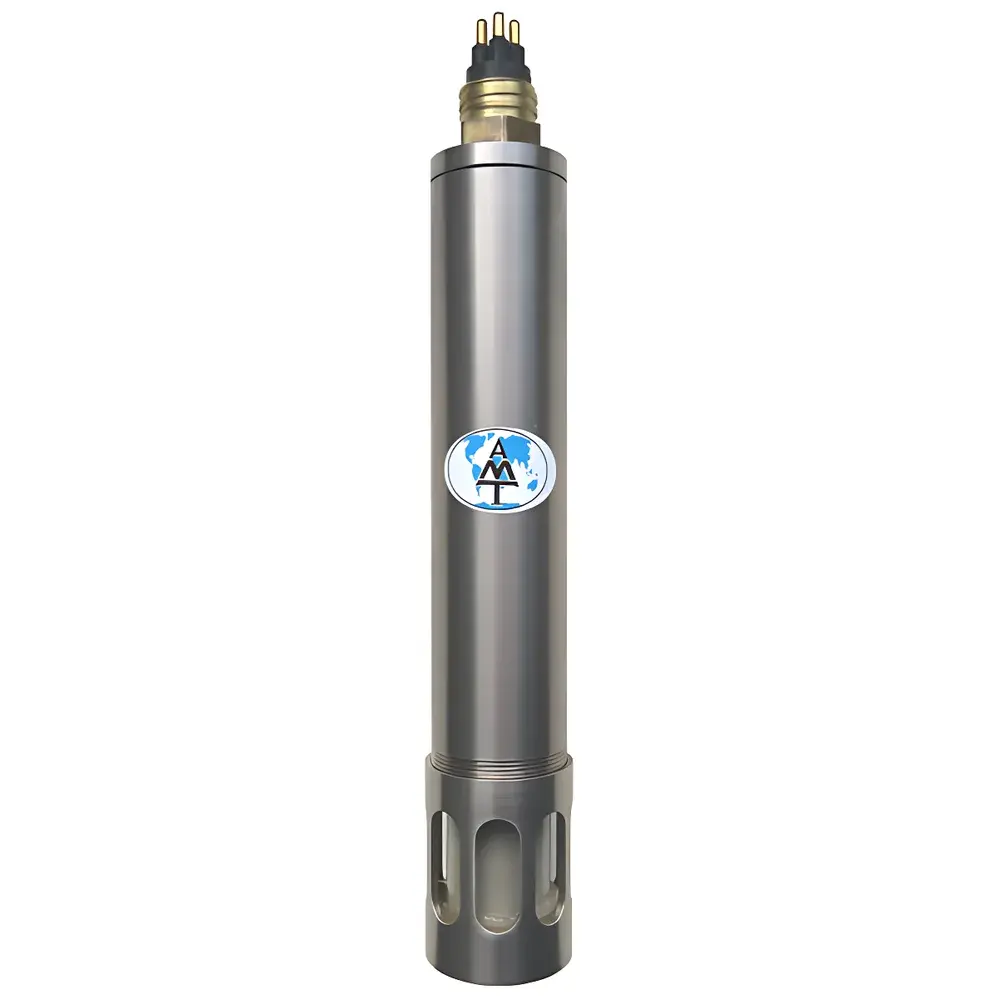
AMT AMT-CO2 Membrane-Covered Optical CO₂ Sensor for Aquatic Environments
| Brand | AMT |
|---|---|
| Origin | Germany |
| Model | AMT-CO₂ |
| Measurement Principle | Optical NDIR (Single-Beam, Dual-Wavelength) |
| Range Options | 15 / 50 / 340 mg/L (customizable) |
| Accuracy | ±2% of reading (5–15 mg/L range) |
| Housing Material | Titanium |
| Dimensions | Ø33 mm × 225 mm |
| Operating Depth | Up to 1000 m |
| Power Supply | 12–30 VDC (digital/voltage output) |
| Power Consumption | <0.5 W |
| Warm-up Time | <12 s (initial stabilization), <2 min (optimal accuracy) |
| Output Options | 4–20 mA, 0–5 V, RS485 |
| Temperature Compensation | Internal, automatic |
| Humidity Compensation | Internal, automatic |
| Operating Temperature | 0–60 °C |
| Immersion Capability | Fully submersible in water or air |
Overview
The AMT AMT-CO₂ Membrane-Covered Optical CO₂ Sensor is a high-fidelity, submersible analytical instrument engineered for continuous, real-time monitoring of dissolved carbon dioxide (CO₂(aq)) partial pressure in aquatic systems. Unlike conventional titrimetric or pH-based indirect methods—such as the m-value approach—it employs a gas-permeable hydrophobic membrane coupled with non-dispersive infrared (NDIR) optical detection. This architecture isolates the sensing element from direct contact with the aqueous matrix, eliminating interference from ionic species (e.g., HCO₃⁻, CO₃²⁻), buffering agents (phosphate, silicate), and suspended solids. The sensor operates on the principle of selective CO₂ diffusion across the membrane into an internal optical chamber, where CO₂ concentration is quantified via dual-wavelength absorption spectroscopy at characteristic infrared bands (typically near 4.26 µm). Simultaneous in-situ measurement of water temperature and ambient pressure is integrated to enable thermodynamic conversion of partial pressure (pCO₂) to mass concentration (mg/L), adhering to standard Henry’s law relationships. Designed for long-term deployment in demanding environments—from recirculating aquaculture systems (RAS) to limnological monitoring stations—the AMT-CO₂ delivers stable, drift-resistant performance without routine recalibration.
Key Features
- Fully submersible titanium housing (Grade 2 Ti) rated for depths up to 1000 m, offering exceptional corrosion resistance in seawater, brackish, and freshwater media.
- Gas-selective silicone or fluoropolymer membrane that permits only CO₂ diffusion—rejecting H₂O vapor, ions, colloids, and particulates—ensuring chemical specificity and long-term fouling resilience.
- Optical NDIR detection with single-beam, dual-wavelength architecture: one wavelength targets the CO₂ absorption peak; the other serves as a reference for optical path compensation, minimizing drift from lens contamination or LED aging.
- Onboard temperature and barometric pressure sensors with factory-traceable calibration, enabling real-time pCO₂-to-mg/L conversion per ISO 8245 and ASTM D5117 protocols.
- Internal compensation algorithms for temperature and humidity effects on membrane permeability and IR signal baseline—no external ancillary sensors required.
- Low-power operation (<0.5 W) compatible with solar-powered telemetry nodes and battery-operated data loggers; rapid thermal stabilization (<12 s) supports high-frequency sampling intervals.
Sample Compatibility & Compliance
The AMT-CO₂ sensor is validated for use in natural waters (lakes, rivers, estuaries), aquaculture tanks, RAS biofilters, and wastewater treatment effluents. It exhibits no cross-sensitivity to common interferents including phosphate (PO₄³⁻), silicate (SiO₄⁴⁻), bicarbonate (HCO₃⁻), carbonate (CO₃²⁻), chloride (Cl⁻), or dissolved organic carbon (DOC). Its measurement traceability aligns with ISO/IEC 17025 requirements for environmental testing laboratories. For regulated applications—such as GLP-compliant aquaculture trials or FDA-reviewed water quality assessments—the sensor’s digital output (RS485 Modbus RTU) supports audit-ready timestamped data logging, while analog outputs (4–20 mA, 0–5 V) integrate seamlessly with SCADA and PLC-based control systems compliant with IEC 61131-3.
Software & Data Management
The sensor communicates via industry-standard RS485 (Modbus RTU) with configurable baud rates (9600–115200 bps), enabling integration into centralized environmental monitoring platforms (e.g., Campbell Scientific LoggerNet, CR1000X; or custom Python/Node-RED deployments). Digital firmware includes built-in diagnostics: membrane integrity verification, LED health monitoring, and temperature-compensation validation flags. All calibration coefficients and compensation parameters are stored in non-volatile memory with write-protection. When deployed with AMT’s optional gateway module, data streams support MQTT/HTTPS transmission to cloud platforms (AWS IoT Core, Azure IoT Hub) with TLS 1.2 encryption and configurable retention policies. Raw sensor output meets FDA 21 CFR Part 11 requirements for electronic records when paired with compliant data acquisition software featuring user access controls and immutable audit trails.
Applications
- Real-time CO₂ management in intensive aquaculture—preventing hypercapnia-induced stress in salmonids, shrimp, and tilapia.
- Process control in denitrification bioreactors and anaerobic digesters where CO₂ evolution correlates with microbial activity.
- Long-term limnological studies tracking diel pCO₂ fluctuations in eutrophic lakes and coastal zones.
- Validation of CO₂ stripping efficiency in degassing columns and packed towers within RAS infrastructure.
- Calibration reference for portable field meters and laboratory benchtop analyzers under ISO 5667-3 field sampling guidelines.
FAQ
Does the sensor require periodic recalibration?
No—factory calibration is stable for ≥12 months under normal operating conditions. Field verification using certified CO₂-spiked water standards (e.g., NIST-traceable solutions) is recommended every 6 months for GMP/GLP applications.
Can it be used in seawater?
Yes—the titanium housing and membrane chemistry are fully compatible with full-strength seawater (35 ppt salinity) and resist biofouling when deployed with optional antifouling caps or intermittent ultrasonic cleaning modules.
How is pressure compensation implemented?
An integrated piezoresistive pressure transducer measures local hydrostatic pressure; combined with temperature and pCO₂ readings, it computes dissolved CO₂ concentration using the thermodynamically rigorous formulation defined in UNESCO (1981) and updated in Dickson et al. (2007).
Is the sensor compatible with existing SCADA systems?
Yes—via RS485 Modbus RTU or analog 4–20 mA output, it interfaces directly with Allen-Bradley, Siemens S7, and Schneider Electric PLCs without protocol translation hardware.
What maintenance is required?
Annual visual inspection of the membrane surface for physical damage or persistent biofilm; gentle cleaning with isopropyl alcohol if needed. No electrolyte refills, pump replacements, or optical alignment procedures are necessary.







