
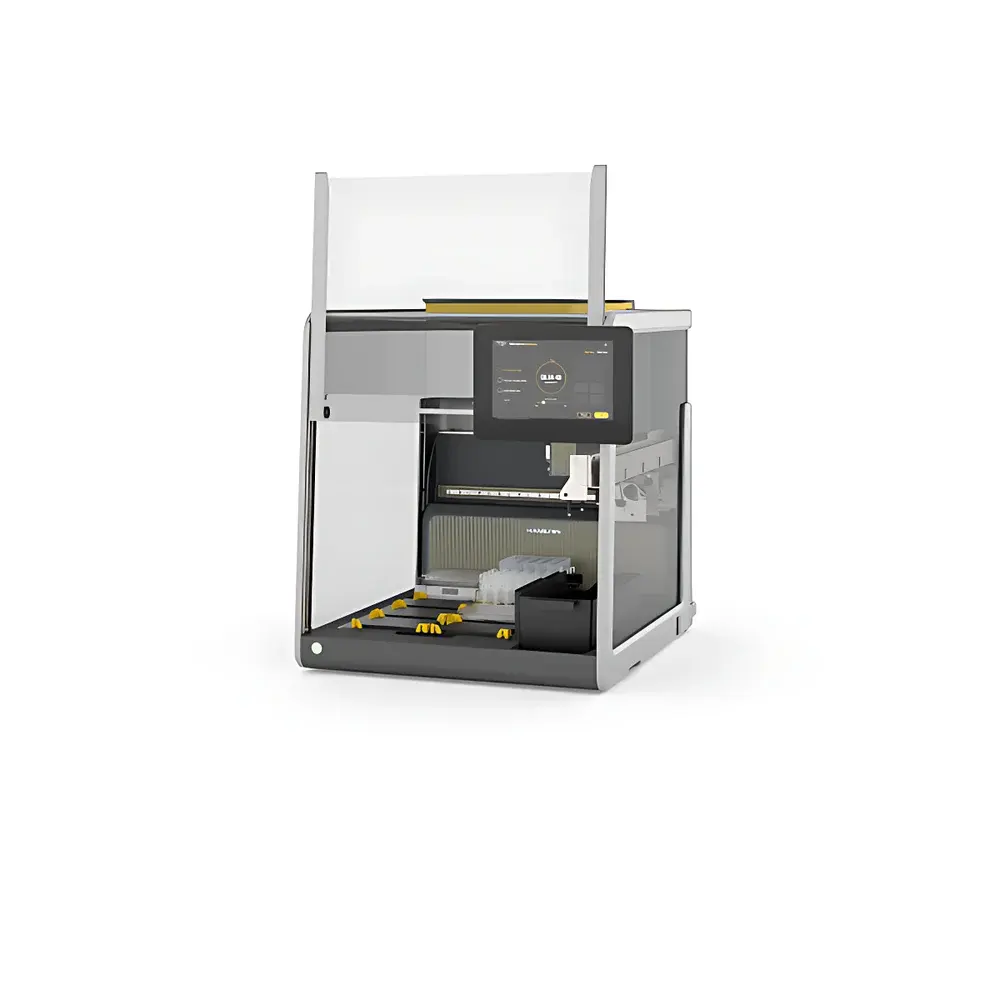
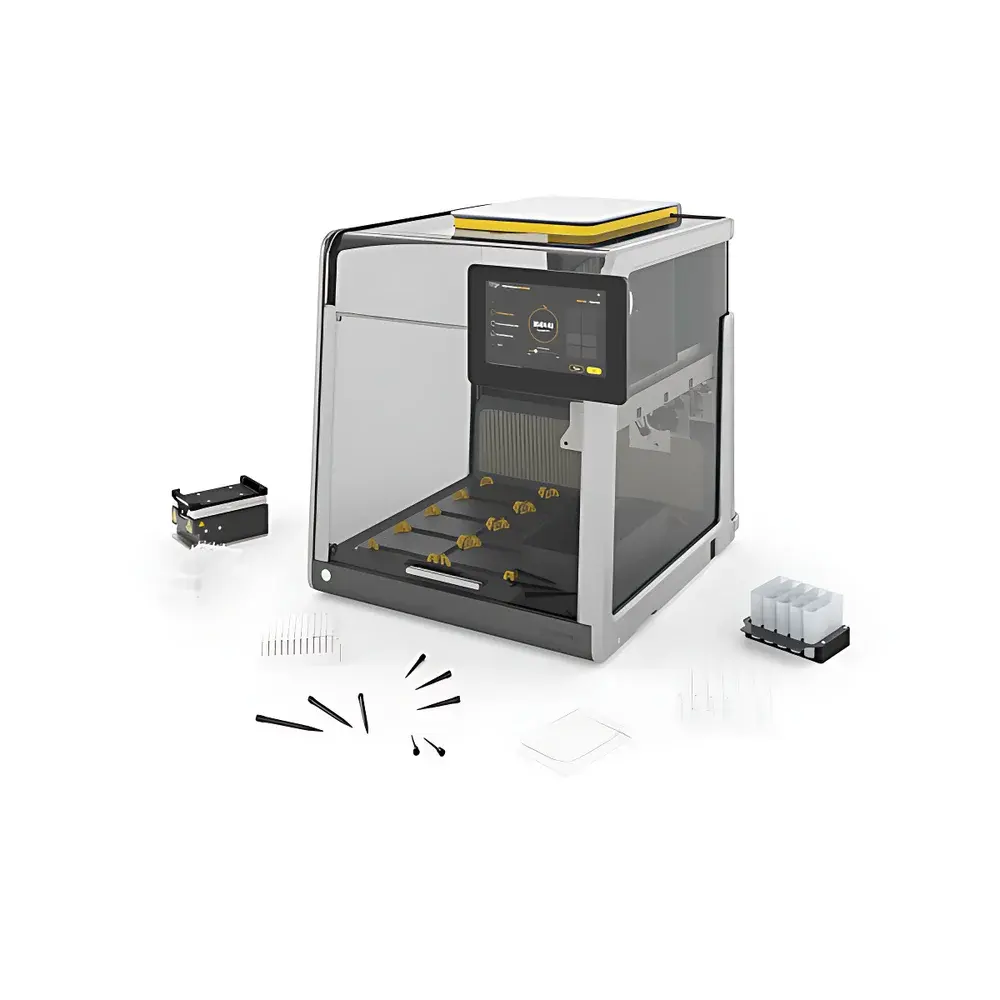
Hamilton Microlab PREP Automated Liquid Handling Workstation
| Brand | Hamilton |
|---|---|
| Origin | USA |
| Manufacturer Type | Original Equipment Manufacturer (OEM) |
| Import Status | Imported |
| Model | Microlab PREP |
| Plate Positions | 8 ANSI/SLAS-compliant deck positions |
| Pipetting Accuracy | ±5% |
| Pipetting Range | 0.5–1000 µL |
| Throughput Configuration | 2 independent single-channel + 8-channel pipetting head (configurable) |
| Dimensions (W × D × H) | 533.4 × 609.6 × 609.6 mm |
Overview
The Hamilton Microlab PREP Automated Liquid Handling Workstation is an entry-tier, benchtop-integrated platform engineered for precision liquid transfer in research, quality control, and assay development laboratories. Built upon Hamilton’s proven microfluidic architecture and decades of robotic liquid handling expertise, the Microlab PREP implements positive-displacement and air-displacement pipetting principles—optimized for reproducible aspiration and dispensing across a broad dynamic range (0.5–1000 µL). Unlike high-throughput systems requiring dedicated infrastructure or complex integration, the Microlab PREP delivers core automation functionality within a compact footprint of 0.28 m²—designed to operate directly on standard laboratory benches without structural modification or HVAC recalibration. Its modular hardware architecture supports three configurable pipetting modes: dual independent single-channel probes, an 8-channel parallel head, or hybrid operation combining both—enabling flexible adaptation to diverse protocol demands including serial dilution, plate reformatting, sample normalization, and master mix preparation.
Key Features
- Compact benchtop design (533.4 × 609.6 × 609.6 mm) with full ANSI/SLAS-compliant deck layout accommodating up to eight standard microplates, tubes, or reservoirs
- Dual-mode pipetting system: independently programmable single-channel probes (2×) and fixed 8-channel head—both utilizing Hamilton’s proprietary ceramic piston technology for low carryover and high mechanical repeatability
- Calibrated volumetric accuracy of ±5% across the full operating range (0.5–1000 µL), validated per ISO 8655-6 and traceable to NIST standards
- Integrated Z-axis collision detection and tip-sensing algorithms to prevent damage during tip pickup, aspiration, and deck navigation
- Tool-free deck configuration: interchangeable carrier modules support 96-well, 384-well plates, PCR strips, conical tubes (1.5–50 mL), and custom labware via user-defined coordinate mapping
- Embedded real-time diagnostics and self-calibration routines accessible via front-panel interface or remote monitoring
Sample Compatibility & Compliance
The Microlab PREP handles aqueous buffers, viscous solutions (e.g., glycerol-containing lysates), low-volume organic solvents (e.g., DMSO ≤10% v/v), and cell suspensions with minimal foaming or droplet loss—validated using Hamilton-certified tips and consumables. All fluid path components are chemically resistant to common laboratory reagents (including ethanol, isopropanol, and 1 M NaOH) and compatible with autoclaving (non-electronic modules only). The system complies with IEC 61000-6-2 (electromagnetic immunity) and IEC 61000-6-4 (emission) standards. While not pre-certified for GMP environments, its audit-ready log structure—including timestamped operator actions, pipetting event records, and calibration history—supports alignment with FDA 21 CFR Part 11 requirements when deployed with validated software configurations and procedural controls.
Software & Data Management
Controlled via Hamilton’s VENUS™ software (v3.5+), the Microlab PREP provides intuitive graphical workflow programming without scripting knowledge. Protocols are constructed using drag-and-drop primitives (Aspirate, Dispense, Mix, Delay, etc.) with parameterized variables (volume, speed, height offset, mixing cycles). All method files are stored in encrypted XML format with SHA-256 integrity verification. Raw execution logs—including per-step timestamps, actual dispensed volumes (where sensor-equipped), error codes, and user login identifiers—are retained locally and exportable as CSV or PDF for GLP documentation. Optional VENUS Connect module enables secure REST API access for LIMS integration and centralized fleet management across multi-instrument labs.
Applications
- High-fidelity sample preparation for qPCR, ELISA, and next-generation sequencing library construction
- Automated serial dilution series generation with inter-plate consistency <±3% CV (n=12)
- Cell-based assay setup: seeding, media exchange, and compound dosing across multi-well formats
- QC sample batching and reference standard preparation in pharmaceutical stability testing
- Reagent consolidation workflows—transferring from bulk containers into assay-ready plates while minimizing cross-contamination risk
- Education and training platforms: exposing students to industrial-grade automation logic and validation principles
FAQ
What pipette tip types are supported?
Hamilton recommends use of certified Microlab-compatible tips (e.g., HTF, LTS, or sterile filtered variants); third-party tips may be used but require individual performance qualification.
Can the Microlab PREP be integrated into existing LIMS or ELN systems?
Yes—via VENUS Connect API or OPC UA gateway (optional add-on), supporting bi-directional data exchange with major LIMS vendors including LabVantage, STARLIMS, and Thermo Fisher SampleManager.
Is routine maintenance required beyond tip replacement and cleaning?
Monthly Z-axis belt tension check and annual ceramic piston inspection are recommended; no lubrication or calibration drift correction is needed under normal operating conditions (20–25°C, 30–70% RH).
Does the system support barcode scanning for plate tracking?
Barcode reading is supported via optional USB-connected 2D imager (Honeywell Granit 1911i or equivalent), with native decoding in VENUS software for plate ID assignment and audit trail linkage.
What is the warranty coverage?
Standard 24-month parts-and-labor warranty from date of installation; extended service contracts include priority remote diagnostics and on-site technician dispatch within 4 business hours.



