
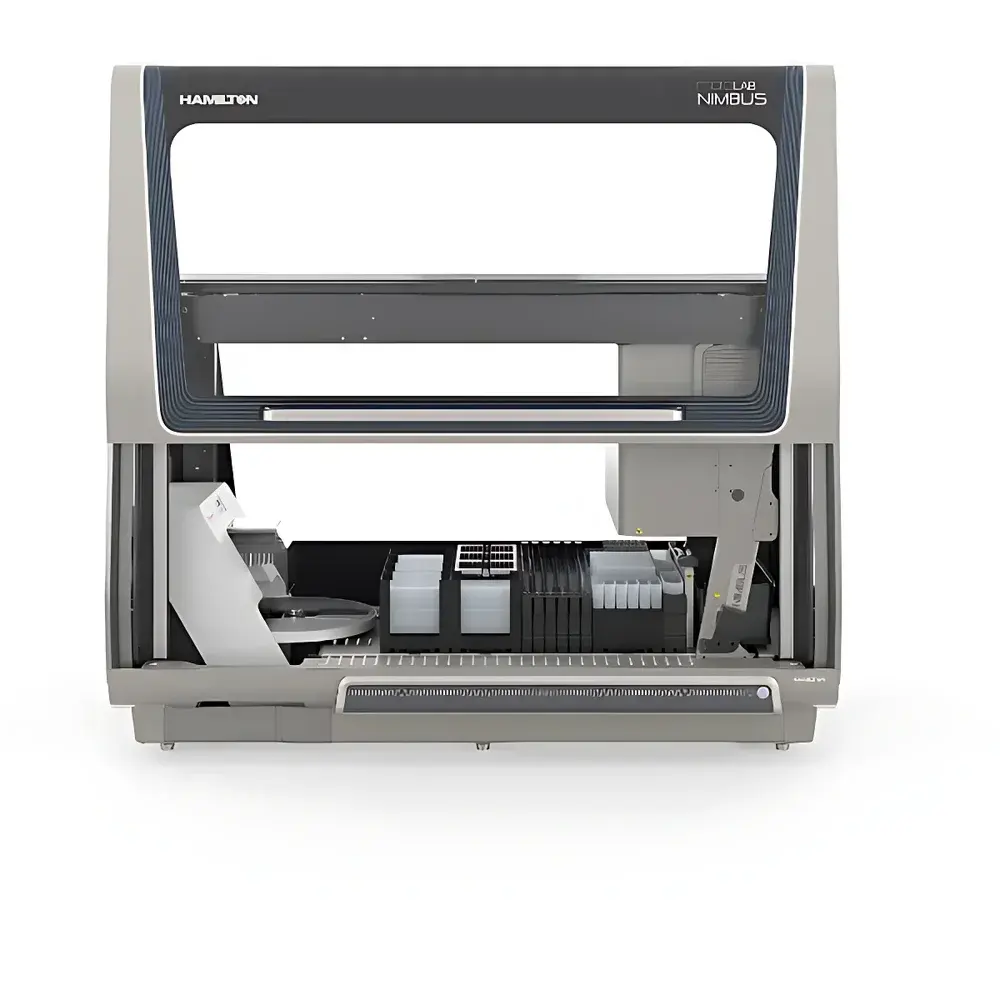
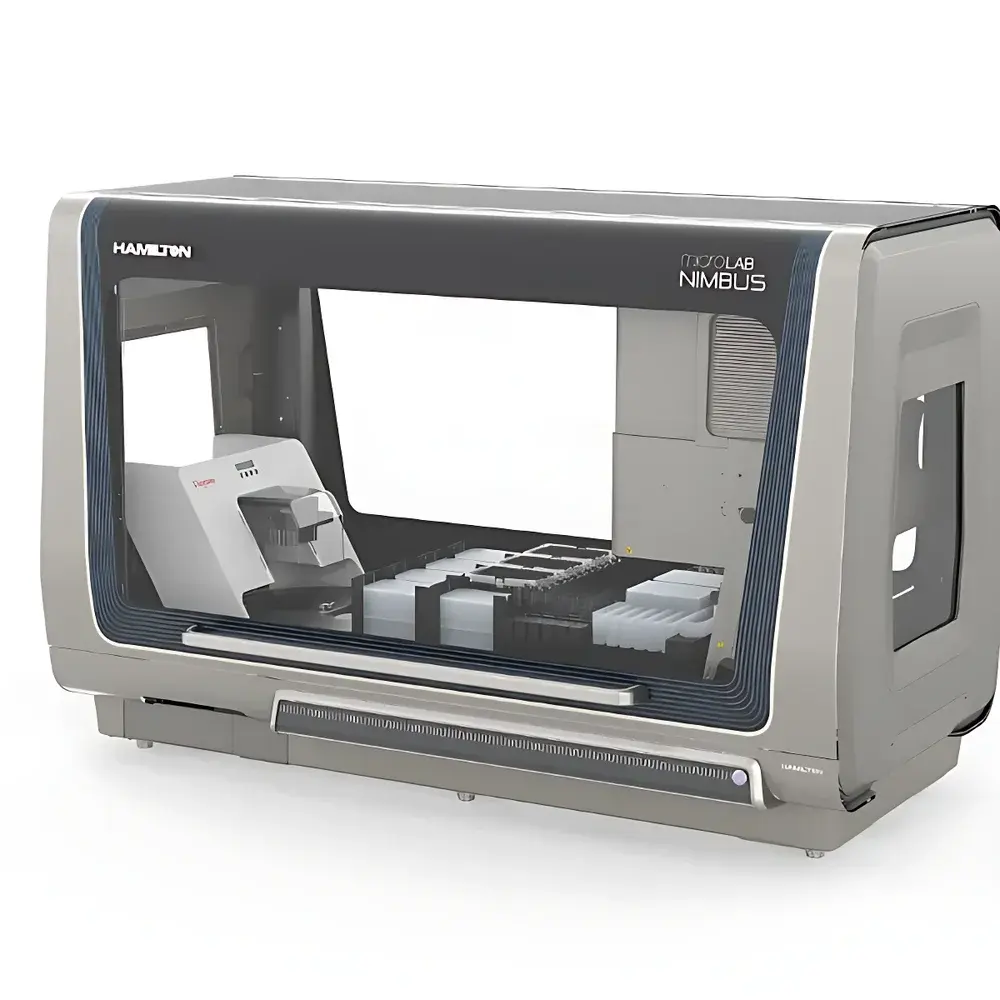
Hamilton ML Nimbus Presto Liquid Handling Workstation
| Brand | Hamilton |
|---|---|
| Origin | Switzerland |
| Manufacturer Type | Manufacturer |
| Origin Category | Imported |
| Model | Hamilton ML Nimbus Presto |
| Plate Positions | 11 |
| Pipetting Accuracy | ±5% |
| Pipetting Range | 0.5–1000 µL |
| Throughput Configuration | 4-channel |
| Instrument Dimensions (W × D × H) | 1041 × 749 × 876 mm |
Overview
The Hamilton ML Nimbus Presto is a fully integrated, benchtop liquid handling workstation engineered for high-fidelity nucleic acid and protein purification in regulated and research-intensive laboratory environments. It combines the precision fluidics architecture of the Hamilton Microlab® NIMBUS platform with the proven magnetic particle separation technology of the Thermo Scientific™ KingFisher Presto system. Unlike standalone pipetting robots or generic automation platforms, the Nimbus Presto operates on a validated magnetic bead-based separation principle—leveraging controlled magnetic field gradients to isolate DNA, RNA, circulating free DNA (cfDNA), and proteins from complex biological matrices. Its design targets reproducible binding, washing, and elution steps under programmable thermal and agitation control, ensuring consistency across extraction batches. The system is optimized for walk-away operation in molecular diagnostics, biobanking, translational research, and QC/QA labs where traceability, minimal hands-on time, and compliance-ready workflows are essential.
Key Features
- Integrated dual-platform architecture: Combines Hamilton’s CO-RE® robotic arm and multi-channel liquid handling with KingFisher’s magnetic rod-based separation module.
- Parallel processing capability: Two independent plate carousels (11-position total) enable concurrent sample preparation and magnetic separation—e.g., while one 96-well plate undergoes lysis and binding, the second is being washed and eluted.
- Modular magnetic heads: Interchangeable 24-well and 96-well magnetic heads ensure compatibility with standard SBS-format microplates without hardware reconfiguration.
- Compact footprint: At 1041 × 749 × 876 mm, the system fits within standard biosafety cabinets or laminar flow hoods, supporting space-constrained core facilities.
- 4-channel pipetting engine: Supports simultaneous aspiration/dispensing across four tips with adjustable tip spacing, enabling flexible assay setup and reagent pre-aliquoting.
- Calibrated liquid handling: Delivers volumetric accuracy of ±5% across its full range (0.5–1000 µL), verified per ISO 8655 and traceable to NIST standards.
Sample Compatibility & Compliance
The Nimbus Presto accommodates diverse clinical and research specimen types—including whole blood, serum, plasma, saliva, buccal swabs, FFPE tissue sections, and cell lysates—without requiring protocol-specific hardware modifications. All wetted components are chemically resistant to common lysis buffers (e.g., guanidine thiocyanate, SDS), ethanol, and isopropanol. The system supports end-to-end sample tracking via optional barcode scanning integration, aligning with GLP and GMP documentation requirements. While not pre-certified as an IVD device, its operational parameters comply with key method validation benchmarks outlined in CLSI EP17-A2 (limit of detection) and ISO/IEC 17025 for testing laboratories. Data integrity features—including electronic signatures, audit trails, and user access controls—facilitate alignment with FDA 21 CFR Part 11 when deployed with compliant LIMS or ELN software.
Software & Data Management
Operation is managed through Hamilton VENUS software, a modular, script-driven environment supporting both graphical workflow builders and Python-based protocol customization. Pre-validated extraction methods for DNA, RNA, cfDNA, and protein purification are available as downloadable application packages, each including full parameter documentation, calibration logs, and failure-mode recovery logic. All run logs—including timestamps, tip usage, liquid level detection events, and magnetic head status—are stored locally in encrypted SQLite databases and exportable in CSV or XML formats. Integration with third-party systems (e.g., LabVantage, Benchling, or custom REST APIs) is supported via standardized OPC UA and HL7 interfaces, enabling seamless data handoff to downstream analysis pipelines.
Applications
- High-throughput genomic library preparation for NGS workflows
- Automated cfDNA isolation from plasma for liquid biopsy assays
- RNA extraction from low-input FFPE samples with RNase-inhibitor compatible protocols
- Protein purification using magnetic affinity resins (e.g., His-tag, GST-tag)
- Sample normalization and pooling prior to qPCR or digital PCR
- Biobank-scale processing of longitudinal biospecimens with full chain-of-custody logging
FAQ
What sample volumes can the Nimbus Presto process?
It handles input volumes from 50 µL to 5000 µL per well, with elution volumes configurable between 20 µL and 200 µL depending on downstream assay requirements.
Is the system compatible with third-party magnetic bead kits?
Yes—provided the kit’s protocol adheres to standard magnetic separation timing, buffer composition, and incubation temperature profiles; Hamilton provides technical validation support for major commercial kits.
Can the Nimbus Presto be integrated into a larger automated lab ecosystem?
Absolutely—the platform includes Ethernet/IP and Modbus TCP connectivity, enabling synchronization with upstream centrifuges, downstream thermocyclers, or robotic sample storage systems via centralized orchestration software.
What maintenance is required for long-term reliability?
Routine maintenance includes monthly CO-RE® arm calibration, quarterly magnetic head cleaning with ethanol/isopropanol, and annual verification of pipetting accuracy using gravimetric assessment per ISO 8655-6.
Does Hamilton provide application-specific protocol development support?
Yes—Hamilton Application Scientists offer remote and on-site protocol optimization services, including feasibility studies, throughput benchmarking, and IQ/OQ documentation packages for regulated environments.



