
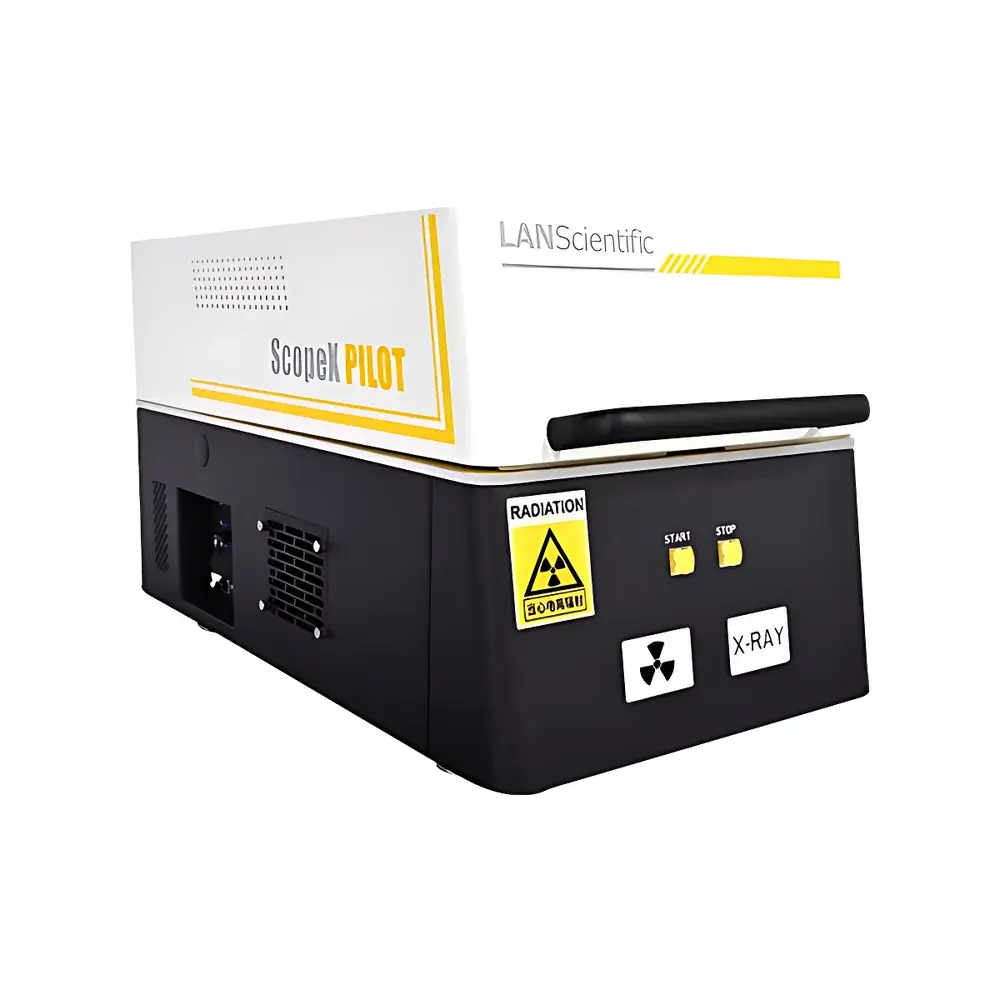
ScopeX PG5 Energy Dispersive X-Ray Fluorescence Spectrometer (ED-XRF)
| Brand | LANScientific |
|---|---|
| Origin | Jiangsu, China |
| Manufacturer | LANScientific |
| Type | Benchtop/Floor-Standing Hybrid |
| Configuration | Conventional ED-XRF System |
| Application Sector | Non-Ferrous Metals Recycling |
| Elemental Range | Al (13) to U (92) |
| Detection Limit | Sub-ppm to % level (matrix-dependent) |
| Safety Compliance | IEC 62495, GB/Z 25480, EN 61000-6-3 |
| Software | ScopeX Analyze v3.2 with Audit Trail & CFR Part 11 Ready Mode |
Overview
The ScopeX PG5 is a purpose-engineered energy dispersive X-ray fluorescence (ED-XRF) spectrometer designed specifically for high-throughput, non-destructive elemental analysis in precious metal recycling operations. Operating on the fundamental principle of X-ray fluorescence—where primary X-rays excite atoms in the sample, causing emission of characteristic secondary X-rays—the instrument delivers rapid, quantitative composition data without sample dissolution, grinding, or coating. Its optimized geometry integrates a high-stability X-ray tube (Pd anode, 50 kV/1 mA), large-area silicon drift detector (SDD, 25 mm² active area, <125 eV Mn Kα resolution), and vacuum-compatible sample chamber (300 × 300 × 150 mm W×D×H). The system is calibrated using certified reference materials traceable to NIST SRMs and ISO 18507 standards, enabling reliable quantification of Au, Ag, Pt, Pd, Cu, Ni, Zn, Fe, and critical adulterants—including W, Ir, Re, Mo, and Pb—in alloys, scrap, jewelry, and refinery feedstocks.
Key Features
- Hybrid form factor: configurable as benchtop or floor-standing unit to accommodate space-constrained assay labs or high-volume refinery QC floors.
- Integrated industrial PC with touch-enabled Windows OS and preloaded ScopeX Analyze v3.2 software—no external computer required.
- Large-volume sample chamber with motorized stage and optional XYZ micro-positioning (±0.1 mm repeatability) for precise targeting of solder joints, prongs, bezels, and gemstone settings.
- Dual-mode excitation: selectable air/vacuum operation for enhanced light-element sensitivity (Al–Cl) or heavy-element optimization (Au–U).
- Multi-layer safety architecture: hardware interlocked high-voltage cutoff, real-time beam shutter control, radiation leakage monitoring (<0.1 µSv/h at 5 cm), and full-metal EMI-shielded enclosure compliant with IEC 62495 Class II requirements.
- One-touch automated analysis workflow: auto-focus, auto-calibration, and auto-report generation reduce operator dependency and minimize training time.
Sample Compatibility & Compliance
The ScopeX PG5 accepts heterogeneous samples up to 300 g and 150 mm in height—including cast bars, granulated scrap, mounted jewelry, watch components, dental alloys, and electronic connectors. No sample preparation is required; surface cleaning (e.g., ultrasonic degreasing) suffices. The system meets ISO 18507:2022 (XRF analysis of gold alloys), ASTM E1621 (standard guide for XRF analysis of metals), and supports GLP/GMP documentation workflows. Audit trail logging, electronic signature support, and 21 CFR Part 11-compliant user access controls are available via optional software license. All firmware and calibration files are digitally signed and version-controlled.
Software & Data Management
ScopeX Analyze v3.2 provides quantitative analysis using fundamental parameters (FP) and empirical calibration models. It includes spectral deconvolution algorithms optimized for overlapping L-lines (e.g., Au Lα vs. Pb Mα) and M-lines (e.g., W Mα vs. Au Lβ). Data export supports CSV, XML, PDF, and LIMS-compatible ASTM E1382 format. Reports include full spectrum overlays, matrix correction logs, uncertainty estimates (k=2), and pass/fail flags against user-defined specification limits. Bluetooth 5.0 interface enables direct wireless printing to certified thermal label printers (e.g., Zebra ZD420) without driver installation.
Applications
- Refinery feedstock verification: rapid screening of incoming gold scrap for tungsten or iridium infiltration prior to smelting.
- Jewelry buyback assessment: non-destructive grading of karat value and alloy composition in rings, chains, and hollowware.
- Plating thickness estimation: semi-quantitative measurement of Au/Ni/Cu layer stacks on base metals using ratio-based FP modeling.
- Electronic waste sorting: identification of Pd-rich ceramic capacitors or Pt-coated thermocouple wires in mixed e-scrap streams.
- Quality assurance in minting and bullion fabrication: batch homogeneity checks and certification report generation aligned with LBMA Good Delivery requirements.
FAQ
Does the ScopeX PG5 require annual source calibration or radioactive standards?
No. The instrument uses a stable Pd-target X-ray tube and factory-calibrated SDD detector. Recalibration is performed using certified metal alloy standards (e.g., Au-Cu, Ag-Pd) and is traceable to NIST SRM 2822 and ISO 18507 reference materials.
Can it distinguish between 24K gold and gold-plated tungsten?
Yes. The combination of high-resolution SDD detection, vacuum mode, and multi-peak fitting enables clear separation of Au L-lines from W M-lines and accurate mass fraction calculation—even for layered or density-matched counterfeits.
Is remote diagnostics and software update supported?
Yes. Secure TLS-encrypted remote access is available via optional LAN/WAN configuration. Firmware updates and method library synchronization occur through authenticated cloud portal with version rollback capability.
What is the typical measurement uncertainty for 999.9 fine gold?
Under optimized vacuum conditions and ≥60 s counting time, relative standard deviation (RSD) is ≤0.03% for Au content in homogeneous, polished samples—validated per ISO 11094 and ASTM E1621 Annex A3 protocols.
Related Products






