
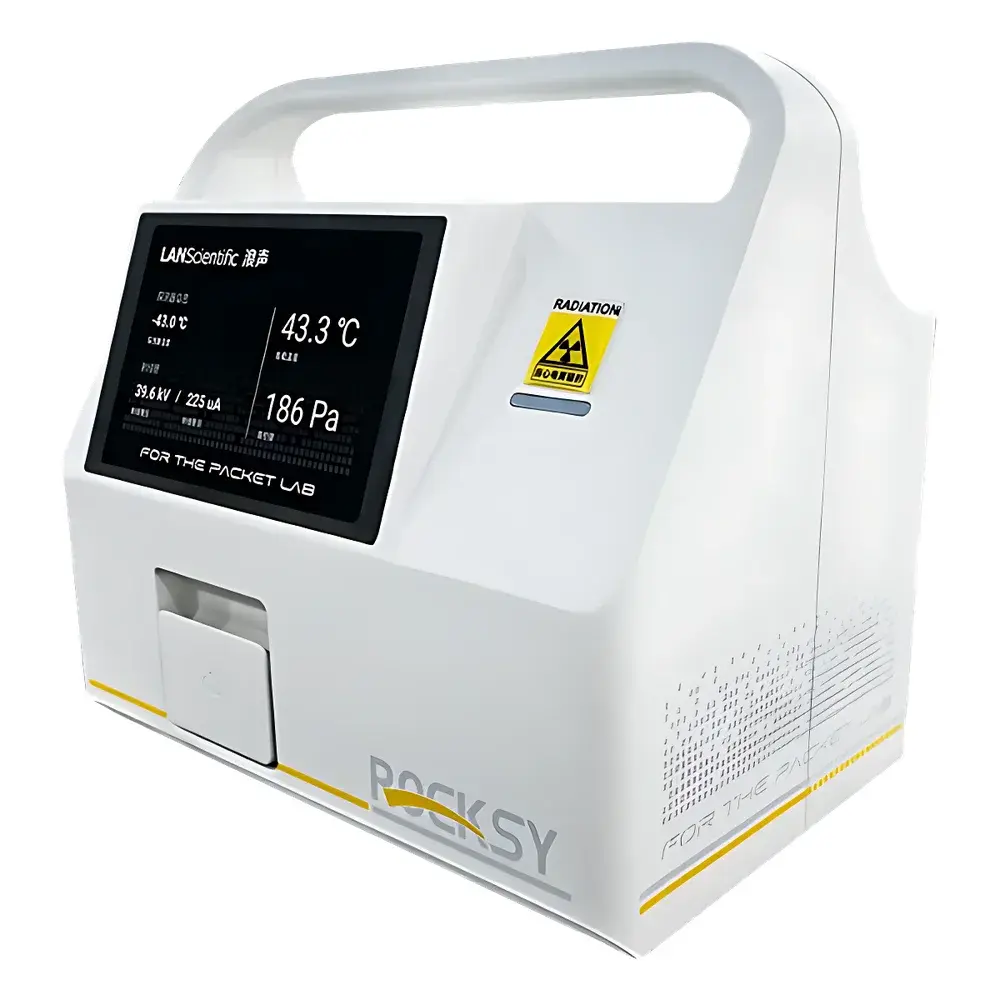
LANScientific ROCKSY Portable Vacuum-Enabled Energy Dispersive X-Ray Fluorescence Spectrometer
| Brand | LANScientific |
|---|---|
| Origin | Jiangsu, China |
| Manufacturer Type | Direct Manufacturer |
| Product Category | Domestic |
| Model | ROCKSY |
| Configuration | Benchtop/Floor-Standing |
| Instrument Type | Conventional ED-XRF |
| Industry-Specific Design | Geological & Mineralogical Analysis |
| Elemental Range | Na (11) – U (92) |
| Quantitative Range | 0.1 ppm – 99.99 wt% |
| Detection Geometry | Top-View (Vertical Illumination) |
| Detector | High-Resolution Silicon Drift Detector (SDD) |
| Vacuum Capability | Integrated Intelligent Vacuum System |
| Portability | Field-Deployable with Onboard Battery |
| Software | ROCKSY Smart Analysis Suite (Real-Time Visualization, Report Automation, GLP-Compliant Data Logging) |
Overview
The LANScientific ROCKSY is a portable, vacuum-enabled Energy Dispersive X-Ray Fluorescence (ED-XRF) spectrometer engineered for high-fidelity elemental analysis in geoscience, mining, and industrial field applications. Unlike conventional benchtop ED-XRF systems constrained by fixed laboratory environments, the ROCKSY integrates a compact, self-contained vacuum chamber with intelligent pressure regulation—enabling reliable detection of light elements (Na through F) without requiring external vacuum pumps or nitrogen purging. Its top-view excitation geometry directs the primary X-ray beam vertically onto the sample surface, minimizing particulate contamination of the SDD detector and eliminating the need for routine detector window replacement—a critical reliability enhancement for long-term deployment in dusty or remote settings. The system operates on fundamental principles of X-ray fluorescence: incident X-rays from a micro-focus Rh anode tube induce inner-shell electron ejection; subsequent characteristic X-ray emission is resolved by the high-resolution SDD (energy resolution ≤125 eV at Mn Kα), enabling precise peak deconvolution and quantitative multi-element analysis across the full periodic range from sodium (Z=11) to uranium (Z=92).
Key Features
- Top-view optical configuration with sealed sample chamber—prevents dust ingress and ensures long-term detector integrity
- Intelligent vacuum control system: achieves <10 Pa within 45 seconds and maintains stable vacuum during acquisition, optimizing sensitivity for Na, Mg, Al, Si, P, S, and Cl
- Portable architecture: net weight <18 kg, integrated rechargeable Li-ion battery (≥6 h continuous operation), ergonomic carry handle and shock-absorbing chassis
- 7-inch capacitive touchscreen interface with real-time status dashboard—displays vacuum pressure, detector temperature, tube current/voltage, and live spectral preview
- High-efficiency Rh-target X-ray tube (max 50 kV / 1 mA) with programmable voltage/current stepping for matrix-adapted excitation
- Onboard calibration libraries pre-validated per ASTM D7359 (petroleum), ISO 12677 (cement), and GB/T 17414.1–2019 (geological samples)
Sample Compatibility & Compliance
The ROCKSY accommodates solid rocks, pressed pellets, loose powders, filter membranes, and homogenized liquids (in sealed XRF cups). No destructive digestion or coating is required. Sample presentation follows ISO 20051:2022 guidelines for ED-XRF—flatness tolerance ±0.1 mm, minimum diameter 15 mm. All analytical protocols support traceability under GLP and ISO/IEC 17025:2017 requirements. The instrument’s firmware implements audit-trail logging (user actions, method parameters, calibration history) compliant with FDA 21 CFR Part 11 for electronic records and signatures. Certificate of Conformance includes factory verification against NIST SRM 2711a (Montana Soil) and SRM 610 (Glass Standard).
Software & Data Management
ROCKSY Smart Analysis Suite is a Windows-based application supporting offline method development, real-time spectral fitting (Fundamental Parameters + Empirical Coefficients), and automated quantification using internal standard or standardless algorithms. Data export options include CSV, Excel (.xlsx), PDF (with embedded spectra, calibration curves, and user-defined headers/logos), and XML for LIMS integration. Local database stores ≥100,000 spectra with time/date stamping, operator ID, GPS coordinates (optional Bluetooth GNSS module), and environmental metadata (ambient T/P/humidity). Software updates are delivered via encrypted OTA protocol with SHA-256 signature verification.
Applications
- Geological exploration: rapid in-situ screening of ore grade (Cu, Zn, Pb, Au pathfinders), lithological discrimination, and alteration mapping
- Mining QA/QC: on-belt analysis of run-of-mine material, stockpile characterization, and concentrate validation
- Cement & building materials: clinker phase estimation (C3S/C2S ratio via Ca/Si/K), alkali content monitoring (Na₂O/K₂O), and heavy metal compliance (Cr, Cd, Pb)
- Petrochemical catalysts: Pt/Pd/Rh loading quantification, sulfur poisoning assessment, and Al/Si ratio tracking in FCC zeolites
- Environmental soil screening: EPA Method 6200-compliant detection of As, Se, Hg, and U at sub-ppm levels under field vacuum conditions
- Recycled metal sorting: alloy identification (e.g., 304 vs. 316 stainless), tramp element detection (Sn, Bi, Sb), and coating thickness estimation (Zn, Cr)
FAQ
Does the ROCKSY require liquid nitrogen or external vacuum pumps?
No. It features a built-in oil-free diaphragm vacuum pump and intelligent pressure feedback loop—no consumables or auxiliary equipment needed.
Can it quantify light elements below magnesium (e.g., C, N, O)?
No. The SDD detector and Be window limit reliable detection to Na (Z=11) and above. For lighter elements, WDXRF or LIBS coupling is recommended.
Is spectral data compatible with third-party chemometric software (e.g., Unscrambler, MATLAB)?
Yes. Raw spectrum files (.rxf) contain channel-energy calibration, live time, and dead time metadata—exportable as ASCII or .csv with energy-channel mapping.
What is the typical detection limit for iron in silicate rock under vacuum mode?
Approximately 12 ppm (3σ) for Fe Kα at 100 s live time, based on repeated measurements of NIST SRM 278 (Basalt Rock).
How is calibration maintained across temperature fluctuations in field use?
The system performs automatic energy calibration every 2 hours using internal Mn Kα reference peak (from tube-generated fluorescence), with thermal drift compensation applied to all subsequent quantifications.




