
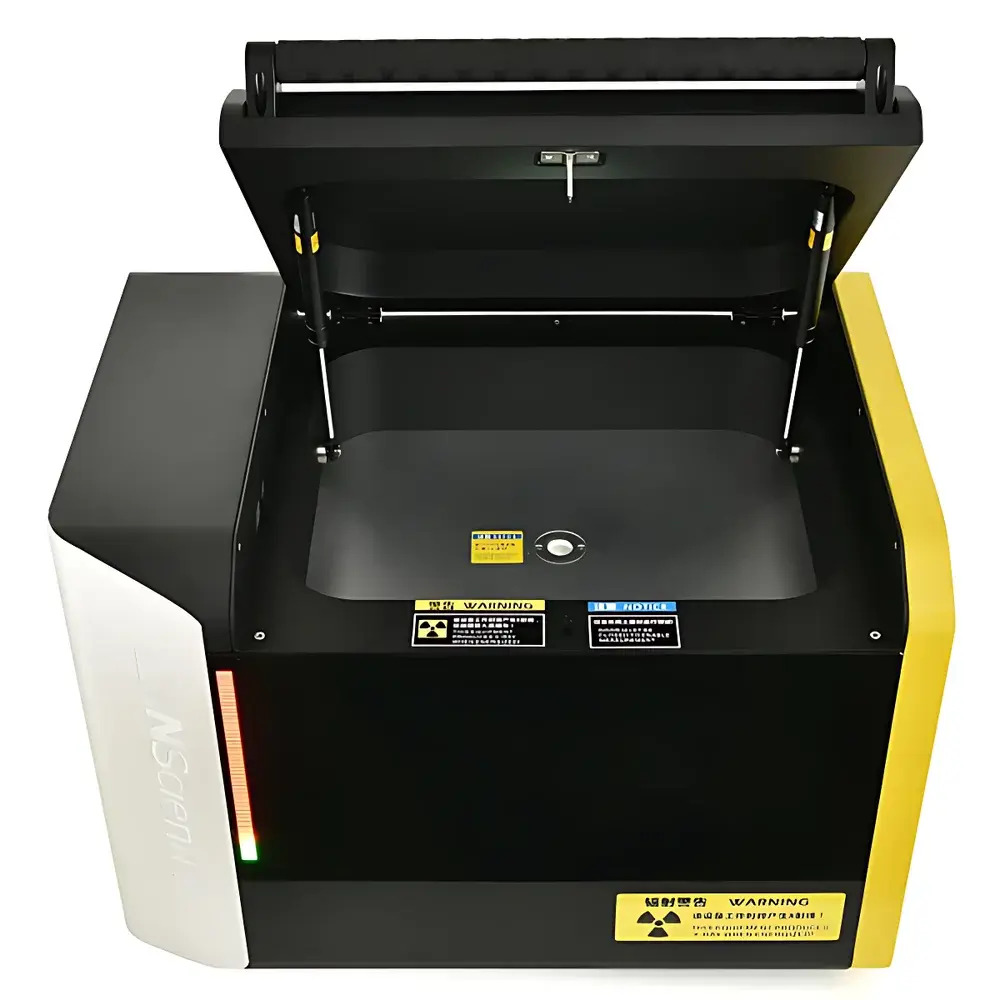
Brookfield ScopeX 980 Energy Dispersive X-Ray Fluorescence Spectrometer (Air-Path Configuration)
| Brand | LANScientific |
|---|---|
| Origin | Jiangsu, China |
| Manufacturer Type | Original Equipment Manufacturer (OEM) |
| Product Category | Domestic |
| Model | ScopeX 980 |
| Form Factor | Benchtop/Floor-Standing |
| Instrument Type | Conventional ED-XRF |
| Application Scope | General-Purpose |
| Detector | High-Resolution Silicon Drift Detector (SDD), Peltier-cooled, <125 eV Mn-Kα resolution |
| Excitation Source | Rhodium-target micro-focus X-ray tube, adjustable voltage (up to 50 kV) and current (up to 1 mA) |
| Safety Compliance | GB18871-2002, GBZ115-2002 |
| Software | LANScientific XRF Analysis Suite v4.2 with FP + Calibration Curve quantification engines |
Overview
The Brookfield ScopeX 980 Energy Dispersive X-Ray Fluorescence Spectrometer is an air-path (non-vacuum) benchtop/floor-standing ED-XRF system engineered for precision elemental analysis of solid, powder, and liquid samples across industrial QA/QC, regulatory compliance, and R&D environments. Operating on the fundamental principle of X-ray fluorescence—where primary X-rays from a Rh-anode microfocus tube excite inner-shell electrons in sample atoms, generating characteristic secondary (fluorescent) X-rays—the instrument delivers rapid, non-destructive, multi-elemental quantification from sodium (Na, Z=11) to uranium (U, Z=92). Unlike vacuum or helium-purged systems, the ScopeX 980’s air-path configuration eliminates gas handling infrastructure while maintaining robust sensitivity for elements above magnesium (Mg), making it especially suited for high-throughput screening in mining, metallurgy, petrochemicals, RoHS/ELV compliance, and environmental monitoring laboratories.
Key Features
- Non-Destructive Analysis: Preserves sample integrity without chemical digestion, surface ablation, or vacuum exposure—ideal for archival materials, coated substrates, and finished products requiring post-test usability.
- High-Throughput Workflow: Automated sample positioning, integrated camera-based alignment, and batch queueing support unattended operation for >50 samples per shift under routine conditions.
- Multi-Algorithm Quantification Engine: Combines empirical calibration curve fitting with physics-based Fundamental Parameters (FP) modeling, enabling accurate quantification across heterogeneous matrices—including alloys, ores, polymers, and catalysts—without matrix-matched standards for every application.
- Intuitive Graphical User Interface: Touch-optimized interface with context-sensitive wizards, drag-and-drop method creation, and real-time spectral preview reduces operator training time to under 2 hours for routine tasks.
- Radiation-Safe Architecture: Fully shielded steel enclosure with interlocked door sensors, redundant hardware cutoff circuits, and automatic beam shuttering compliant with Chinese national radiation safety standards GB18871-2002 and GBZ115-2002.
- Modular Software Permissions: Role-based access control (administrator, analyst, reviewer) enforces GLP/GMP-aligned audit trails; all user actions—including method edits, result overrides, and report exports—are timestamped and logged.
Sample Compatibility & Compliance
The ScopeX 980 accepts flat, irregular, or curved solids up to 300 mm × 300 mm × 100 mm (L×W×H), powders in standard 32-mm cups, and liquids in sealed XRF vials. No vacuum pumping or cryogenic cooling is required, significantly lowering operational overhead versus wavelength-dispersive (WD-XRF) or vacuum-dependent ED-XRF platforms. Method validation supports ISO 12885, ASTM E1621, and IEC 62321-5 for RoHS screening. Data integrity protocols align with FDA 21 CFR Part 11 requirements for electronic records and signatures, including full audit trail export, digital signature capability, and secure password policy enforcement.
Software & Data Management
LANSpectra Suite v4.2 provides end-to-end analytical workflow management—from method setup and spectral acquisition to reporting and database archiving. The software includes built-in spectral deconvolution algorithms, peak overlap correction using iterative least-squares fitting, and automated background subtraction. Users can define custom pass/fail criteria per element (e.g., “Pb ≤ 1000 ppm”, “Br ≥ 500 ppm”) with conditional logic triggering alerts or auto-rejection flags. Reports are exportable in PDF (with embedded spectra and metadata), Excel (including raw counts, net intensities, and uncertainty estimates), and CSV formats. All exported files retain traceable links to original acquisition parameters, calibration history, and operator credentials—ensuring full data lineage for internal audits or third-party certification.
Applications
- Mineral & Mining: Grade control of Fe, Cu, Zn, Pb, Ni, and rare earth elements in drill core, pulverized ore, and concentrate samples.
- Metals & Alloys: Positive material identification (PMI), coating thickness verification (e.g., Zn on steel), and inclusion analysis in stainless steels, aluminum alloys, and superalloys.
- Petrochemicals: Sulfur content determination in fuels (ASTM D4294), additive metals (Ca, Zn, P) in lubricants, and catalyst poisoning assessment (V, Ni).
- RoHS/ELV Compliance: Screening for restricted substances (Pb, Cd, Hg, Cr⁶⁺, Br, Cl) in electronics, automotive components, and plastic housings per EU Directive 2011/65/EU and 2000/53/EC.
- Environmental Monitoring: Heavy metal profiling (As, Cd, Cr, Pb, Hg) in soils, sediments, and fly ash per EPA Method 6200 and China’s HJ 803-2016.
FAQ
Does the ScopeX 980 require vacuum or helium purging for light element analysis?
No. The instrument operates in ambient air and is optimized for elements from Na upward. Light elements below Mg (e.g., C, N, O, F) are not reliably quantifiable in air-path mode due to atmospheric absorption.
Can the system be validated for ISO/IEC 17025 accredited testing?
Yes. Full documentation packages—including IQ/OQ/PQ protocols, uncertainty budgets per ISO/IEC 17025 Annex A.4, and metrological traceability statements—are available upon request for laboratory accreditation submissions.
Is remote diagnostics and software update support provided?
Yes. Secure TLS-encrypted remote access (opt-in only) enables firmware updates, spectral library patches, and technical troubleshooting via Brookfield’s certified service engineers.
What detector cooling technology is used?
A two-stage Peltier thermoelectric cooler maintains the silicon drift detector (SDD) at –20 °C, ensuring stable energy resolution (<125 eV at Mn-Kα) and low noise performance over extended acquisition periods.
How is data security enforced during multi-user operation?
All user accounts are authenticated via encrypted password storage. Session logs record login/logout timestamps, method modifications, result approvals, and report generation events—exportable as tamper-evident XML or PDF-A archives.






