
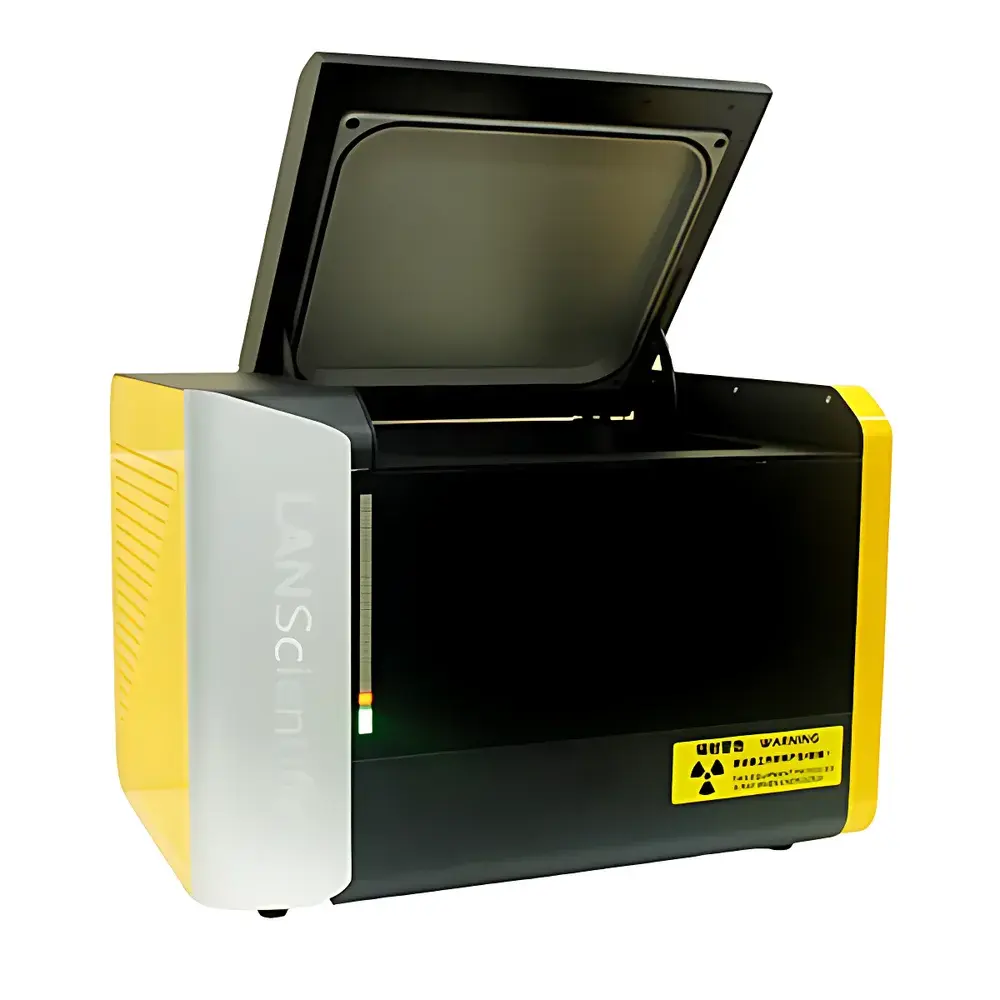
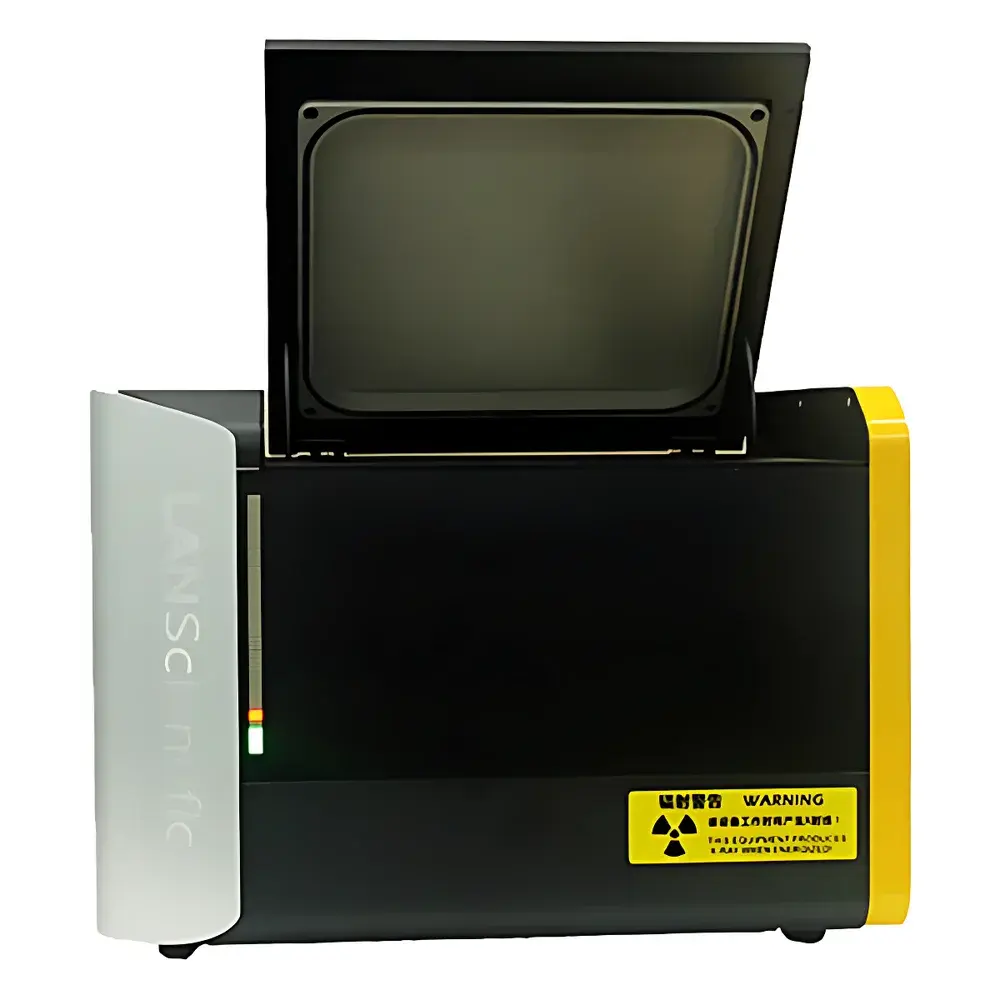
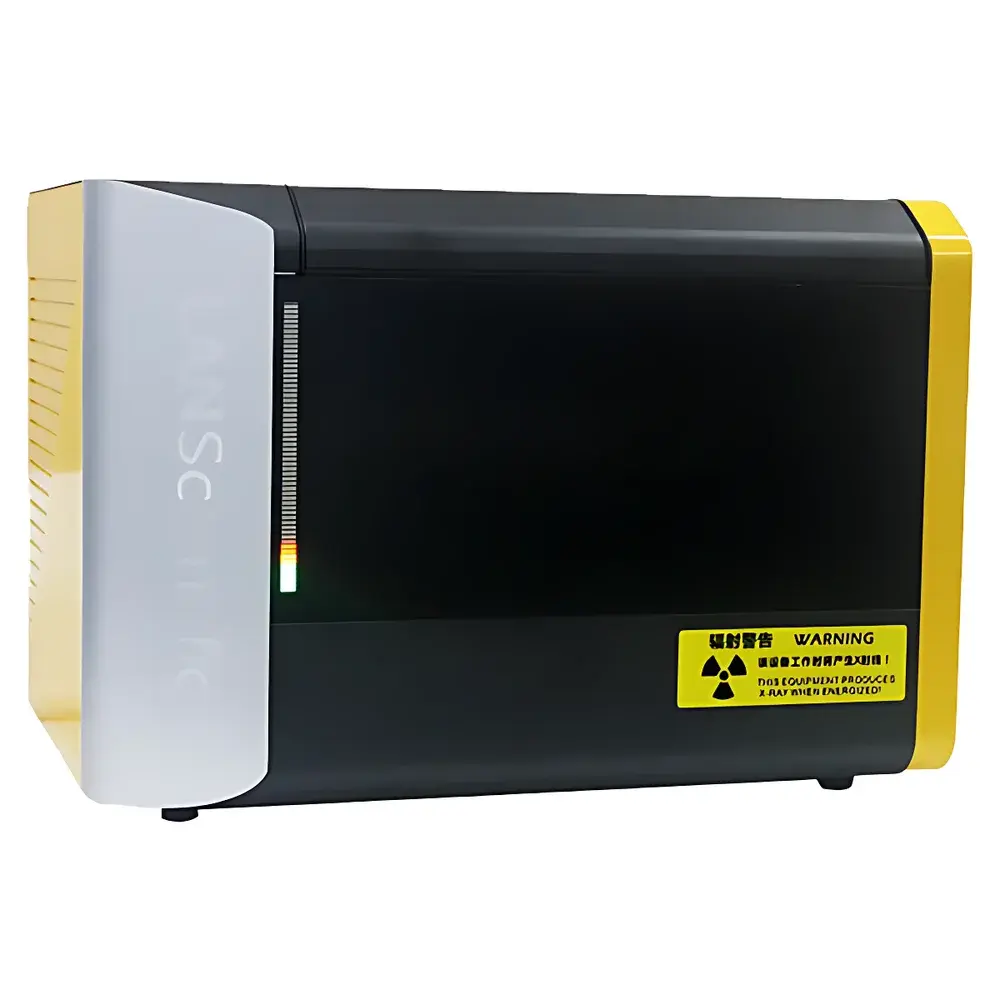
LANScientific ScopeX Desktop Energy Dispersive X-Ray Fluorescence Spectrometer
| Brand | LANScientific |
|---|---|
| Origin | Jiangsu, China |
| Manufacturer Type | Manufacturer |
| Origin Category | Domestic |
| Model | ScopeX |
| Form Factor | Benchtop |
| Instrument Type | Conventional ED-XRF |
| Application Scope | General-purpose |
| Elemental Range | Na (11) to U (92) |
| Detection Limit | 1 ppm |
| Energy Resolution | <125 eV (Mn Kα) |
| Repeatability | ≤0.1% RSD |
| Detector | Peltier-cooled Silicon Drift Detector (SDD) |
Overview
The LANScientific ScopeX is a benchtop energy dispersive X-ray fluorescence (ED-XRF) spectrometer engineered for precise, non-destructive elemental analysis of solid, powdered, liquid, thin-film, and irregularly shaped samples. Operating on the fundamental principle of X-ray fluorescence spectroscopy, the instrument irradiates the sample with high-energy primary X-rays, ejecting inner-shell electrons from constituent atoms. As outer-shell electrons transition to fill these vacancies, characteristic secondary X-ray photons—unique in energy to each element—are emitted. These spectral signatures are collected by a high-resolution silicon drift detector (SDD), enabling quantitative and qualitative identification of elements from sodium (Na, Z=11) to uranium (U, Z=92). The ScopeX integrates optimized X-ray excitation geometry, intelligent vacuum control, and low-power microfocus X-ray tube technology to ensure reliable detection of light elements—including Na, Mg, Al, Si, P, and S—without cryogenic cooling. Its compact footprint and large sample chamber support high-throughput routine analysis in quality assurance, raw material verification, and process monitoring environments.
Key Features
- Non-destructive analysis: No sample digestion, coating, or preparation required; preserves sample integrity and enables reanalysis.
- Peltier-cooled SDD detector: Eliminates dependence on liquid nitrogen while maintaining <125 eV energy resolution at Mn Kα, ensuring high peak-to-background ratio and accurate deconvolution of overlapping spectral lines.
- Intelligent vacuum system: Automatically engages during light-element measurement (Na–Cl), optimizing transmission efficiency and signal-to-noise performance without manual intervention.
- Motorized multi-aperture collimation: Four selectable collimators (5 mm, 3 mm, 1 mm, and 0.5 mm) and programmable filter set enable spatial resolution tuning and matrix-specific background suppression.
- Robust radiation safety architecture: Fully shielded metal enclosure with interlocked door switch and hardware-based beam cutoff; compliant with GB18871-2002 (Basic Standards for Protection Against Ionizing Radiation) and GBZ115-2002 (Radiation Protection Standards for X-ray Fluorescence Analyzers).
- Flexible connectivity: Native support for USB 3.0, Wi-Fi 5 (802.11ac), and Bluetooth 5.0 for instrument control, remote diagnostics, and real-time data synchronization.
Sample Compatibility & Compliance
The ScopeX accommodates diverse physical forms—bulk solids, pressed pellets, loose powders, liquids in specialized cups, thin films on substrates, and irregular geometries up to 300 × 300 × 150 mm (W × D × H). Its open-sample design allows rapid loading/unloading without disassembly. Method development aligns with ASTM E1621 (Standard Guide for XRF Analysis of Waste Materials), ISO 21043 (XRF — General Requirements), and IEC 62321-5 (RoHS screening). Data acquisition workflows support audit-ready documentation per GLP and GMP requirements, including electronic signatures, user access logs, and full audit trail generation for regulatory submissions.
Software & Data Management
Controlled via LANScientific’s proprietary QuantStudio™ software, the ScopeX provides intuitive method creation, spectral visualization, peak deconvolution, and empirical or fundamental parameter (FP)-based quantification. Users may define custom report templates in Excel (.xlsx) or PDF format, embedding company logos, spectral overlays, calibration curves, and metadata (operator ID, timestamp, instrument ID, sample ID). All raw spectra and processed results are stored in an encrypted SQLite database with version-controlled backups. Software supports 21 CFR Part 11-compliant user authentication, role-based permissions, and immutable electronic records for pharmaceutical, environmental, and contract testing laboratories.
Applications
The ScopeX delivers validated performance across multiple industrial sectors: cement and clinker analysis (SiO₂, Al₂O₃, Fe₂O₃, CaO); geological exploration and ore grade assessment (Cu, Zn, Pb, Ni, Co); precious metal assay in jewelry and recycling streams (Au, Ag, Pt, Pd); plating thickness and composition verification (Cr, Ni, Sn, Zn on steel or PCBs); polymer additive screening (Br, Cl, Cd, Pb for RoHS compliance); and catalyst characterization (V, Mo, Co, W in petrochemical feedstocks). Its repeatability of ≤0.1% RSD ensures statistical confidence in batch release testing and long-term trend monitoring.
FAQ
What elements can the ScopeX detect and quantify?
The instrument detects and quantifies elements from sodium (Na, Z=11) through uranium (U, Z=92), with detection limits as low as 1 ppm for most mid-Z elements under optimized conditions.
Is liquid nitrogen required for detector operation?
No. The Peltier-cooled SDD operates continuously at –20 °C without cryogens, reducing operational overhead and extending detector lifetime.
Can the ScopeX analyze light elements such as magnesium and aluminum?
Yes. Integrated vacuum mode and low-energy X-ray excitation enable robust quantification of Na, Mg, Al, Si, P, and S in air-sensitive matrices.
How does the system ensure measurement traceability and regulatory compliance?
All calibrations are traceable to NIST SRM reference materials. Software enforces 21 CFR Part 11 controls, and hardware meets national radiation safety standards GB18871-2002 and GBZ115-2002.
Is method transfer possible between different ScopeX units?
Yes. QuantStudio™ supports export/import of complete method files—including excitation parameters, collimator/filter settings, calibration curves, and FP coefficients—ensuring cross-instrument reproducibility.
Related Products




