
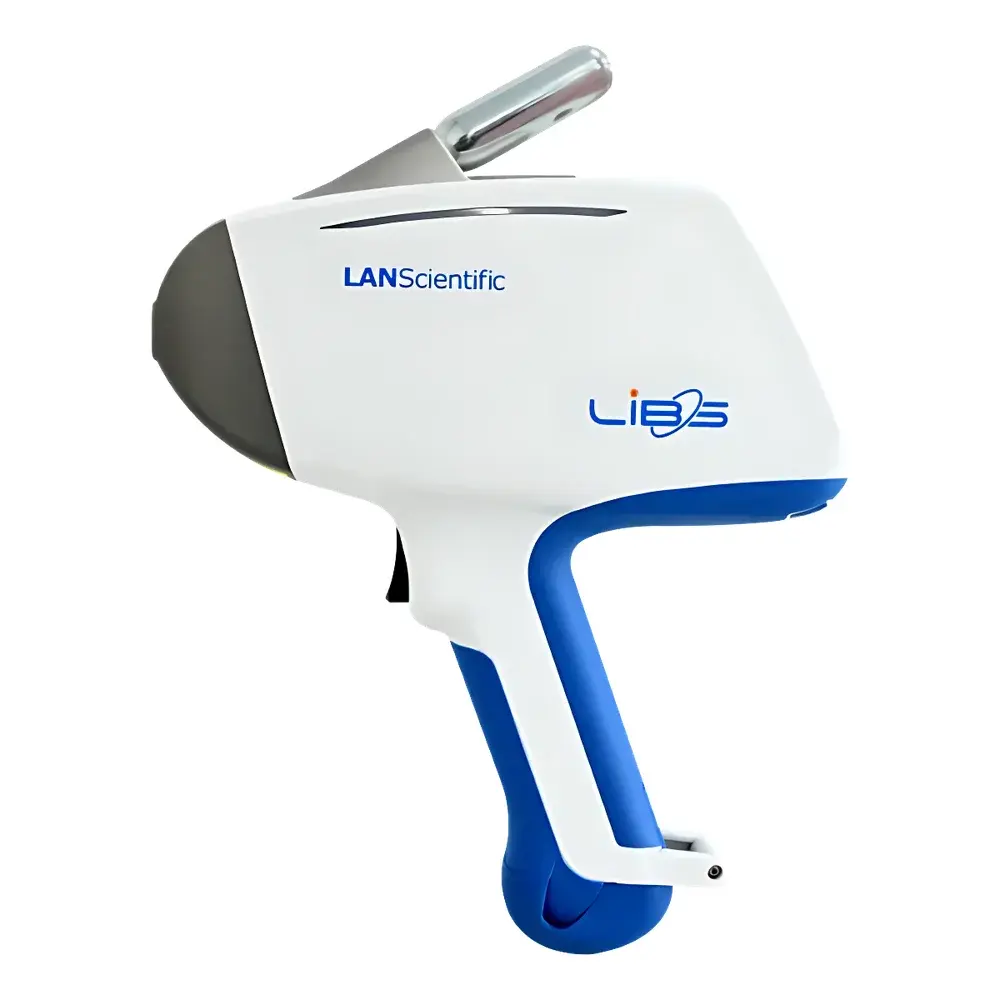
Handheld LIBS Carbon Analyzer LANScientific LIBS 830C
| Brand | LANScientific |
|---|---|
| Origin | Jiangsu, China |
| Manufacturer Type | Manufacturer |
| Country of Origin | Domestic (China) |
| Model | LIBS 830C |
| Instrument Type | Handheld |
| Technology | Laser-Induced Breakdown Spectroscopy (LIBS) |
Overview
The LANScientific LIBS 830C Handheld LIBS Carbon Analyzer is an industrial-grade, field-deployable elemental analyzer engineered for rapid, in-situ carbon quantification and multi-element compositional analysis of metallic alloys. It operates on the fundamental principle of Laser-Induced Breakdown Spectroscopy (LIBS): a high-energy, nanosecond-pulsed laser (Class 3B) is focused onto the sample surface, generating a transient micro-plasma (~10,000 K). As the plasma cools, atoms and ions emit element-specific atomic and ionic emission lines across the UV–VIS–NIR spectrum (200–900 nm). These emissions are collected via high-throughput fiber-optic coupling and resolved by a ruggedized, thermally stabilized echelle spectrometer with CMOS detector. Unlike X-ray fluorescence (XRF), LIBS enables direct detection of light elements—including carbon (C), boron (B), beryllium (Be), and lithium (Li)—without vacuum or helium purge requirements. The system delivers quantitative carbon measurement down to low ppm levels in ferrous and non-ferrous matrices, supporting real-time grade identification and compositional verification in dynamic production or scrap sorting environments.
Key Features
- Ultra-portable design: Total mass of 1.7 kg; ergonomic grip and balanced center-of-gravity for extended one-handed operation
- Integrated argon purge module: Reduces atmospheric N2 and O2 interference, enhancing signal-to-noise ratio (SNR) of C I 247.86 nm and C II 232.56 nm lines
- Micro-ablation capability: Typical crater diameter < 100 µm; minimal surface damage—often invisible to unaided eye—preserving sample integrity for QA/QC retesting
- High-speed analysis cycle: Full spectral acquisition, background correction, peak fitting, and alloy grade matching completed within ≤3 seconds per measurement
- Laser safety architecture: Dual-redundant interlock system (hardware shutter + proximity sensor) compliant with IEC 60825-1:2014; Class 3B laser operation with automatic beam termination upon disengagement
- Low-power electronics: Optimized for >8 hours continuous operation on hot-swappable Li-ion battery packs; supports USB-C charging and external power input (12–24 V DC)
Sample Compatibility & Compliance
The LIBS 830C is validated for direct analysis of solid conductive and semi-conductive materials without polishing, coating removal, or pelletization. Primary applications include stainless steels (304, 316, duplex), Cr-Mo steels (P11, P22), low-alloy steels (A106, A333), cast irons (gray, ductile), aluminum alloys (6061, 7075), and titanium grades (Ti-6Al-4V). It meets ISO 11582:2021 (LIBS performance criteria for metals), ASTM E2926-22 (Standard Test Method for Determination of Carbon in Steel by LIBS), and supports GLP/GMP audit trails via time-stamped, user-logged spectra and calibration records. Optional firmware modules enable compliance with FDA 21 CFR Part 11 for electronic signatures and data integrity in regulated manufacturing settings.
Software & Data Management
The embedded Android-based operating system runs LANScientific’s proprietary SpectraLink™ software, featuring intuitive touch interface, real-time spectral visualization, and adaptive chemometric modeling (PLS-R, PCA). Calibration models are stored locally and support user-defined matrix-matched standards (e.g., CRM 126a, NIST SRM 2165). All spectra, metadata (laser energy, delay time, gate width), and quantitative reports (ppm/%, uncertainty estimates, confidence scores) are exported as ASCII-compatible .csv or vendor-neutral .jdx files. Cloud synchronization (optional) enables centralized fleet management, remote model updates, and cross-site method sharing—fully traceable under ISO/IEC 17025 documentation requirements.
Applications
- Metal fabrication QA: Rapid verification of carbon content prior to heat treatment or welding procedure qualification
- Scrap metal sorting: On-site discrimination of low-carbon vs. high-carbon steel grades at recycling yards
- Aerospace MRO: In-field validation of turbine blade material composition during maintenance inspections
- Power generation: Monitoring carbon segregation in boiler tubes and pressure vessel welds
- Automotive supply chain: Incoming inspection of forged crankshafts and suspension components
- Research & development: Mapping elemental distribution in additive-manufactured alloy samples using raster scan mode (via optional tripod mount)
FAQ
What is the typical detection limit for carbon in low-alloy steel?
For C in ASTM A106 Grade B pipe steel, the 3σ detection limit is 12 ppm under argon purge, with RSD < 3.5% (n=10) at 0.15 wt% C.
Can the instrument analyze painted or oxidized surfaces?
Yes—LIBS ablates through thin oxide layers (< 5 µm) and organic coatings; however, thick rust or heavy paint requires pre-cleaning for optimal precision.
Is spectral library customization supported?
Yes: Users may build and validate custom grade libraries using certified reference materials and export them as encrypted .lib files for secure deployment across multiple units.
How often does the optical system require recalibration?
Factory calibration remains stable for ≥12 months under normal use; optional annual verification kits include NIST-traceable spectral line sources and certified alloy check standards.
Does the device meet IP rating requirements for outdoor industrial use?
It carries IP54 certification—dust-protected and resistant to water splashing from any direction—validated per IEC 60529.






