
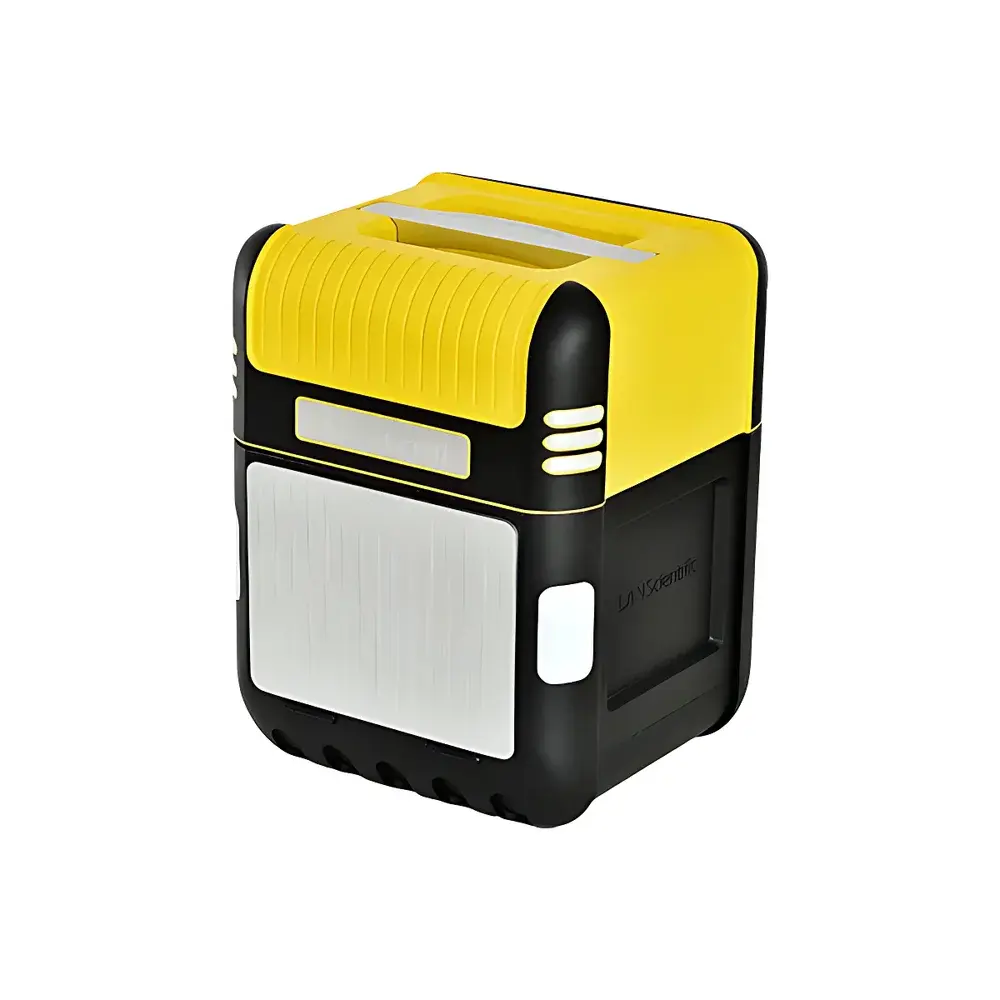
PeDX Portable Energy Dispersive X-Ray Fluorescence Spectrometer
| Brand | LANScientific |
|---|---|
| Origin | Jiangsu, China |
| Manufacturer Type | Direct Manufacturer |
| Model | PeDX 980 / PeDX 980S / PeDX 980CS |
| Application | Handheld / Portable |
| Instrument Type | Conventional ED-XRF |
| Industry Use | General-Purpose |
| Elemental Range | Mg to U |
| Detection Range | 1 ppm – 99.99% |
| Energy Resolution | < 136 eV (at Mn Kα) |
| Repeatability | ≤ 0.1% RSD (for repeated measurements under controlled conditions) |
Overview
The PeDX Portable Energy Dispersive X-Ray Fluorescence Spectrometer is an industrial-grade handheld ED-XRF analyzer engineered for rapid, non-destructive elemental quantification in liquid, solid, and semi-solid matrices—particularly optimized for sulfur analysis in petroleum-based fuels and lubricants. Operating on the principle of energy-dispersive X-ray fluorescence, the instrument excites sample atoms using a miniaturized X-ray tube source; characteristic secondary X-rays emitted by elements are resolved by a high-resolution silicon drift detector (SDD), enabling simultaneous multi-element detection from magnesium (Mg) through uranium (U). Designed to meet evolving regulatory requirements—including IMO 2020 global sulfur cap (0.50% m/m), SECAs (0.10% m/m), and ASTM D7039, D7220, and ISO 8754 compliance—the PeDX delivers field-deployable performance without sacrificing laboratory-grade reproducibility.
Key Features
- Integrated high-stability miniature X-ray tube with adjustable voltage (up to 50 kV) and current (up to 200 µA), optimized for light-element excitation (Mg–P) and heavy-element sensitivity (Fe–U).
- Silicon drift detector (SDD) with <136 eV energy resolution at Mn Kα (5.9 keV), enabling precise peak separation and low-background spectral acquisition.
- Real-time spectrum processing powered by LANScientific’s proprietary Super-FP fundamental parameters algorithm, supporting matrix correction, inter-element effects compensation, and empirical calibration hybrid modeling.
- One-touch operational workflow: power-on → auto-initialization → collimated beam targeting → 10–60 s measurement → instant quantitative report generation.
- Ruggedized IP54-rated enclosure with shock-absorbing polymer housing, ergonomic grip, and integrated Li-ion battery providing ≥8 hours continuous operation.
- Onboard touchscreen interface with multilingual OS support (English, Spanish, French, Chinese), intuitive icon-driven navigation, and context-sensitive help.
Sample Compatibility & Compliance
The PeDX supports direct analysis of unprepared or minimally prepared samples—including neat fuels (gasoline, diesel, jet A-1, marine residual fuel), lubricating oils, hydraulic fluids, crude oil emulsions, and solid particulates (e.g., catalyst fines, wear debris on filters). No vacuum or helium purge is required for sulfur analysis in hydrocarbon matrices due to optimized beam filtration and atmospheric pressure operation. The system complies with IEC 61000-6-3 (EMC), IEC 61000-6-4 (industrial emission), and meets radiation safety standards per IEC 62495 and national Class II device regulations. Method validation documentation aligns with ASTM D7039 (standard test method for sulfur in gasoline and diesel by monochromatic WDXRF) and supports GLP-compliant data integrity when paired with optional audit-trail-enabled firmware.
Software & Data Management
The embedded PeDX Control Suite enables full spectral acquisition, live background subtraction, peak deconvolution, and real-time quantification. All raw spectra and processed results are timestamped and stored with operator ID, GPS coordinates (optional), sample ID, and environmental metadata (temperature, humidity). Data export supports PDF (with embedded spectrum image, calibration history, and uncertainty estimates) and Excel (.xlsx) formats—including editable columns for LOQ verification, spike recovery tracking, and QC flagging. Custom report templates allow insertion of corporate branding, regulatory statement footers, and multi-layered QA/QC annotations. Remote firmware updates and method library synchronization are supported via secure HTTPS-based LANScientific CloudLink™ platform, ensuring traceable version control and ISO/IEC 17025-aligned instrument lifecycle management.
Applications
- Marine fuel bunkering verification: rapid onboard screening of sulfur content in heavy fuel oil (HFO), very low sulfur fuel oil (VLSFO), and marine distillates against IMO MARPOL Annex VI limits.
- Refinery process control: real-time monitoring of sulfur removal efficiency across hydrotreaters, feedstock blending tanks, and product storage terminals.
- Wear metal analysis in turbine and engine oils: quantification of Fe, Cu, Al, Cr, Pb, and Si to assess mechanical degradation and filter performance.
- Contaminant screening in biofuels: detection of Cl, Ca, Na, K, and Zn in biodiesel (B100) and ethanol-gasoline blends to evaluate corrosion risk and catalyst poisoning potential.
- Field-based crude assay support: estimation of S, Ni, V, and Ca concentrations during upstream sampling campaigns where lab turnaround time is prohibitive.
FAQ
Is the PeDX suitable for regulatory reporting under IMO 2020 or EPA Tier 3 compliance programs?
Yes—when operated per validated SOPs and calibrated against CRM-certified fuel standards (e.g., NIST SRM 2724c), PeDX data meets the precision and accuracy criteria specified in IMO MEPC.1/Circ.817 and ASTM D7039 for enforcement-level screening.
Can the instrument analyze sulfur in high-salinity or water-contaminated fuel samples?
It can quantify total sulfur in emulsified or water-cut fuels; however, phase separation or excessive water content (>5% v/v) may attenuate signal intensity and require dilution or centrifugation pre-treatment for optimal precision.
Does the PeDX support method transfer from benchtop WDXRF or ICP-OES laboratories?
Yes—LANScientific provides cross-platform correlation protocols and matrix-matched calibration kits to facilitate alignment with existing lab methods, including slope-intercept adjustment and bias correction workflows.
What maintenance is required to sustain long-term calibration stability?
Annual verification using factory-certified check sources (Mn, Fe, Cu, Zn) and quarterly drift correction with internal reference standards are recommended. Detector vacuum integrity and X-ray tube output stability are monitored automatically and logged in the diagnostic dashboard.





