
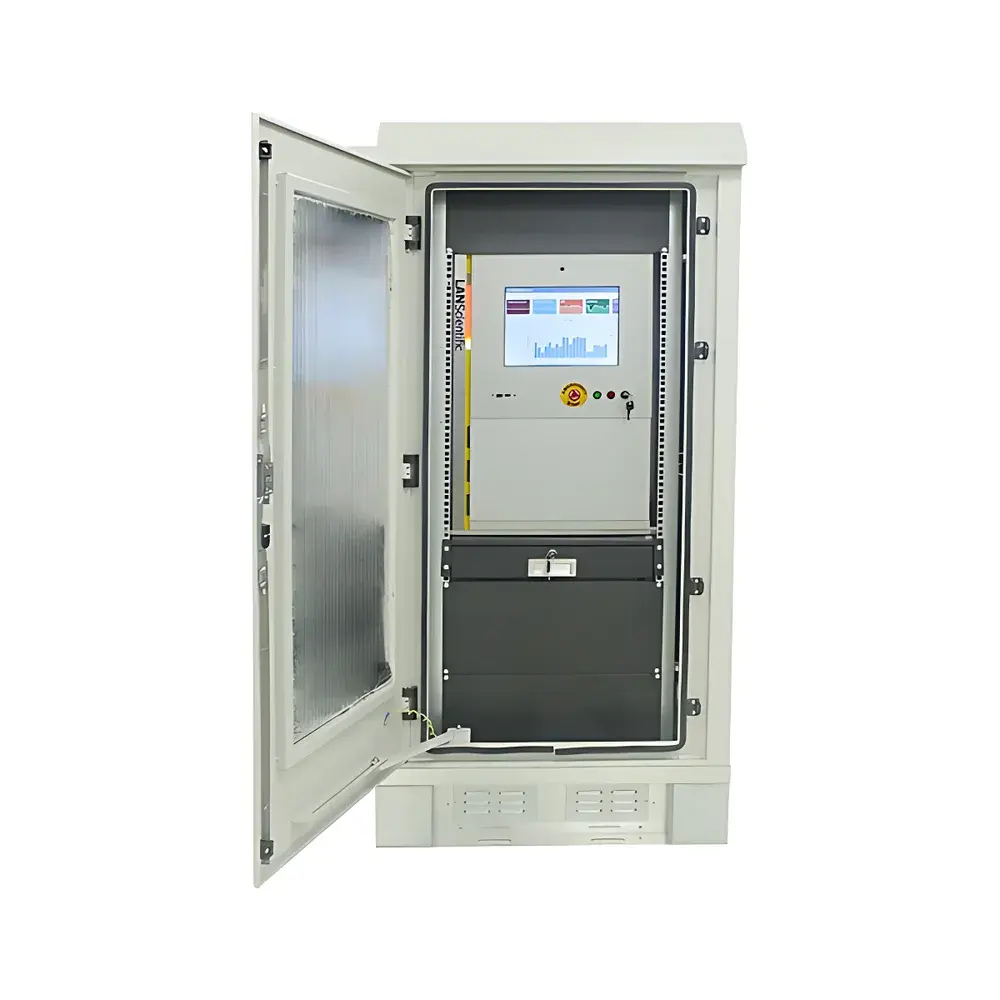
LANScientific AOA 200CEMS Continuous Emission Monitoring System for Heavy Metals in Flue Gas
| Brand | LANScientific |
|---|---|
| Origin | Jiangsu, China |
| Manufacturer Type | OEM Manufacturer |
| Product Category | Domestic |
| Model | AOA 200CEMS |
| Instrument Type | Continuous Emission Monitoring System (CEMS) |
| Measurement Principle | Heated Extractive Sampling + Isokinetic Particulate Sampling + Energy-Dispersive X-Ray Fluorescence (ED-XRF) |
| Target Analytes | Pb, Cr, Cd, As, Hg, Ni, Zn, Cu, Mn, Sb (as particulate-bound species) |
| Sampling Interval | Programmable (default 15 min) |
| Data Output Interfaces | RS232/RS485, USB, GPRS, ADSL, Ethernet |
| Radiation Safety | Fully Shielded ED-XRF Module with <0.1 µSv/h external dose rate |
| QC Protocol | Internal Standard Element Monitoring for Drift Correction |
| Compliance Framework | Designed to support EPA Method 29 / ISO 14956 / HJ 657–2013 / HJ 93–2013 alignment |
Overview
The LANScientific AOA 200CEMS is an industrial-grade continuous emission monitoring system engineered specifically for real-time quantification of heavy metal elements in flue gas streams from stationary combustion and thermal processing sources. It operates on a dual-stage physical-chemical measurement principle: first, heated extractive sampling coupled with isokinetic probe technology ensures representative particulate-phase capture without condensation-induced fractionation; second, collected aerosols are continuously deposited onto a moving ribbon filter, followed by in-situ analysis via energy-dispersive X-ray fluorescence (ED-XRF). This non-destructive, calibration-free elemental detection method enables trace-level (sub-µg/m³) quantification of up to 12 regulated toxic metals—including Pb, Cr(VI)-proxy elements, Cd, As, Hg, Ni, Zn, Cu, Mn, and Sb—without chemical digestion or carrier gas dependency. The system is designed for unattended operation in harsh stack environments (up to 200 °C flue gas temperature, 20 % O₂, ≤30 % RH), meeting the fundamental performance requirements for regulatory CEMS deployment under national and provincial environmental monitoring frameworks.
Key Features
- Heated extractive sampling train with thermostatically controlled probe (180–220 °C), PTFE-lined transport line, and thermoelectrically cooled condenser (2–5 °C dew point) to preserve volatile metal species and prevent water interference.
- Auto-isokinetic sampling controller with dynamic pitot tube feedback, maintaining ±5 % velocity matching across variable stack flow conditions (1–30 m/s).
- Motor-driven continuous ribbon filtration (polytetrafluoroethylene membrane, 0.45 µm pore size), enabling long-term (>30 days) unattended operation with automated filter advancement and background blank correction.
- High-sensitivity ED-XRF module featuring Peltier-cooled silicon drift detector (SDD), Rh anode X-ray tube (50 kV, 1 mA), and multi-layer secondary target configuration optimized for Kα-line excitation of transition metals.
- Integrated radiation containment architecture: lead–borosilicate glass viewing window, 360° tungsten–polymer composite shielding, and interlocked beam shutter—certified to IEC 61000-4-3 and GBZ 126–2011 standards.
- Embedded Linux-based controller with dual-core ARM processor, supporting local data logging (≥1 year at 15-min intervals), SD card backup, and watchdog-triggered auto-recovery.
Sample Compatibility & Compliance
The AOA 200CEMS is validated for use across diverse high-temperature industrial exhaust matrices, including alkaline fly ash (cement kilns), chlorinated dioxin co-emissions (waste incinerators), sulfur-rich flue gas (coal-fired boilers), and high-metal-content off-gas (non-ferrous smelters). Its particulate-phase targeting excludes gaseous Hg⁰ or methylmercury—consistent with EPA Method 29’s scope for filterable metals. System design aligns with Chinese standard HJ 657–2013 (ambient air—determination of metals by XRF) and HJ 93–2013 (particulate matter samplers), while hardware architecture satisfies electromagnetic compatibility per GB/T 17626 series. For international deployment, the platform supports optional audit-ready data packaging compliant with ISO/IEC 17025 documentation hierarchy and GLP-style electronic record retention (time-stamped, immutable logs with user access control).
Software & Data Management
The embedded CEMS Manager software provides ISO 14064-aligned data handling: automatic zero/background subtraction, matrix-matched calibration curve generation (using NIST-traceable CRM filters), and uncertainty propagation per GUM (Guide to the Expression of Uncertainty in Measurement). All raw spectra, spectral deconvolution reports, and QC metrics (e.g., internal standard intensity drift, peak-to-background ratio, detector resolution FWHM) are stored in HDF5 format with SHA-256 checksums. Remote access is enabled via TLS 1.2-secured web interface or Modbus TCP protocol; data export supports CSV, XML (ISO 13843-compliant), and EPA CDX-compliant formats. Audit trail functionality records all parameter modifications, calibration events, and maintenance actions with operator ID, timestamp, and reason code—fully traceable for regulatory inspections under China’s “Double Random, One Open” enforcement regime.
Applications
- Battery recycling facilities: monitoring Pb and Cd release during pyrometallurgical recovery.
- Municipal solid waste incinerators: verifying compliance with EU IED Annex VI and China’s GB 18485–2014 limits for As, Cr, and Ni.
- Cement clinker production: quantifying Cr(VI) precursors in kiln exit gas for occupational exposure assessment.
- Coal-fired power plants equipped with ESP/FF + wet FGD: evaluating residual particulate metal carryover post-abatement.
- Secondary copper smelters: tracking As and Sb volatility during roasting and converting stages.
- Steel sintering plants: assessing Zn and Pb enrichment in recycled dust loops.
- Petrochemical FCC units: detecting catalyst-derived Ni and V in regenerator off-gas.
FAQ
What heavy metals does the AOA 200CEMS quantify, and in what form?
It measures filterable particulate-bound metals—including Pb, Cr, Cd, As, Hg, Ni, Zn, Cu, Mn, and Sb—reported as mass concentration (µg/m³, normalized to 11 % O₂, dry basis). Gaseous elemental mercury (Hg⁰) requires complementary sorbent trap analysis.
Does the system require daily calibration or consumable reagents?
No aqueous reagents or radioactive sources are used. Calibration relies on factory-characterized reference filters; field verification uses certified aerosol challenge tests per HJ 657–2013 Annex B. Internal standard (e.g., Co or Y) monitors long-term instrumental stability.
How is data integrity ensured during transmission to environmental authorities?
All communications employ HMAC-SHA256 message authentication. Data packets include sequence numbers, timestamps, and CRC-32 error detection. Failed transmissions trigger local retry queues with exponential backoff and persistent storage until ACK receipt.
Can the system operate in high-dust or high-moisture stacks?
Yes—the heated sampling probe, isokinetic flow control, and thermoelectric condenser maintain stable particulate collection efficiency across dust loadings up to 10 g/m³ and moisture content ≤30 % v/v, provided inlet particulate size distribution remains within PM₁₀ range.
Is remote diagnostic support available?
LANScientific provides secure SSH-enabled remote maintenance access with role-based permissions (engineer-only firmware update, operator-level parameter adjustment), integrated with predictive failure analytics using vibration, temperature, and spectral SNR telemetry.







