
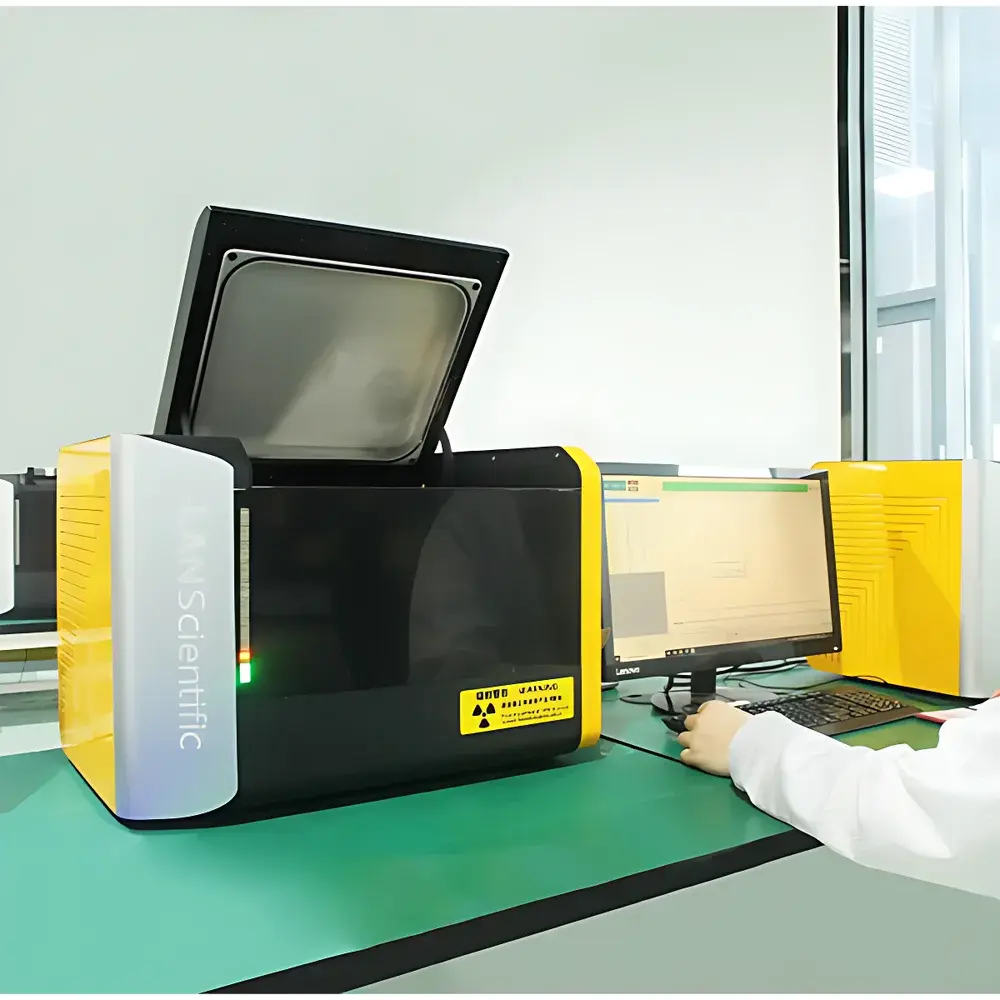
LANScientific ScopeX 860CS Copper Alloy-Specific Energy Dispersive X-Ray Fluorescence Spectrometer
| Brand | LANScientific |
|---|---|
| Origin | Jiangsu, China |
| Manufacturer Type | Direct Manufacturer |
| Regional Classification | Domestic (China) |
| Model | ScopeX 860CS |
| Form Factor | Benchtop/Floor-Standing |
| Instrument Type | Conventional ED-XRF |
| Application Scope | General-Purpose with Copper Alloy Optimization |
| Elemental Range | Na (11) to U (92) |
| Detection Limit | 1 ppm (for typical matrix elements under optimized conditions) |
| Detector | High-Resolution Silicon Drift Detector (SDD), Peltier-cooled, ≥140 eV Mn-Kα resolution |
| Vacuum System | Integrated Automatic Vacuum Pump |
Overview
The LANScientific ScopeX 860CS is a benchtop/floor-standing energy dispersive X-ray fluorescence (ED-XRF) spectrometer engineered specifically for high-precision elemental analysis of copper-based alloys. Operating on the fundamental principle of X-ray fluorescence—where primary X-rays excite characteristic secondary (fluorescent) X-rays from sample atoms—the instrument delivers non-destructive, multi-element quantification across the full range from sodium (Na, Z=11) to uranium (U, Z=92). Its optical and electronic architecture is optimized for the spectral challenges inherent in copper-rich matrices, including strong Cu Kα/Kβ emission lines, overlapping L-lines of alloying elements (e.g., Zn, Sn, Al, Ni, Pb, Fe), and low-concentration trace impurities critical to mechanical and electrical performance. Designed for industrial laboratories requiring regulatory compliance and process repeatability, the ScopeX 860CS supports both routine quality control and advanced R&D workflows in copper alloy manufacturing, recycling, and certification.
Key Features
- Copper-alloy-optimized excitation geometry and spectral deconvolution algorithms to resolve critical overlaps (e.g., Zn Kα/Cu Lα, Sn Lα/Cu Kβ, Pb Mα/Cu Lβ)
- High-resolution silicon drift detector (SDD) with ≤140 eV Mn-Kα energy resolution and Peltier cooling for stable count-rate performance and long-term calibration retention
- Fully automated vacuum system enabling light-element analysis down to sodium (Na) without manual intervention or gas purging
- Dual-mode operation: air-path mode for heavy elements (Z > 20) and vacuum mode for enhanced sensitivity to Na–Mg–Al–Si–P–S–Cl
- Robust sample chamber accommodating irregularly shaped castings, wires, plates, and scrap fragments up to 300 mm × 300 mm × 100 mm (W×D×H)
- Pre-aligned collimated X-ray beam (φ 10 mm standard, optional 3 mm micro-spot) ensuring reproducible excitation volume and minimal matrix heterogeneity effects
Sample Compatibility & Compliance
The ScopeX 860CS accepts solid metallic samples—including as-cast billets, rolled sheets, extruded profiles, machined components, and shredded scrap—without requirement for pelletization or fusion. Surface preparation guidelines align with ASTM E1621 and ISO 21043 for metal alloy analysis. The system supports GLP/GMP-compliant operation through hardware-enforced audit trails, user authentication with role-based permissions (operator, supervisor, administrator), and electronic signature capability per FDA 21 CFR Part 11 requirements. Calibration standards are traceable to NIST SRMs (e.g., NIST 482, 484, 675) and certified reference materials from BAM and IARM. Routine performance verification follows ISO 8258 (Shewhart control charts) and ASTM E2923 (XRF precision and bias assessment).
Software & Data Management
Powered by LANScientific’s proprietary XRF Analysis Suite v5.x, the instrument integrates multiple quantification engines: empirical calibration curves, fundamental parameters (FP) method with matrix correction, and hybrid FP/standard-based calibration. Spectral visualization includes real-time peak identification, overlay comparison of up to six spectra, and automatic interference flagging. Users define custom pass/fail criteria via threshold-based logic (e.g., “Sn < 0.05 wt% AND Pb < 0.002 wt%”) and generate dynamic screening reports. All measurement data—including raw spectra, processed results, acquisition parameters, operator ID, timestamp, and environmental logs—are stored in an encrypted SQLite database. Export formats include CSV, Excel (.xlsx), PDF (with embedded spectra and company branding), and XML for LIMS integration. Report templates are fully editable using WYSIWYG editor; header/footer fields support logo insertion, QA stamping, and revision-controlled metadata.
Applications
- Quality assurance of brass (Cu–Zn), bronze (Cu–Sn), cupronickel (Cu–Ni), aluminum bronze (Cu–Al), and beryllium copper (Cu–Be) alloys against ASTM B135, B150, B283, and EN 13604 specifications
- In-process monitoring of melt composition during casting and continuous casting operations
- Scrap sorting and grade verification in metal recycling facilities to prevent cross-contamination
- Failure analysis of stress-corrosion cracking or dezincification-prone components via trace element mapping (e.g., As, Sb, Bi segregation)
- Development and validation of new high-strength, high-conductivity copper alloys for EV busbars, semiconductor leadframes, and RF shielding components
FAQ
Does the ScopeX 860CS require external cooling water or liquid nitrogen?
No. The SDD is thermoelectrically cooled via integrated Peltier modules; no consumables or external chillers are required.
Can it analyze coated or plated copper alloys?
Yes—using variable kV/kV filtering and layer-thickness modeling algorithms compatible with ISO 3497 and ASTM B568 for quantitative coating mass/thickness determination.
Is method transfer possible between different ScopeX units?
Yes. Calibration files, spectral libraries, and quantification models are portable across instruments of the same model series when validated per ASTM E1361.
What maintenance is required for the vacuum system?
The oil-free diaphragm pump requires only annual inspection; no oil changes or filter replacements are needed within the first 5 years of operation.
How is data integrity ensured during power interruption?
All acquisitions are written to non-volatile memory before spectrum finalization; unsaved data is automatically recovered upon restart.





