
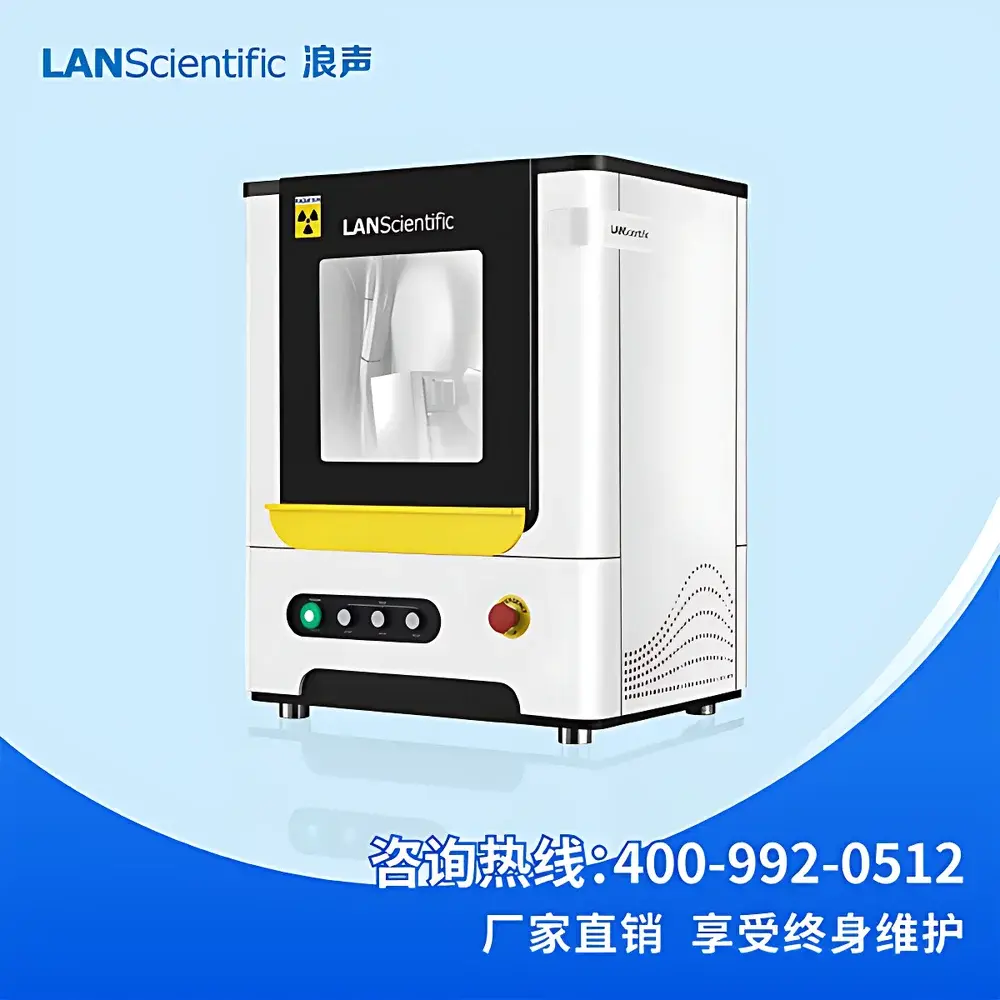
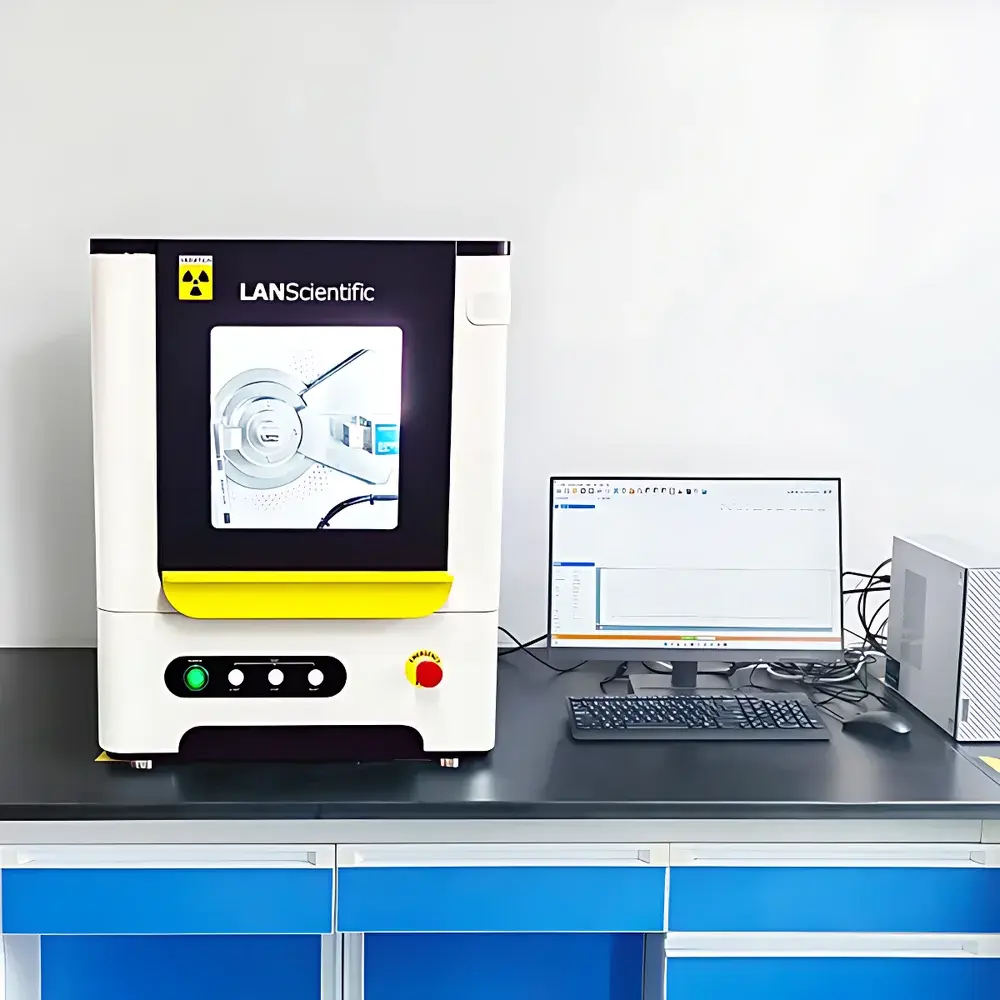
LANScientific FRINGE EV Desktop Powder X-ray Diffractometer for Zeolite and Microporous Material Characterization
| Brand | LANScientific |
|---|---|
| Origin | Jiangsu, China |
| Manufacturer Type | Direct Manufacturer |
| Product Category | Domestic |
| Model | FRINGE EV |
| Instrument Type | Powder X-ray Diffractometer |
| Power Rating | kW-class (rated for continuous high-intensity operation) |
| Detector | Digital Pulse Processing Counter (DPPC), ≥1×10⁷ counts per second (CPS) |
| Optical Configuration | Integrated Soller collimator (fixed, no moving parts) |
| Geometry | Bragg–Brentano θ–2θ reflection mode |
| Safety | Interlocked sample chamber with automatic beam shutter, real-time door status feedback in GUI |
| Software | CrystalX — automated phase identification, quantitative Rietveld refinement, crystallinity index calculation, and energy-dispersive spectral overlay |
Overview
The LANScientific FRINGE EV is a benchtop powder X-ray diffractometer engineered for rigorous structural characterization of microporous and mesoporous materials—including zeolites, MOFs, aluminosilicates, and other crystalline or semi-crystalline porous frameworks. Operating on the Bragg–Brentano θ–2θ reflection geometry, it employs a fixed-anode kW-class X-ray source coupled with a high-throughput Digital Pulse Processing Counter (DPPC) detector. Unlike conventional scintillation or proportional counters, the DPPC delivers simultaneous diffraction pattern acquisition and energy-dispersive spectroscopy (EDS) data without requiring a secondary monochromator—enabling rapid, multi-modal analysis of phase composition, lattice parameters, and elemental distribution within a single measurement cycle. Its compact footprint, air-spring assisted large-window sliding door, and vibration-isolated optical path make it suitable for installation in standard laboratory workspaces, mobile analytical platforms, and GLP-compliant quality control environments.
Key Features
- kW-class sealed-tube X-ray source delivering stable, high-flux Cu Kα radiation (λ = 1.5418 Å) for enhanced signal-to-noise ratio and reduced acquisition time
- Integrated Soller collimator system—mechanically fixed, zero-adjustment design—ensuring long-term angular reproducibility and minimizing maintenance-induced calibration drift
- DPPC detector with ≥1×10⁷ CPS counting capacity and on-the-fly pulse-height discrimination, supporting concurrent XRD/EDS data collection
- Interlocked sample chamber with fail-safe beam shutter activation and real-time GUI status indication—fully compliant with IEC 61010-1 and ANSI N43.3 safety standards
- Modular goniometer architecture compatible with optional accessories: variable-temperature stage (−10 °C to +600 °C), humidity-controlled cell, and thin-film reflectivity attachment
- Benchtop form factor (W × D × H: 620 × 580 × 490 mm) with integrated vibration damping and low acoustic emission (<45 dB(A))
Sample Compatibility & Compliance
The FRINGE EV accommodates powdered, pressed pellet, bulk polycrystalline, and thin-film samples up to 50 mm in diameter. Its optimized beam path and low-divergence optics ensure high-resolution diffraction from low-concentration zeolitic phases (e.g., FAU, LTA, MFI frameworks) and amorphous matrix components. The instrument meets ISO 17025 requirements for analytical competence when operated under documented SOPs. Data integrity is maintained via audit-trail-enabled CrystalX software compliant with FDA 21 CFR Part 11 (electronic signatures, user access controls, immutable raw data storage). All hardware and firmware adhere to CE marking directives (EMC Directive 2014/30/EU, Low Voltage Directive 2014/35/EU) and RoHS 2011/65/EU restrictions.
Software & Data Management
CrystalX is a validated, Windows-based analytical suite featuring automated phase identification against ICDD PDF-4+ and COD databases, full-pattern Rietveld refinement (using GSAS-II engine integration), quantitative phase analysis (QPA) with internal standard correction, and crystallinity index calculation per ASTM E1361. Raw data are stored in industry-standard .raw/.udf formats; processed reports export to PDF, CSV, and CIF with embedded metadata (instrument settings, calibration history, operator ID, timestamp). The software supports networked deployment across lab-wide installations and integrates with LIMS via ODBC drivers. All processing steps—including background subtraction, peak deconvolution, and lattice parameter optimization—are fully traceable and repeatable.
Applications
- Zeolite synthesis monitoring: tracking framework crystallization kinetics, Si/Al ratio estimation via unit-cell expansion, and extra-framework cation occupancy
- Catalyst characterization: identifying active phase dispersion, detecting amorphous support contributions, and quantifying thermal degradation products
- Pharmaceutical solid-state analysis: polymorph screening, hydrate/anhydrate differentiation, and excipient compatibility assessment per USP
- Construction materials: quantification of clinker phases (alite, belite), gypsum dehydration states, and pozzolanic reactivity indices
- Geological and mineralogical studies: clay mineral identification (smectite/illite ratio), ore grade estimation, and metamorphic facies mapping
- Advanced ceramics and battery materials: crystallographic texture analysis, lithium intercalation staging detection, and SEI layer phase evolution
FAQ
Is the FRINGE EV suitable for GMP-regulated pharmaceutical labs?
Yes—when configured with CrystalX’s 21 CFR Part 11 module and operated under validated SOPs, it satisfies data integrity and audit-trail requirements for QC release testing.
Can it perform in situ or operando experiments?
With optional environmental stages (heating, cooling, gas flow), it supports time-resolved XRD up to 10 Hz frame rate for dynamic structural evolution studies.
Does the DPPC detector require liquid nitrogen cooling?
No—the DPPC operates at Peltier-cooled temperatures (−20 °C) and requires no cryogens or vacuum pumps.
What sample preparation protocols are recommended for zeolite powders?
Standard back-loading into zero-background silicon holders is advised; for low-abundance phases, spinning sample stages and longer scan times (≥30 min) improve detection limits.
How is angular calibration verified and maintained?
Calibration is performed using NIST-traceable SRM 660c (LaB₆) and automatically validated before each session via built-in reference scan routines.
Related Products






