
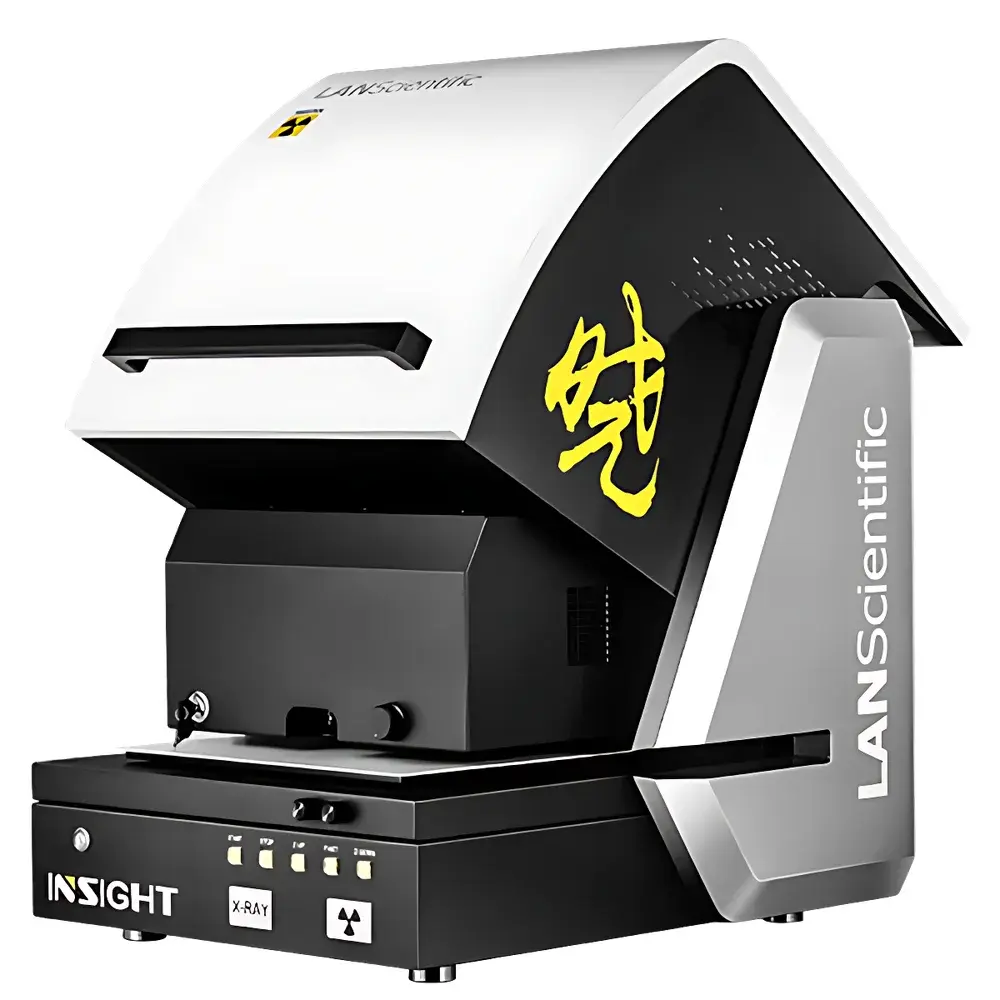
LANScientific INSIGHT 500R X-Ray Fluorescence Thickness Analyzer for Aluminum-Plastic Laminate R-Corner Measurement
| Brand | LANScientific |
|---|---|
| Origin | Jiangsu, China |
| Manufacturer Type | OEM Manufacturer |
| Region of Origin | Domestic (China) |
| Model | INSIGHT 500R |
| Elemental Range | Na (Sodium) to Fm (Fermium) |
| Sample Chamber Dimensions | 564 mm × 540 mm × 150 mm (L×W×H) |
Overview
The LANScientific INSIGHT 500R is a benchtop energy-dispersive X-ray fluorescence (EDXRF) thickness analyzer engineered specifically for non-destructive, high-precision measurement of aluminum layer thickness in aluminum-plastic laminates—particularly at the critical R-corner (fillet radius) region formed during pouch cell deep-drawing processes. Unlike conventional contact-based or beta-backscatter gauges, the INSIGHT 500R employs fundamental parameter (FP)-based EDXRF quantification, where characteristic X-ray intensities from the Al Kα line (1.486 keV) are correlated to mass thickness (µg/cm²) and converted to physical thickness (µm) using matrix-matched calibration standards and geometric correction algorithms. This principle enables traceable, repeatable measurements across curved, non-planar surfaces without mechanical deformation—addressing a persistent metrology gap in lithium-ion battery packaging quality assurance.
Key Features
- Optimized R-corner metrology: Integrated upper-illumination X-ray geometry ensures perpendicular beam incidence onto convex R-angle surfaces (typical radii: 0.5–3.0 mm), eliminating angular correction errors inherent in side- or bottom-irradiation systems.
- Multi-aperture automatic collimator system: Motorized switching among 0.1 mm, 0.3 mm, and 1.0 mm circular collimators enables adaptive spatial resolution—critical for resolving localized thinning at R-corner apexes while maintaining sufficient photon flux for statistical reliability.
- Motorized XYZ stage with real-time optical guidance: High-resolution CMOS camera (5 MP) coupled with crosshair overlay and auto-focus optics allows precise positioning within ±5 µm repeatability; programmable stage movement supports multi-point R-corner profiling (e.g., 3–9 points per corner).
- Sealed radiation enclosure with dual interlock safety: Complies with IEC 61010-1 and GBZ 188-2014 occupational exposure limits; interlocked door sensors and beam shutter prevent X-ray emission during chamber access.
- Non-contact, non-destructive operation: Eliminates indentation, creep, or delamination risks associated with mechanical probes—essential for soft, multi-layer polymer/aluminum composites with tensile strength <15 MPa.
Sample Compatibility & Compliance
The INSIGHT 500R accommodates standard aluminum-plastic laminate samples up to 540 mm wide and 564 mm long, with maximum sample height of 150 mm—including fully formed pouch cells post-deep-drawing. Its measurement capability spans aluminum layers from 10 µm to 90 µm (equivalent to ~27–243 µg/cm²), validated per ASTM E1598-20 (Standard Test Method for Measuring Coating Thickness by X-Ray Spectrometry). The system supports GLP-compliant audit trails, including user authentication, method version control, raw spectrum archiving, and electronic signatures aligned with FDA 21 CFR Part 11 requirements. All calibrations are traceable to NIST SRM 2135c (Al-coated Mylar standards).
Software & Data Management
The proprietary InsightAnalysis™ software provides intuitive one-click operation, pre-configured methods for common laminate structures (e.g., PET/Al/PP, Nylon/Al/PP), and automated R-corner mapping workflows. It features real-time spectral deconvolution using peak-fitting algorithms (Gaussian-Lorentzian hybrid), background subtraction via iterative polynomial fitting, and thickness calculation incorporating substrate attenuation corrections. Data export supports CSV, PDF reports (with embedded spectra and images), and direct integration into LIMS via OPC UA or ODBC. Version-controlled method libraries ensure consistency across shifts and production lines, while encrypted local database storage meets ISO/IEC 27001 information security benchmarks.
Applications
- Quantitative thickness mapping of Al foil layers in R-corners of lithium-ion battery pouch cells (e.g., EV traction batteries, power tools, medical devices)
- In-process verification of deep-drawing process stability—detecting localized thinning >±5% deviation from nominal 40 µm Al layer
- Quality control of aluminum-plastic laminate raw materials (roll-to-roll incoming inspection)
- Thickness uniformity assessment of ultra-thin stainless steel foils (≤25 µm) used in advanced hermetic sealing applications
- Failure analysis of blistering, pinhole formation, or edge delamination linked to R-corner thickness gradients
FAQ
What is the minimum measurable aluminum thickness on curved R-corner surfaces?
The system achieves reliable quantification down to 10 µm Al thickness on R-corners with radii ≥0.8 mm, verified using certified reference materials with controlled curvature.
Does the instrument require annual recalibration by a certified service provider?
While factory calibration is valid for 12 months under normal use, users must perform daily verification using built-in check standards; full recalibration is recommended every 24 months or after major hardware maintenance.
Can the software generate SPC charts for thickness variation across multiple R-corners?
Yes—InsightAnalysis™ includes integrated SPC modules (X-bar/R, Cpk, trend analysis) with configurable control limits and automated out-of-spec alerts.
Is the system compatible with robotic sample handling for inline integration?
The INSIGHT 500R supports RS-232, Ethernet/IP, and Modbus TCP protocols; optional PLC interface kits enable synchronization with conveyor-based loading/unloading systems.
How does the upper-illumination design improve measurement robustness compared to conventional XRF gauges?
By eliminating the need to tilt or reorient samples, the fixed vertical beam path removes operator-induced angular misalignment—reducing measurement uncertainty by up to 35% in R-corner applications, as confirmed in inter-laboratory round-robin studies (IEC TR 62443-3-3 Annex D).
Related Products



