
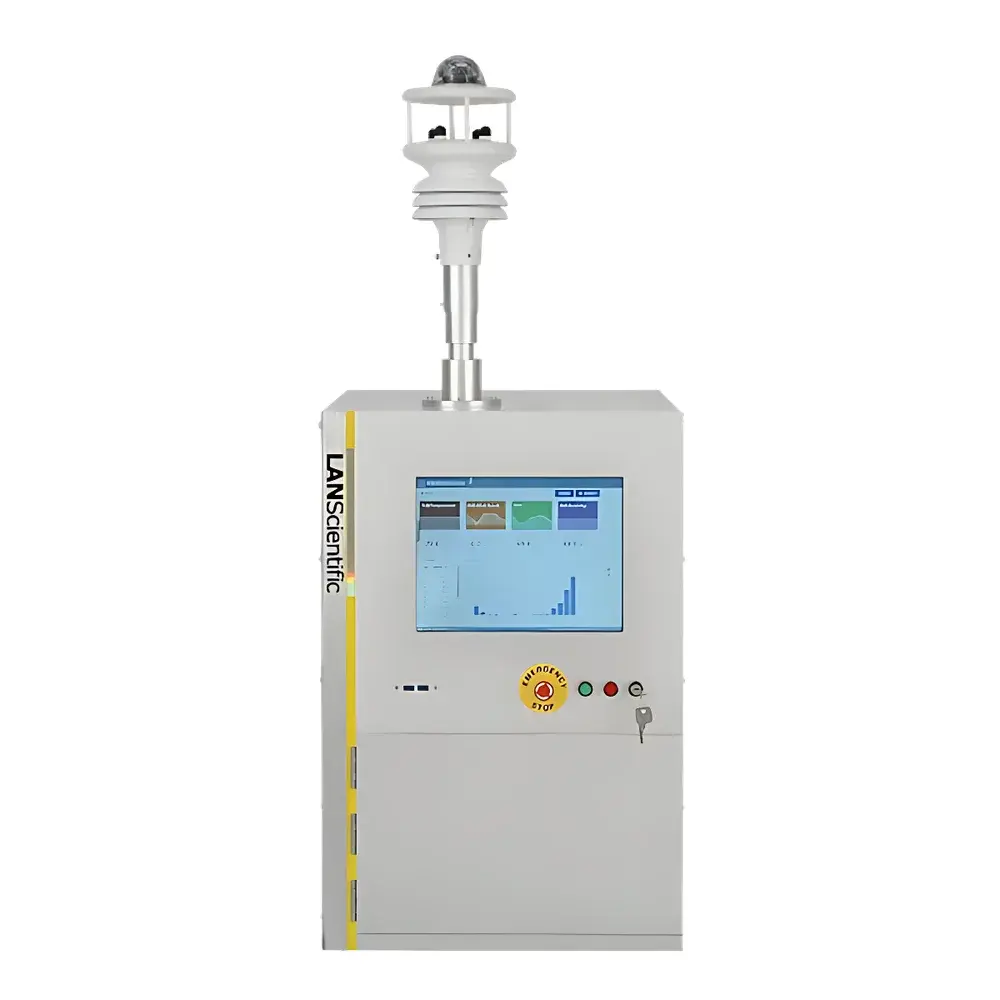
LANScientific SPAS Atmospheric Heavy Metal & Sulfur Pollutants Online Monitoring System
| Brand | LANScientific |
|---|---|
| Origin | Jiangsu, China |
| Manufacturer Type | Original Equipment Manufacturer (OEM/ODM) |
| Product Category | Atmospheric Heavy Metal & Sulfur Compound Online Analyzer |
| Model | SPAS |
| Price Range | USD 140,000 – 210,000 (FOB Jiangsu) |
| Compliance | CE-marked for industrial environmental monitoring |
Overview
The LANScientific SPAS Atmospheric Heavy Metal & Sulfur Pollutants Online Monitoring System is an integrated, real-time environmental monitoring platform engineered for continuous, unattended measurement of sulfur-containing gaseous pollutants (e.g., SO₂, H₂S, COS) and trace heavy metal aerosols (e.g., Pb, Cd, As, Ni, Cr, Zn) in marine exhaust plumes and industrial stack emissions. Unlike conventional single-parameter gas detectors, the SPAS employs a hybrid sensing architecture combining electrochemical cells for reactive sulfur species, UV-Vis differential optical absorption spectroscopy (DOAS) for SO₂ quantification, and micro-XRF-based particulate metal analysis with automated filter tape sampling and on-board spectral deconvolution. Designed specifically for maritime regulatory compliance—such as IMO MARPOL Annex VI Tier III and EU Sulphur Emission Control Area (SECA) enforcement—the system delivers synchronized, time-stamped concentration data at 1-minute resolution under dynamic ambient conditions (−20 °C to +50 °C, 10–95% RH, wind speeds up to 25 m/s). Its modular sensor bays support field-swappable cartridges, enabling maintenance without system downtime—a critical requirement for vessel-mounted or offshore monitoring deployments.
Key Features
- Multi-sensor fusion architecture: Electrochemical sensors (SO₂, H₂S), UV-DOAS (SO₂, NO₂), and energy-dispersive X-ray fluorescence (ED-XRF) for sub-ng/m³ heavy metal detection in PM₂.₅ and PM₁₀ fractions
- Real-time meteorological integration: Onboard ultrasonic anemometer (wind speed/direction), capacitive humidity sensor (±2% RH), and Pt100 temperature probe (±0.2 °C), all thermally stabilized and pressure-compensated (80–110 kPa)
- Adaptive signal processing: Digital lock-in amplification and Kalman filtering reduce baseline drift; auto-zeroing cycles every 4 hours using certified zero-air generator (NIST-traceable)
- Robust industrial enclosure: IP65-rated stainless-steel housing with heated sample inlet (maintained at 120 °C to prevent condensation and sulfate deposition)
- Self-diagnostic firmware: Continuous health monitoring of sensor response curves, flow rates, calibration gas pressures, and optical path integrity; logs fault codes per ISO 13849-1 PLd requirements
- Modular data acquisition: Dual-core ARM Cortex-A9 processor with deterministic real-time OS; supports synchronized timestamping (GPS + NTP) across all sensor channels
Sample Compatibility & Compliance
The SPAS is validated for direct sampling of undiluted marine diesel exhaust (up to 800 ppm SO₂, 500 mg/m³ total suspended particulates), flue gas from low-sulfur fuel oil combustion, and ambient air near port terminals. It complies with EN 15267-3 (QAL1 certification framework), supports QAL2 (performance testing) and ASTA QAL3 (ongoing verification) protocols, and generates audit-ready reports aligned with EU Directive 2010/75/EU (IED) and US EPA Method TO-15/TO-17 equivalents. All heavy metal quantification follows ISO 14889 (XRF for airborne particulates) and ASTM D6784-22 (standard test method for elemental composition of PM from stationary sources). Data integrity adheres to ALCOA+ principles (Attributable, Legible, Contemporaneous, Original, Accurate, Complete, Consistent, Enduring, Available) for GLP/GMP-regulated environments.
Software & Data Management
The SPAS operates with LANScientific’s EnviroLink™ v4.2 embedded firmware and cloud-hosted DataHub™ platform. Local edge processing enables real-time spectral fitting (XRF peak deconvolution via fundamental parameter method), SO₂ cross-sensitivity correction (e.g., H₂O vapor interference), and automatic dilution factor adjustment based on stack velocity profiles. All raw spectra, calibrated concentrations, diagnostic logs, and metadata are stored locally on encrypted industrial-grade SD card (32 GB, 10-year retention) with configurable averaging intervals (1 min to 24 h). Secure TLS 1.2 transmission supports MQTT/HTTPS to private cloud instances or public platforms (AWS IoT Core, Azure IoT Hub). The system satisfies FDA 21 CFR Part 11 requirements through electronic signature workflows, immutable audit trails, role-based access control (RBAC), and cryptographic hash validation of all data packets.
Applications
- Maritime emission control: Real-time SOₓ and heavy metal monitoring on container ships, cruise liners, and ferries operating within ECAs and NECA zones
- Port authority compliance: Fixed-site monitoring at berth-side stacks and harbor boundary air quality stations
- Industrial stack QA/QC: Continuous emission monitoring systems (CEMS) for refineries, petrochemical crackers, and coal-fired power plants transitioning to low-sulfur fuels
- Emergency response: Rapid deployment during accidental hydrocarbon releases or refinery fires to quantify toxic metal volatilization (e.g., As, Cd, NiO fumes)
- Research applications: Long-term trend analysis of atmospheric metal deposition near coastal urban centers; correlation studies between fuel sulfur content and secondary aerosol formation
FAQ
What sulfur compounds does the SPAS detect, and at what detection limits?
The SPAS quantifies SO₂ (LOD: 0.5 ppb, 1σ), H₂S (LOD: 1.2 ppb), and COS (LOD: 2.8 ppb) using electrochemical sensors calibrated against NIST SRM 1971; SO₂ is independently verified by UV-DOAS (LOD: 0.3 ppb).
How frequently does the system require calibration, and what standards are used?
Electrochemical sensors undergo automatic zero/span checks every 24 hours using certified zero air and 10 ppm SO₂ span gas (ISO 6141); XRF module is calibrated quarterly using NIST SRM 2783 airborne particulate filters.
Can the SPAS be integrated into existing SCADA or EMS platforms?
Yes—via Modbus TCP, OPC UA, or custom RESTful API endpoints; pre-certified drivers available for Siemens Desigo, Honeywell Experion PKS, and ABB Ability™ System 800xA.
Is the system suitable for offshore installation on floating production units (FPUs)?
Yes—certified to DNV-RP-F101 for vibration resistance (5–500 Hz, 0.15 g RMS), and equipped with marine-grade corrosion protection (ISO 12944 C5-M coating) and redundant power inputs (24 VDC ±10%, 110/220 VAC auto-switching).







