
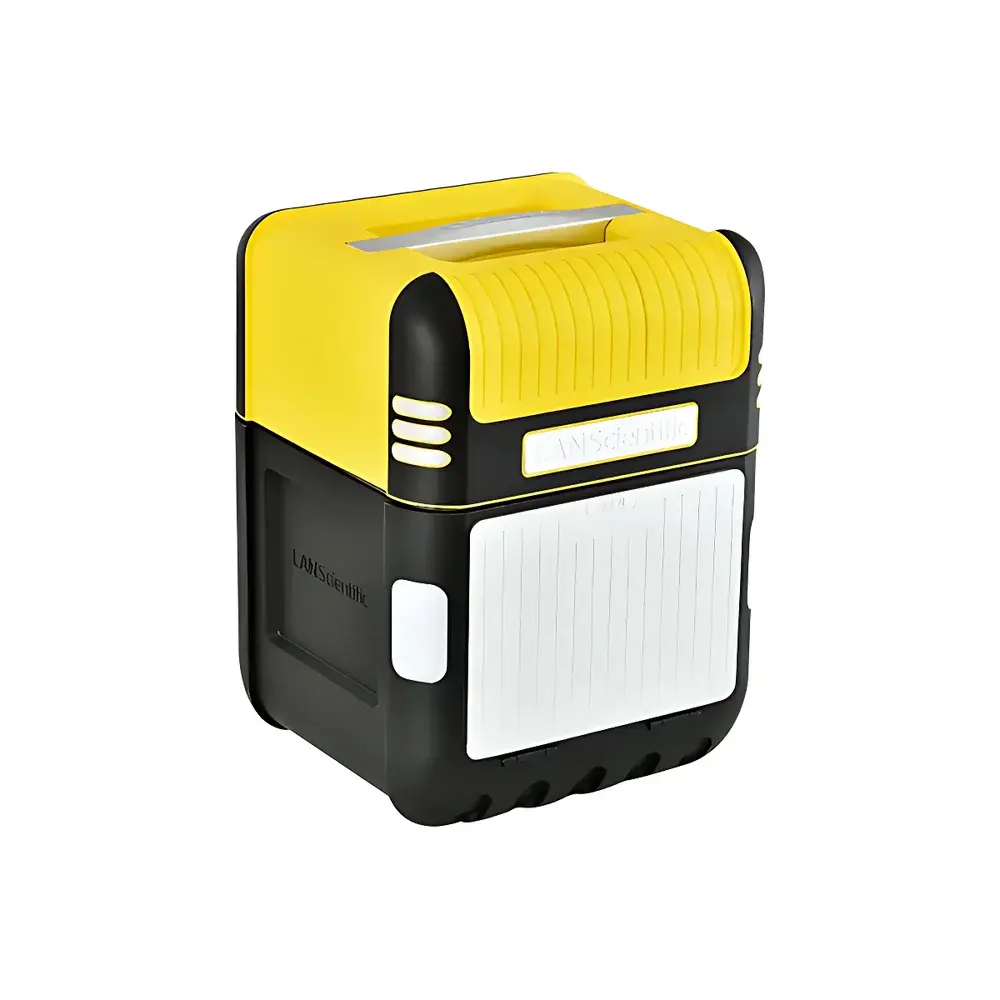
PeDX G5 Portable Energy Dispersive X-Ray Fluorescence Spectrometer by LANScientific
| Brand | LANScientific |
|---|---|
| Origin | Jiangsu, China |
| Manufacturer Type | Direct Manufacturer |
| Regional Classification | Domestic (China) |
| Model | PeDX G5 |
| Application Form Factor | Handheld / Portable |
| Instrument Type | Conventional EDXRF |
| Industry Use | General-Purpose |
| Elemental Range | Al to U (Atomic Number 13–92) |
| Quantification Range | 1 ppm – 99.99 wt% |
| Energy Resolution | <136 eV at Mn Kα |
| Repeatability (RSD) | ≤0.1% for homogeneous alloy standards |
Overview
The PeDX G5 is a handheld energy dispersive X-ray fluorescence (EDXRF) spectrometer engineered for rapid, non-destructive elemental analysis of precious metals in industrial and commercial environments. Operating on the fundamental principle of X-ray fluorescence—where primary X-rays excite atoms in a sample, causing emission of characteristic secondary X-rays—the PeDX G5 delivers quantitative composition data based on spectral peak intensity and energy calibration. Its compact form factor and integrated 40 kV micro-focus X-ray tube enable high-sensitivity detection across the full Al–U range, with particular optimization for Au, Ag, Pt, Pd, Cu, Ni, Zn, and common alloying elements. Designed for factory-floor deployment, it meets the operational demands of gold refineries, jewelry manufacturers, scrap recyclers, and pawn shops where real-time decision-making on material grade, purity verification, and incoming/outgoing quality control is critical.
Key Features
- Optimized EDXRF architecture with silicon drift detector (SDD) delivering <136 eV energy resolution at Mn Kα, ensuring robust peak separation for overlapping lines in multi-element precious metal alloys.
- High-reproducibility measurement engine: ≤0.1% relative standard deviation (RSD) achieved under standardized test conditions using certified reference materials (CRMs) traceable to NIST or equivalent national metrology institutes.
- Integrated 40 kV/100 µA micro-focus X-ray source with automatic voltage/current adjustment per element group, balancing sensitivity and beam stability for consistent excitation across light and heavy elements.
- Ergonomic, IP54-rated enclosure constructed from reinforced magnesium alloy—lightweight (<1.8 kg) yet mechanically robust for daily field use in dusty, humid, or temperature-variable workshop settings.
- Long-life lithium-ion battery supporting ≥8 hours of continuous operation (typical assay mode), with hot-swappable design enabling uninterrupted shift-based usage.
- One-touch assay workflow: “Place sample → Close shutter → Press Test → View result” — no user calibration or parameter selection required for routine precious metal grading.
Sample Compatibility & Compliance
The PeDX G5 accommodates irregularly shaped, flat, curved, or plated samples up to 50 mm in diameter and 30 mm in height—including bullion bars, jewelry pieces, scrap fragments, solder residues, and electroplated components. Surface geometry compensation algorithms minimize matrix effects from curvature or roughness. It complies with IEC 61000-6-3 (EMC emissions), IEC 61000-6-2 (immunity), and adheres to ISO 8596:2021 guidelines for portable XRF instrument performance verification. While not classified as a medical device, its radiation safety design conforms to GBZ 18871-2002 (China’s basic safety standard for ionizing radiation) and includes dual interlock mechanisms (mechanical shutter + software-enforced exposure timer) to limit operator dose to <1 µSv/h at 5 cm distance during operation.
Software & Data Management
Firmware runs on a real-time Linux OS with embedded touchscreen GUI supporting multilingual UI (English, Chinese, Spanish, Arabic). All spectra and quantitative reports are timestamped and stored locally with optional cloud sync via secure TLS 1.2 connection. Data export formats include CSV, PDF (with embedded spectrum image and metadata), and XML compliant with ASTM E1361-22 for analytical data interchange. Audit trail functionality logs all user actions—including method changes, calibration events, and report generation—with read-only archive mode enabled by default. The system supports GLP-compliant workflows through configurable user roles (Operator, Supervisor, Admin), electronic signatures, and 21 CFR Part 11–ready audit log export for regulated QA/QC environments.
Applications
- Gold refinery feedstock screening: Rapid distinction between karat-grade alloys (e.g., 14K vs. 18K), detection of intentional adulterants (e.g., W, Re, Ir), and quantification of refining losses (Cu, Fe, Pb).
- Jewelry manufacturing QC: In-line verification of plating thickness (Au/Ni/Cu stack), base metal substrate identification, and compliance with hallmarking regulations (e.g., UK Hallmarking Act, EU Directive 2015/863).
- Scrap recycling sorting: On-site classification of catalytic converter substrates, dental alloys, and electronic scrap based on Pt/Pd/Rh content and contamination levels.
- Retail and pawn operations: Instant assessment of item authenticity, karat verification, and residual impurity profiling to support fair valuation and consumer transparency.
- Research & development labs: Compositional mapping of prototype alloys, diffusion layer analysis in brazed joints, and catalyst formulation validation.
FAQ
Does the PeDX G5 require annual recalibration?
No—factory calibration is stable for ≥12 months under normal operating conditions. A built-in verification check using internal reference foils (Ti, Cu, Zn, Sn, Pb) can be run before each shift; full recalibration is only recommended after physical impact, extreme thermal cycling, or detector performance drift exceeding specification limits.
Can it analyze gold-plated items accurately?
Yes—using proprietary thin-film quantification algorithms that deconvolute signal contributions from plating layer and substrate. Minimum detectable plating thickness is ~0.2 µm for 24K Au on Cu/Ni base, assuming uniform coverage and surface flatness.
Is Bluetooth printing compatible with third-party printers?
Only certified Bluetooth 4.2+ thermal printers supporting ESC/POS command set are supported. The bundled printer is pre-paired and validated for report fidelity, including spectral overlay and uncertainty estimates.
What sample preparation is required?
None for solid, clean metals. For heavily oxidized, coated, or porous samples, light mechanical abrasion (e.g., 600-grit SiC paper) is advised to expose representative bulk material. No acid digestion or pelletization is needed.
How does it handle heterogeneous scrap mixtures?
It performs single-point micro-analysis (spot size ~3 mm). For representative results on mixed batches, users must follow ASTM E2923-23 guidance: collect ≥5 random subsamples, average results, and report combined uncertainty incorporating sampling variance.





