



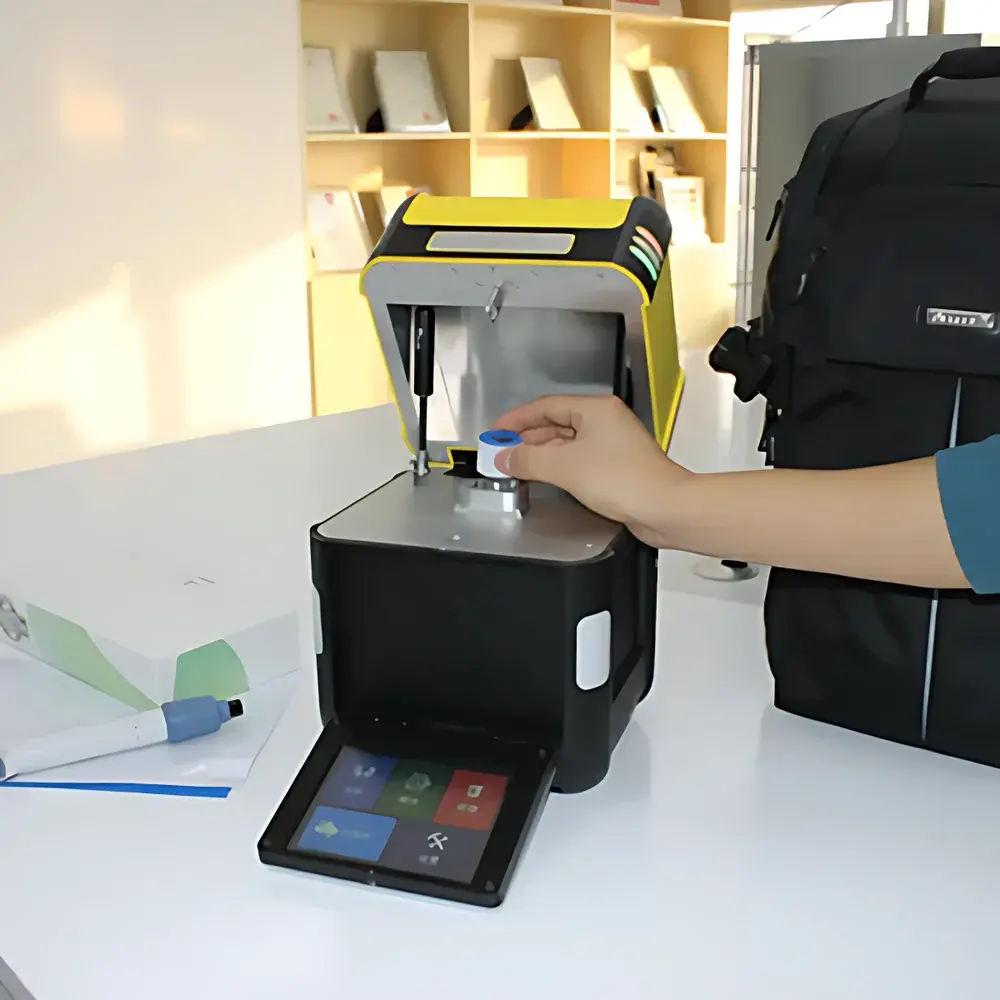
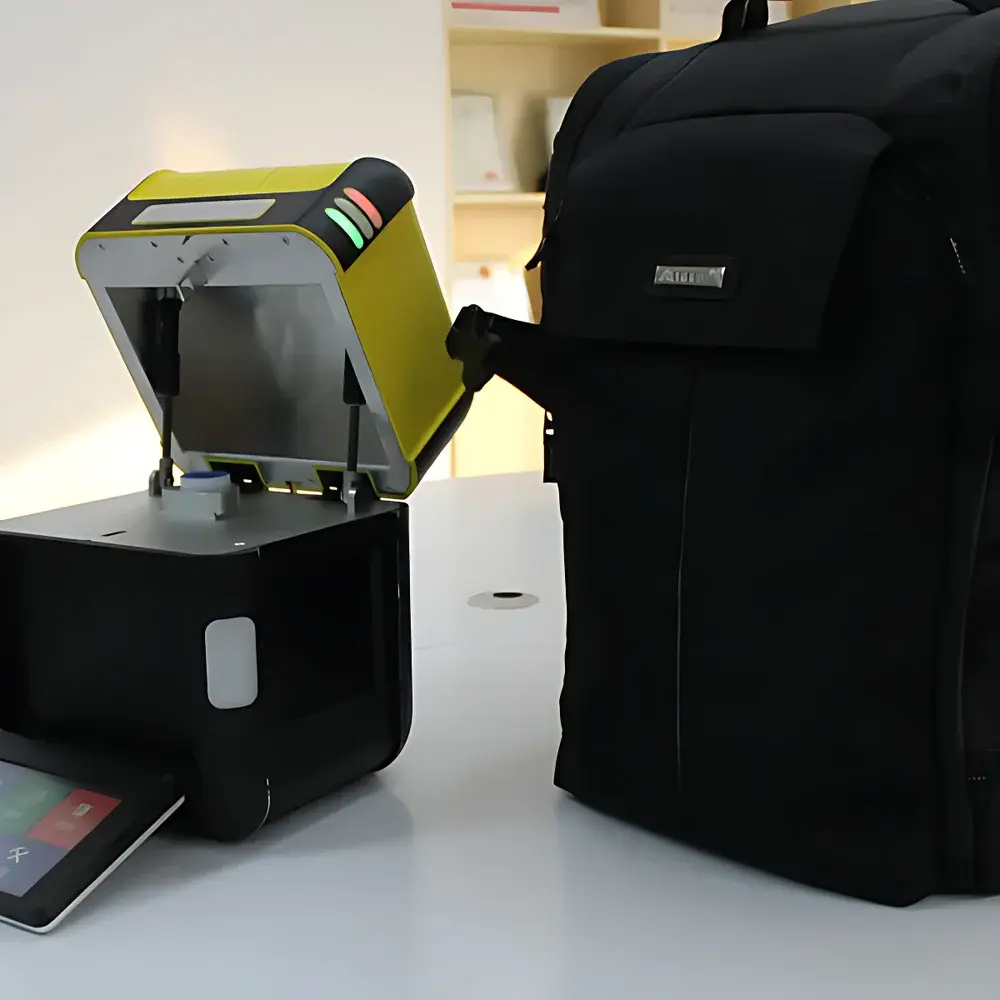
Brookfield LANScientific PeDX OIL Portable Energy-Dispersive X-Ray Fluorescence (EDXRF) Analyzer for Sulfur and Multi-Element Analysis in Petroleum Products
| Brand | LANScientific |
|---|---|
| Origin | Jiangsu, China |
| Manufacturer Type | Direct Manufacturer |
| Regional Classification | Domestic (China) |
| Model | PeDX OIL |
| Form Factor | Handheld / Portable |
| Instrument Type | Conventional EDXRF Spectrometer |
| Application Scope | General-Purpose Petrochemical Analysis |
| Elemental Range | Mg to U |
| Quantification Range | 1 ppm – 99.99% (for S and key wear metals/additives) |
| Energy Resolution | <136 eV (at Mn Kα) |
| Repeatability (RSD) | ≤0.1% for sulfur in stable matrix conditions |
Overview
The LANScientific PeDX OIL is a purpose-engineered handheld energy-dispersive X-ray fluorescence (EDXRF) spectrometer designed specifically for rapid, on-site quantification of sulfur and critical elemental contaminants in liquid petroleum products. Operating on the fundamental principle of X-ray fluorescence—where primary X-rays excite atoms in the sample, inducing emission of characteristic secondary X-rays—the instrument delivers non-destructive, matrix-compensated elemental analysis without sample digestion or chemical reagents. Its compact, ruggedized chassis integrates a high-stability miniature X-ray tube (Ag anode), large-area silicon drift detector (SDD), and real-time spectral processing firmware optimized for low-Z to high-Z elements across the Mg–U range. Unlike benchtop WDXRF systems, the PeDX OIL employs advanced scatter-based normalization and dynamic background subtraction to maintain accuracy across variable oil viscosities, densities, and container geometries—including sealed cans, drums, and inline flow cells (with optional accessories). It meets the core analytical requirements of ISO 8754:2003, ASTM D4294–22, and IMO MARPOL Annex VI for marine fuel sulfur compliance verification.
Key Features
- True handheld operation with integrated battery (≥8 hours continuous use) and IP54-rated enclosure for field deployment in refineries, bunkering terminals, and vessel engine rooms.
- Optimized optical path and collimation geometry enabling direct measurement of sulfur in fuels down to 1 ppm LOD (limit of detection) under standard 60-s acquisition, validated per ASTM D4294 precision criteria.
- Dual-mode analysis: quantitative mode (using factory-calibrated Super-FP fundamental parameters algorithm) and semi-quantitative screening mode (for rapid pass/fail decisions against user-defined thresholds).
- Real-time spectral deconvolution with automatic peak identification and interference correction for overlapping lines (e.g., S Kα vs. Pb Mα, Ca Kβ vs. S Kβ), minimizing false positives in complex additive packages.
- One-touch workflow: power-on → auto-calibration check → aim-and-shoot measurement → result display with confidence indicators — no operator training required beyond safety briefing.
- On-device data review with zoomable full-spectrum view, element-specific overlays, and statistical summary (mean, SD, RSD) for sequential measurements.
Sample Compatibility & Compliance
The PeDX OIL accommodates liquid samples in standard containers (glass vials, PET bottles, metal cans) as well as semi-solid residues (e.g., used engine oil sludge, filter deposits) and thin-film coatings on metallic substrates. For volatile or low-viscosity fuels (e.g., gasoline, jet A-1), measurement is performed through certified X-ray-transparent polypropylene windows or using the optional vacuum-sealed sample cup to minimize evaporation artifacts. Solid particulates (wear metals from engine oil) are analyzed in situ on filter membranes without extraction. The system complies with IEC 61000-6-3 (EMC) and IEC 61010-1 (safety), and supports audit-ready documentation for GLP/GMP environments via optional 21 CFR Part 11-compliant software modules. All calibration models are traceable to NIST SRM 2721 (lubricating oil) and CRM-101 (diesel fuel) reference materials.
Software & Data Management
Data acquisition and reporting are managed via the LANScientific PeDX Suite (v4.2+), compatible with Windows 10/11 and Android 12+. Raw spectra, quantitative results, metadata (operator ID, GPS stamp, ambient temperature/humidity), and instrument health logs are stored locally and exportable in three formats: (1) PDF reports with embedded spectra, company branding, and customizable fields (batch ID, sample description, test location); (2) Excel (.xlsx) files containing full tabular output with editable columns for QA review; (3) CSV for LIMS integration. Audit trail functionality records all parameter changes, calibration events, and report generation timestamps. Remote firmware updates and method library synchronization occur over secure HTTPS channels.
Applications
- Marine fuel sulfur verification pre-bunkering and post-delivery per IMO 2020 global cap (≤0.50% m/m) and ECA limits (≤0.10% m/m).
- In-line quality control at refinery blending units for diesel, jet fuel, and marine gas oil (MGO) to ensure additive package consistency and contaminant exclusion (e.g., Na, Al, Si, Ca, Zn, P).
- Condition monitoring of in-service lubricants: tracking wear metals (Fe, Cr, Cu, Al), contaminants (Si, Na, B), and oxidation byproducts (Ca, P, Zn) in turbine, hydraulic, and engine oils.
- Crude assay support: rapid screening of S, Ni, V, Fe, and Ca content during crude tank receipt and desalting optimization.
- Regulatory enforcement: port state control (PSC) inspections and customs verification of fuel declarations.
FAQ
Does the PeDX OIL require external helium purging or vacuum pumping for sulfur analysis?
No. The instrument uses air-path measurement optimized for sulfur Kα (2.307 keV) with enhanced low-energy response via proprietary detector window design and pulse processing algorithms.
Can it quantify sulfur in ultra-low-sulfur diesel (ULSD) below 15 ppm?
Yes — when operated under standardized conditions (60 s count time, clean sample surface, temperature-controlled environment), typical repeatability is ≤0.1% RSD at 10 ppm S, meeting ASTM D4294 precision requirements for ULSD.
Is calibration transfer possible between different PeDX OIL units?
Yes. Cross-unit calibration alignment is supported via shared method files and reference sample validation protocols compliant with ISO/IEC 17025 clause 7.7.2.
What maintenance is required for long-term field reliability?
Annual detector resolution verification using Mn Kα source and biannual X-ray tube output stability check — both automated via built-in diagnostics and reportable in PDF format.
How is operator radiation safety ensured?
The device incorporates dual interlock sensors (beam shutter + proximity detection), dose-rate monitoring (<1 µSv/h at 5 cm), and full compliance with GBZ 188-2014 and EU Directive 2013/59/Euratom for handheld XRF devices.



