
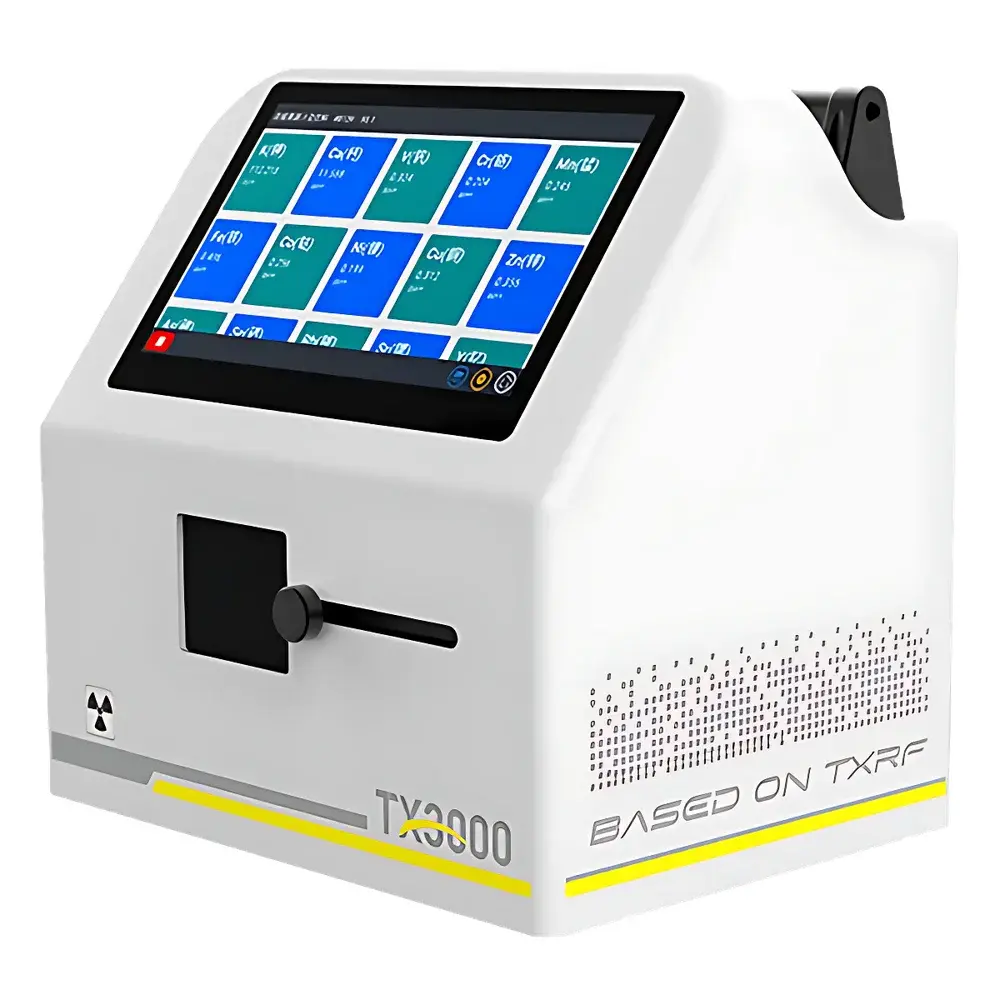
LANScientific TX3000 Portable Total Reflection X-Ray Fluorescence Spectrometer
| Brand | LANScientific |
|---|---|
| Origin | Jiangsu, China |
| Manufacturer Type | Direct Manufacturer |
| Product Category | Domestic |
| Model | TX3000 Series (Portable) |
| Instrument Type | Total Reflection XRF (TXRF) |
| Application Scope | Soil & Atmospheric Analysis |
| Sample Form Compatibility | Liquid, Suspension, Solid, Particulate Deposits |
| Regulatory Alignment | Compliant with ISO 8519, ASTM D7706 (for trace metal analysis in environmental matrices), GLP-ready data handling |
Overview
The LANScientific TX3000 Portable Total Reflection X-Ray Fluorescence (TXRF) Spectrometer is an engineered solution for field-deployable, ultra-trace elemental quantification. Unlike conventional energy-dispersive X-ray fluorescence (ED-XRF) systems, the TX3000 leverages total external reflection geometry: a monochromatic X-ray beam strikes the sample carrier—typically a silicon wafer or quartz slide—at a grazing incidence angle (< 0.1°), inducing minimal background scattering while maximizing fluorescent yield from surface-adsorbed analytes. This principle enables detection limits in the low femtogram (fg) to sub-picogram (pg) range for elements from Na to U, making it particularly suited for regulatory-grade monitoring of heavy metals (e.g., Pb, Cr, Cd, As, Hg, Ni, Cu, Zn) in environmental particulates, filter-collected aerosols, leachates, and digested soil extracts. Its compact, battery-operated architecture eliminates dependence on liquid nitrogen cooling, high-vacuum pumps, or external gas supplies—enabling true in-situ operation under ISO/IEC 17025-aligned field conditions.
Key Features
- Monochromatized excitation: Multilayer optic-based Mo Kα (17.4 keV) source ensures spectral purity and minimizes Bremsstrahlung background.
- Grazing-incidence optics: Optimized beam path with 95% relative to conventional ED-XRF.
- Integrated Peltier-cooled SDD detector: 25 mm² active area, resolution ≤135 eV at Mn Kα, enabling robust peak deconvolution for overlapping transitions (e.g., As Kα/Pb Lα).
- Zero-consumables operation: No cryogens, purge gases, or vacuum oils required; typical power draw < 25 W (12 V DC or internal Li-ion battery).
- Automated alignment and calibration: Motorized stage positioning with real-time beam optimization; factory-calibrated using NIST-traceable thin-film standards.
- Radiation safety certified: Meets IEC 61010-1 and GB 4793.1 requirements; effective dose rate < 0.5 µSv/h at 5 cm from housing during operation.
Sample Compatibility & Compliance
The TX3000 accepts micro-volume samples (1–20 µL liquid, 0.1–5 µg solid residue) deposited onto ultraclean quartz or Si carriers via drop-casting, spin-coating, or electrostatic deposition. It supports direct analysis of airborne particulate matter collected on polycarbonate or Teflon filters (after solvent transfer), acid-digested soil extracts (EPA Method 3050B/3051A compatible), and aqueous leachates (TCLP/SPLP compliant). Data acquisition and reporting comply with ISO 11885 (water), ISO 14889 (soil), and ASTM D7706 (trace metals in environmental samples). Audit trails, electronic signatures, and user-access controls align with FDA 21 CFR Part 11 requirements when operated with optional GLP mode enabled.
Software & Data Management
The proprietary TX3000 Control Suite (v4.2+) provides fully guided workflows—from carrier loading and beam alignment to quantitative analysis using internal standard (e.g., Ga or Y) or fundamental parameters (FP) algorithms. All spectra are stored with embedded metadata (GPS coordinates, timestamp, operator ID, ambient temperature/humidity). Raw data export supports .csv, .rtd, and .spc formats; spectral libraries include EPA 6010D, EU RoHS Directive Annex II, and Chinese HJ 680-2013 reference spectra. Remote diagnostics and firmware updates are supported via encrypted Wi-Fi or USB-C interface; local database encryption meets ISO/IEC 27001 baseline requirements.
Applications
- Environmental Monitoring: Real-time screening of PM2.5-bound metals at industrial fence lines, landfill perimeters, and remediation sites.
- Soil & Sediment Assessment: Quantification of bioavailable Cd, Pb, and As fractions following sequential extraction protocols.
- Air Quality Compliance: Validation of filter-based monitoring networks against national ambient air quality standards (e.g., GB 3095-2012).
- Regulatory Forensics: Rapid identification of contamination sources in brownfield investigations using fingerprinting of multi-element ratios.
- Research Applications: Speciation studies requiring minimal sample perturbation—e.g., nanoparticle uptake in plant tissues or atmospheric deposition flux modeling.
FAQ
What is the minimum detection limit (MDL) for lead in aqueous solution?
Typical MDL for Pb in 10 µL of 2% HNO₃ matrix is 0.8 pg (equivalent to 0.08 ng/mL), validated per EPA Method 200.8 criteria.
Can the TX3000 analyze powdered solids without digestion?
Yes—homogenized powders may be suspended in ethanol or isopropanol and deposited as thin films; however, acid digestion remains recommended for total element recovery per ISO 11466.
Is spectral interference correction available for overlapping S Kα and Pb Mα lines?
Yes—the software applies iterative least-squares fitting with physical background modeling and peak shape constraints derived from Monte Carlo simulations.
How is calibration traceability maintained across field deployments?
Each instrument ships with a set of NIST SRM 2783 (Air Particulate on Filter) and custom thin-film standards; annual recalibration is traceable to CNAS-accredited laboratories in China.
Does the system support automated report generation for regulatory submissions?
Yes—templates conform to Chinese HJ 168-2020 and EU EN 14802-2 reporting structures, including uncertainty budgets calculated per GUM (JCGM 100:2008).




