
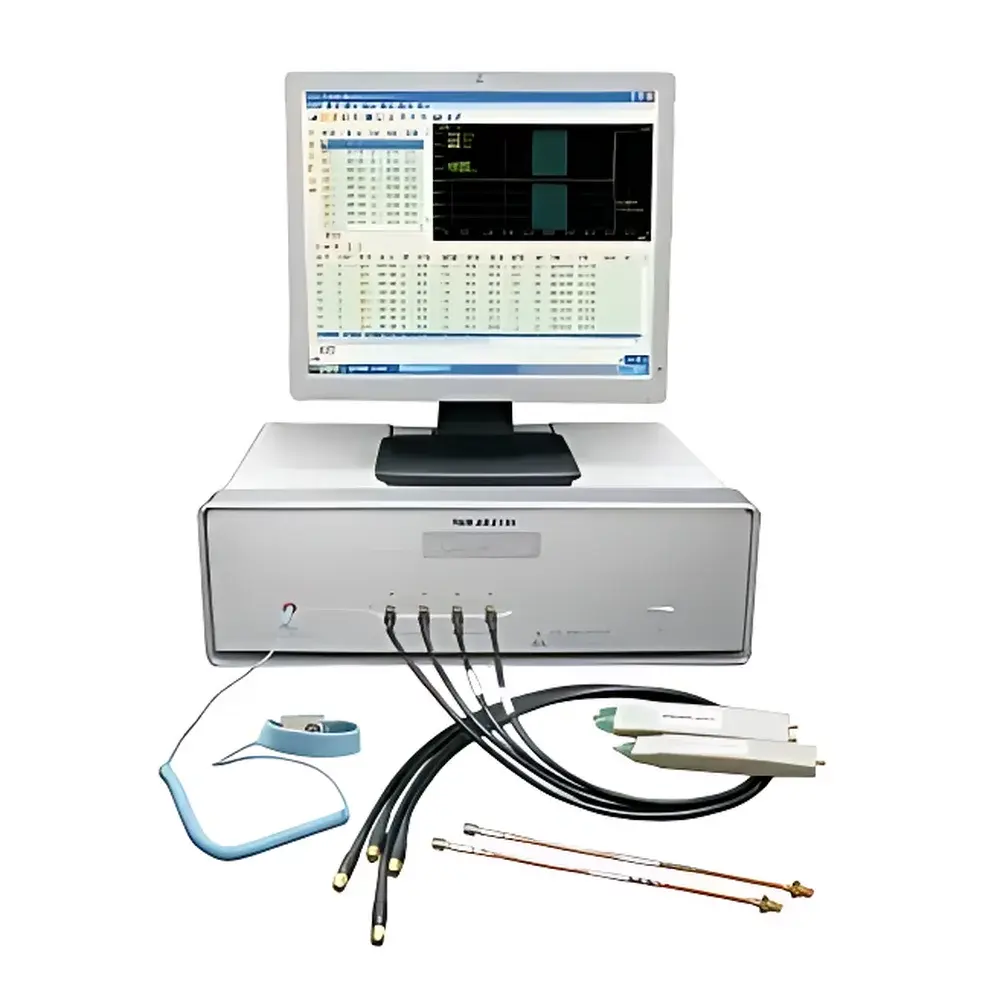
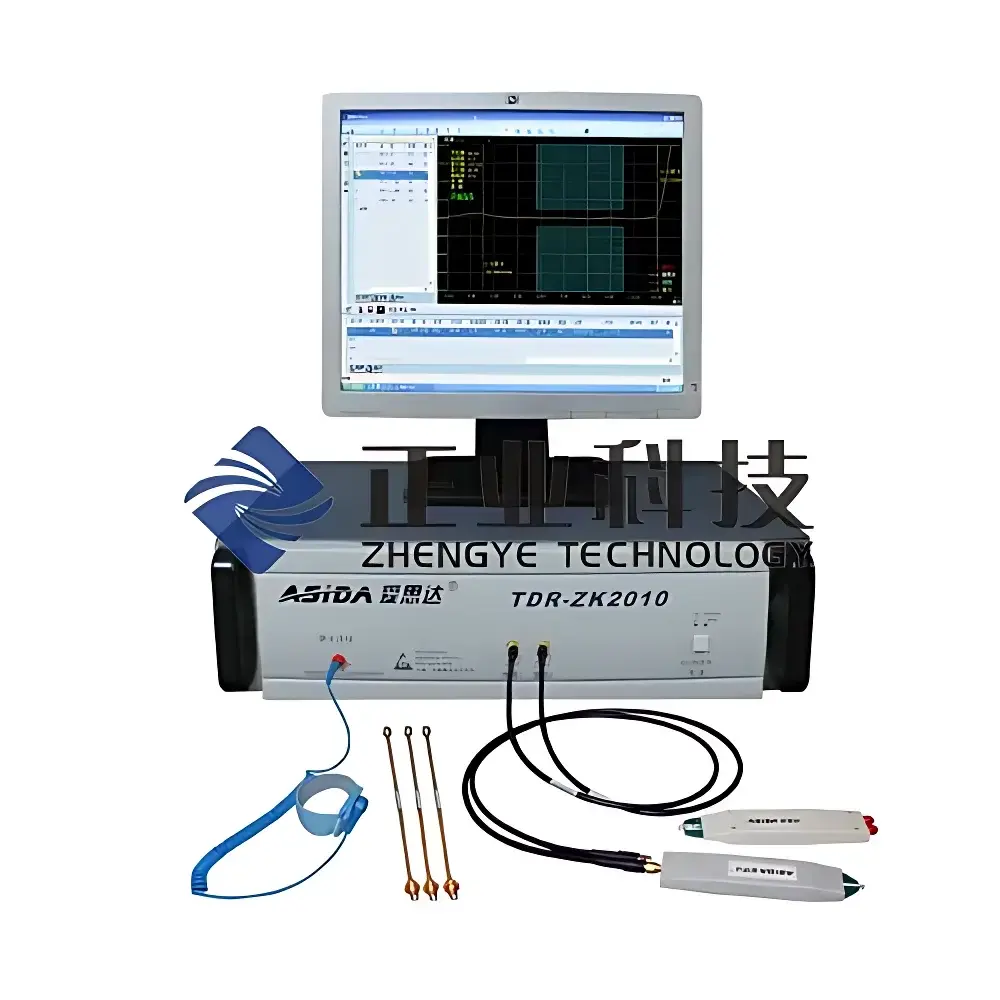
Aisida ZK2130 TDR-Based Characteristic Impedance Analyzer for Wire & Cable Applications
| Brand | Aisida |
|---|---|
| Origin | Guangdong, China |
| Manufacturer Type | Authorized Distributor |
| Country of Origin | China |
| Model | ZK2130 |
| Pricing | Upon Request |
Overview
The Aisida ZK2130 is a time-domain reflectometry (TDR)-based characteristic impedance analyzer engineered for precision measurement of high-frequency transmission lines in wire, cable, and printed circuit board (PCB) applications. Unlike conventional sampling oscilloscopes, the ZK2130 integrates a dedicated TDR architecture with embedded signal integrity analysis algorithms to deliver repeatable, traceable, and production-ready impedance profiling. Its core principle relies on launching calibrated fast-rise-step pulses (sub-100 ps edge) into the device under test (DUT); reflections caused by impedance discontinuities—such as impedance mismatches, vias, connectors, or material transitions—are captured and time-correlated to spatial locations along the transmission path. This enables not only quantitative characteristic impedance (Z₀) extraction (e.g., 50 Ω, 75 Ω, 100 Ω differential) but also fault localization at centimeter-level resolution. The system complies with IPC-TM-650 2.5.1, Intel High-Speed Interconnect Design Guidelines, and IEC 61189-2 for PCB and cable characterization, supporting both R&D validation and inline quality assurance in high-volume manufacturing environments.
Key Features
- 3 GHz analog bandwidth for accurate impedance profiling of traces up to 4–5 cm in length—optimized for flexible PCBs (FPC), flat flexible cables (FFC), and high-speed backplanes
- Traceable calibration against NIST-traceable 28 Ω, 50 Ω, 75 Ω, and 100 Ω reference standards, ensuring metrological consistency across labs and production sites
- Dual-reference mode: configurable measurement alignment to either Tektronix or Polar reference platforms for cross-platform data correlation
- Automated electrostatic discharge (ESD) protection: instrument enters low-power standby after user inactivity, reducing long-term drift and extending component lifetime
- Sub-1-second per-measurement cycle time with batch parameter presets—enabling mixed-mode testing (single-ended + differential, multiple Z₀ targets) without manual reconfiguration
- Integrated waveform de-embedding and impedance profile smoothing algorithms to suppress noise-induced artifacts in noisy factory-floor environments
Sample Compatibility & Compliance
The ZK2130 supports a broad range of passive interconnect structures, including rigid and flex PCBs, coaxial and twisted-pair cables, high-frequency RF wires, copper-clad laminates, and FFC/FPC assemblies. It accommodates DUTs with impedance ranges from 25 Ω to 150 Ω (single-ended) and 50 Ω to 200 Ω (differential), with minimum feature resolution down to 1 mm. All measurements adhere to IPC-2141A (Design Guidelines for High-Speed Controlled Impedance Circuit Boards) and IPC-TM-650 Method 2.5.1 (Characteristic Impedance Measurement Using TDR). For regulated industries, the instrument’s audit trail functionality—including timestamped operator ID, parameter logs, and raw waveform archives—supports GLP/GMP documentation requirements and FDA 21 CFR Part 11-compliant data integrity frameworks when paired with validated software configurations.
Software & Data Management
The proprietary Aisida TDR Analysis Suite provides a unified interface for acquisition, visualization, statistical evaluation, and reporting. Core capabilities include real-time impedance profile rendering, SPC-based process capability indices (Cp/Cpk), pass/fail binning against user-defined limits, automated Excel export (CSV/XLSX), and customizable PDF report generation with embedded waveforms, metadata, and compliance stamps. Raw TDR waveforms are stored in IEEE 1597.1-compliant binary format for third-party post-processing. The software includes built-in support for dielectric constant (εᵣ) derivation via propagation delay measurement, enabling indirect quantification of material properties such as moisture content in geotechnical monitoring applications—consistent with ASTM D5778 and ISO 11465 methodologies.
Applications
Beyond standard wire-and-cable impedance verification, the ZK2130 serves cross-sector technical roles: in electronics manufacturing, it validates controlled-impedance routing on HDI PCBs and high-speed serial links (PCIe, USB4, HDMI); in civil infrastructure, its long-term cable-deformation monitoring mode supports landslide, dam displacement, and bridge foundation stability assessment; in agronomy and environmental science, it functions as a non-invasive soil moisture sensor using coaxial probe TDR methodology. Its dual-use architecture bridges laboratory-grade metrology and field-deployable diagnostics—making it suitable for QC labs, NPI engineering centers, and geotechnical monitoring stations alike.
FAQ
What impedance standards is the ZK2130 calibrated against?
The instrument is calibrated using NIST-traceable 28 Ω, 50 Ω, 75 Ω, and 100 Ω resistive standards, with full uncertainty budgets documented per ISO/IEC 17025 requirements.
Does the system support differential impedance measurement?
Yes—it performs true differential TDR with simultaneous dual-channel acquisition, supporting common-mode rejection and skew analysis for high-speed differential pairs.
Can raw TDR waveforms be exported for external analysis?
Yes—waveform data is exportable in IEEE 1597.1-compliant binary format, compatible with MATLAB, Python (SciPy), and industry-standard SI tools.
Is the software compliant with FDA 21 CFR Part 11?
When deployed with validated user access controls, electronic signatures, and audit trail configuration, the software meets Part 11 requirements for electronic records and signatures in regulated environments.
What is the minimum measurable impedance discontinuity length?
With 3 GHz bandwidth and sub-100 ps rise time, the system resolves impedance variations over physical lengths ≥1 mm (dependent on propagation velocity in the DUT medium).



