
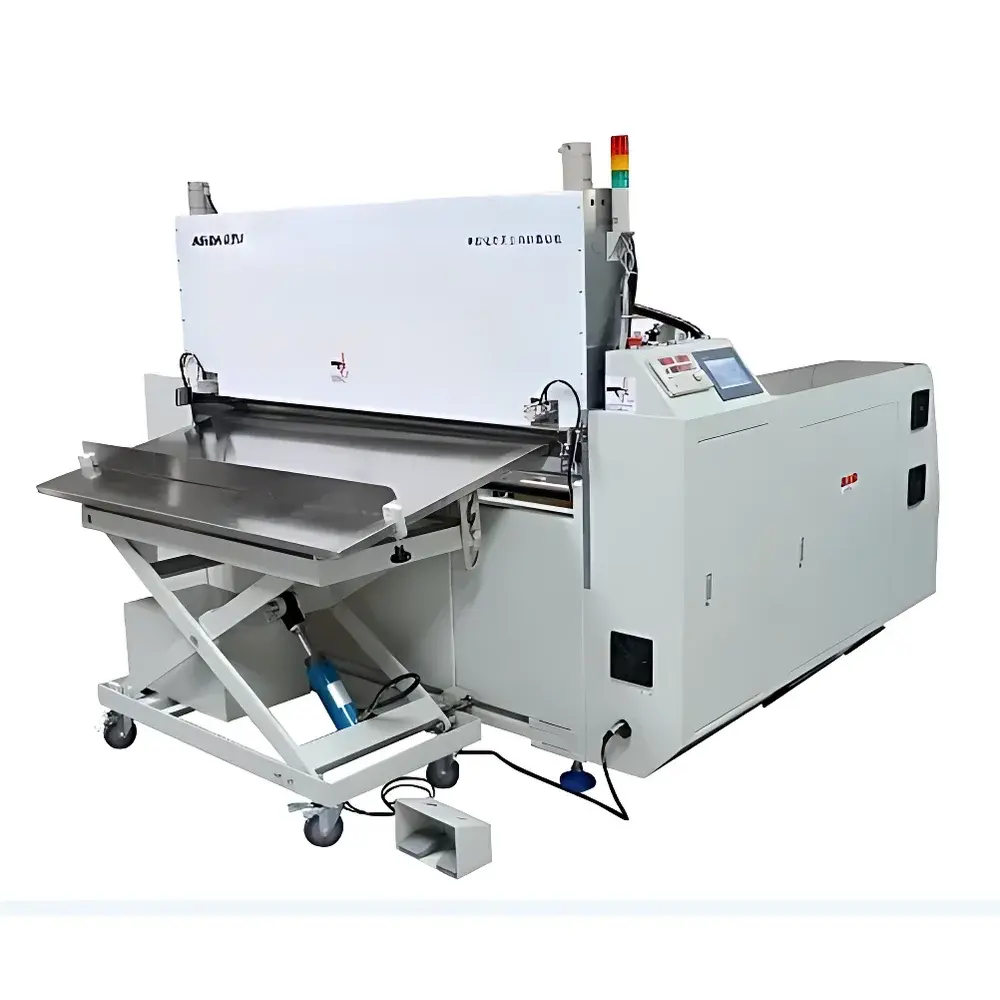
Aisida CQ2000 Automated Non-Contact Thermal Slitting System for Prepreg (PP) Rolls
| Brand | Aisida |
|---|---|
| Origin | Guangdong, China |
| Manufacturer Type | Authorized Distributor |
| Region of Manufacture | Domestic (PRC) |
| Model | CQ2000 |
| Pricing | Available Upon Request |
Overview
The Aisida CQ2000 is an automated thermal slitting system engineered specifically for the precision processing of fiberglass-reinforced epoxy prepreg (PP) rolls used in printed circuit board (PCB) and copper-clad laminate (CCL) manufacturing. Unlike conventional mechanical slitting or cold-cutting systems, the CQ2000 employs localized non-contact infrared (IR) heating immediately upstream of the cutting zone. This controlled thermal softening enables clean, low-stress separation of the thermosetting resin matrix without full polymerization—allowing the cut edge to self-seal upon rapid cooling. The result is a dust-free, fray-free, and dimensionally stable PP sheet with minimal glass fiber pull-out and no post-processing required. Designed for integration into high-throughput laminating lines, the system operates under ambient factory conditions and conforms to standard cleanroom-compatible material handling protocols for Class 10,000 environments.
Key Features
- Non-contact IR thermal pre-softening module: Delivers precise, repeatable energy dosage to the slit line, enabling clean separation while preserving resin integrity and preventing edge delamination.
- High-precision servo-driven web indexing and tension control: Ensures ±0.15 mm length accuracy at speeds up to 30 m/min, eliminating cumulative metering drift during extended runs.
- Dust-suppressed operation: Achieves >98% reduction in airborne particulate generation compared to blade-based slitters, verified per ISO 14644-1 Class 8 particle counting protocols.
- Integrated edge sealing functionality: Thermally fused edges eliminate fraying, glass fiber shedding, and micro-cracking—reducing downstream inspection rejection rates in lamination prep stages.
- Automated stacker with programmable layer count and interleaf spacing: Supports batch stacking of up to 200 sheets with consistent alignment and minimal handling-induced distortion.
- PLC-based HMI with recipe management: Stores and recalls slit width, length, speed, and thermal profile parameters for up to 99 material configurations.
Sample Compatibility & Compliance
The CQ2000 accommodates standard PP roll widths from 500 mm to 1,800 mm and thicknesses ranging from 0.05 mm to 0.30 mm (including FR-4, high-Tg, and halogen-free formulations). It supports both epoxy and phenolic resin systems with varying glass fabric weaves (e.g., 106, 1080, 2116). All electrical components comply with GB/T 5226.1–2019 (equivalent to IEC 60204-1), and the machine meets CE machinery directive requirements when installed with optional safety guarding. While not certified to UL or IPC standards as a standalone unit, its output meets IPC-4101D specification thresholds for edge quality, dimensional stability, and resin flow consistency—validated through in-house QA testing per IPC-TM-650 2.5.5.7 (edge inspection) and 2.4.40 (dimensional tolerance).
Software & Data Management
The embedded control system runs on a real-time Linux-based PLC platform with dual Ethernet ports for OPC UA integration into MES/SCADA networks. All process parameters—including web speed, IR power output, slit position deviation, and stack count—are logged with timestamped audit trails compliant with GLP/GMP documentation requirements. Optional data export supports CSV and XML formats for traceability reporting. Firmware updates are delivered via secure HTTPS, and user access levels (Operator, Technician, Administrator) enforce role-based parameter restrictions aligned with FDA 21 CFR Part 11 principles for electronic records.
Applications
- Prepreg segmentation for multilayer PCB core and build-up film lamination
- Cut-to-length processing of CCL reinforcement layers prior to etching
- Production of standardized PP blanks for HDI and IC substrate fabrication
- Low-dust prepreg handling in Class 10K cleanrooms for aerospace and medical electronics
- Prototyping and small-batch prepreg preparation where edge integrity directly impacts yield
FAQ
Does the CQ2000 require compressed air or external cooling water?
No—only single-phase 220 VAC/50 Hz power and ambient ventilation are required. The IR emitters operate passively cooled; no auxiliary fluid circuits are integrated.
Can it process phenolic or polyimide-based prepregs?
Yes—thermal profiles are adjustable across 200–450 °C ranges; validated compatibility includes common phenolic resins (e.g., FR-1) and select polyimide systems with modified curing kinetics.
What maintenance intervals are recommended for the IR heating array?
Annual optical calibration and quartz emitter inspection are advised; mean time between failures exceeds 12,000 operating hours under standard duty cycles.
Is offline programming supported for custom slit patterns?
Yes—the HMI supports G-code-style pattern definition for nested or staggered layouts, with preview simulation prior to execution.






