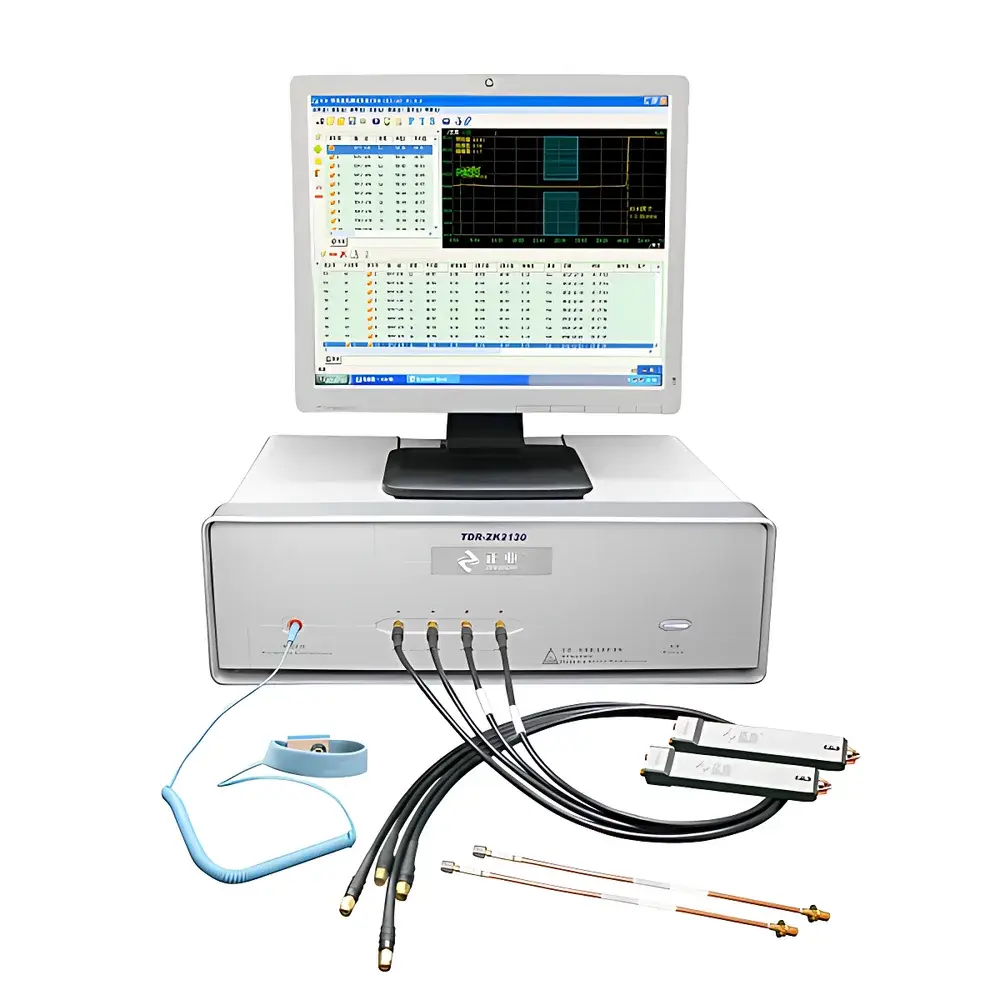
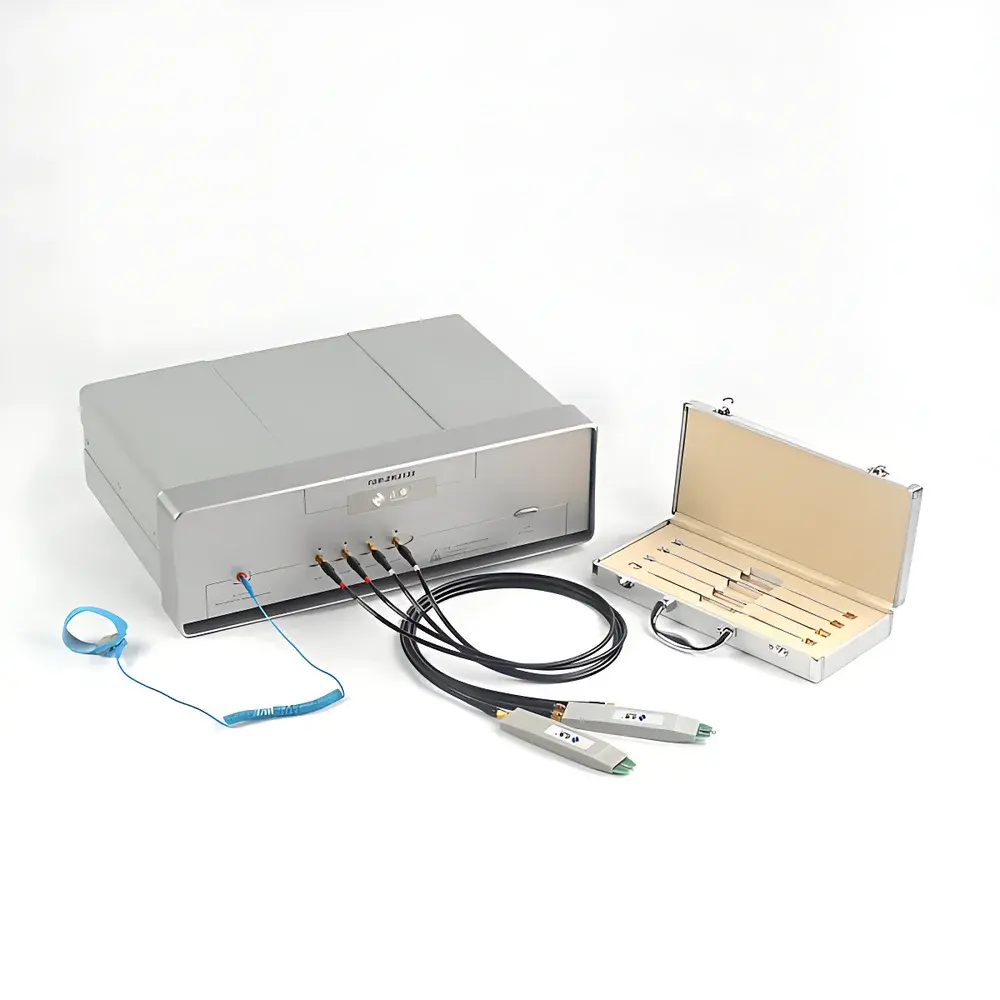
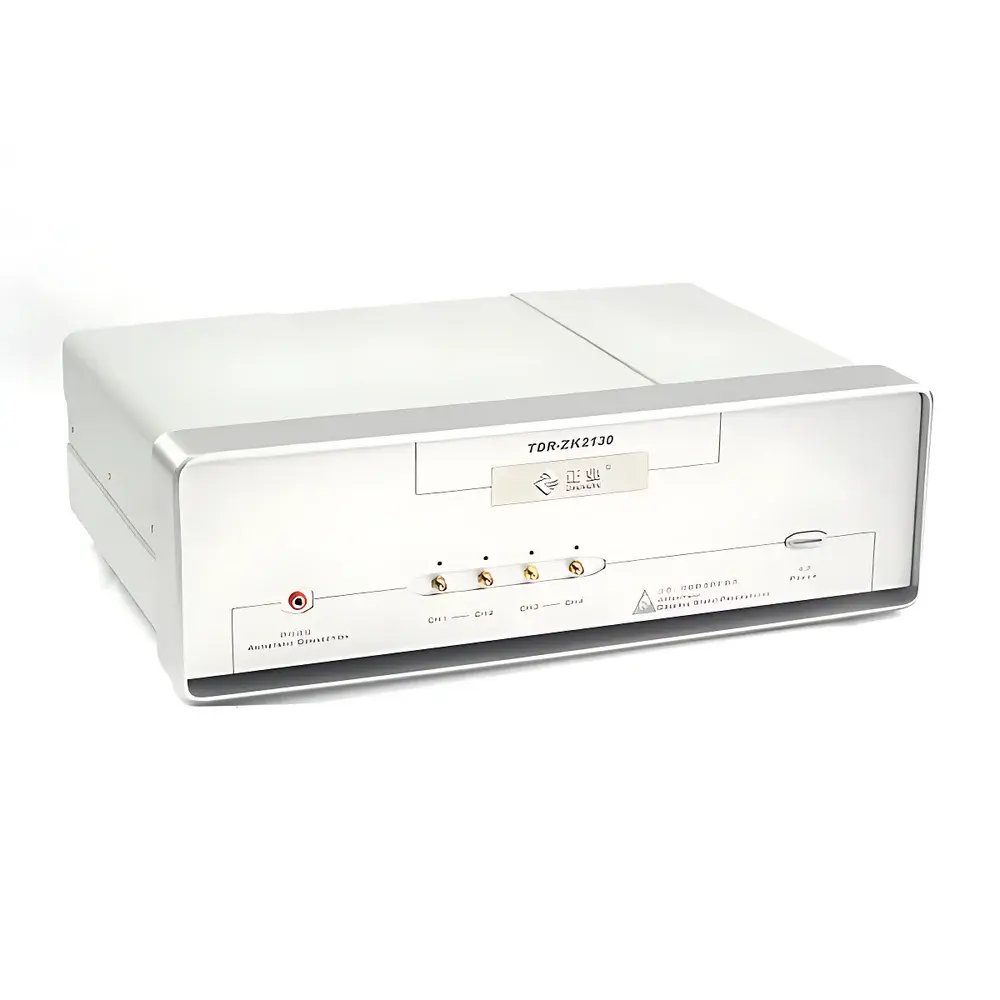
TDR Impedance Analyzer ZK2130 by Zhengye
| Brand | Zhengye |
|---|---|
| Model | ZK2130 |
| Origin | Guangdong, China |
| Manufacturer Type | OEM Manufacturer |
| Measurement Principle | Time-Domain Reflectometry (TDR) |
| Impedance Range | 20–150 Ω |
| Length Range | 0.05–2 m |
| Accuracy | ±1% @ 50 Ω |
| Measurement Speed | ≤1 s per point |
| Bandwidth | 3 GHz |
| Dynamic Range for S-Parameter Measurement | >100 dB |
| Compliance | Designed for IPC-TM-650 2.5.1 and IPC-TR-579 compliant PCB impedance verification |
Overview
The Zhengye ZK2130 TDR Impedance Analyzer is a precision time-domain reflectometry instrument engineered for high-fidelity characteristic impedance characterization of printed circuit board (PCB) transmission lines and coaxial cables. Based on the physical principle of incident pulse reflection analysis—where a fast-rising step or impulse signal propagates along a test structure and reflections are captured in real time—the ZK2130 quantifies impedance discontinuities, impedance profiles, and distributed line parameters with sub-nanosecond temporal resolution. Its 3 GHz bandwidth enables reliable measurement of microstrip, stripline, and coplanar waveguide structures commonly found in high-speed digital and RF PCBs operating up to 1.5 GHz fundamental frequencies. Unlike vector network analyzers (VNAs), which rely on frequency-domain synthesis, the ZK2130 delivers direct time-localized impedance mapping without Fourier transformation artifacts, making it especially suitable for production floor deployment where rapid pass/fail decisions and trace-level fault localization are required.
Key Features
- High-accuracy TDR core with ±1% impedance accuracy referenced to 50 Ω standard, validated against NIST-traceable calibration standards;
- Integrated high-resolution sampling architecture with synchronized acquisition and multi-point calibration routines accessible to users;
- Programmable high-frequency coaxial switching matrix supporting automated multi-port, multi-layer board testing without manual probe repositioning;
- Onboard waveform analysis engine enabling real-time impedance profile extraction, derivative-based discontinuity detection, and length-to-fault calculation;
- One-click multi-task sequencing: supports concurrent impedance measurement across multiple traces, statistical batch reporting, and auto-generation of IPC-compliant test records;
- Fully open calibration interface—users may perform full two-port short-open-load (SOL) calibration or apply custom error models for fixture de-embedding;
- Rugged industrial enclosure rated for continuous operation in factory environments (IEC 60068-2 environmental compliance);
- Front-panel USB-C and Gigabit Ethernet interfaces for firmware updates, remote control via SCPI commands, and integration into MES/SPC systems.
Sample Compatibility & Compliance
The ZK2130 accommodates a broad range of sample configurations including bare PCB coupons, loaded boards with surface-mount components, and discrete coaxial cables (RG-174, RG-316, semi-rigid). It supports standard IPC test fixtures (e.g., IPC-2141A compliant launch structures) and offers configurable impedance reference planes for accurate de-embedding of probe-to-pad transitions. All measurements adhere to IPC-TM-650 Test Method 2.5.1 (“Characteristic Impedance of Printed Board Traces Using TDR”) and align with IPC-TR-579 guidelines for statistical process control of impedance uniformity. The system’s data logging architecture includes timestamped audit trails, user authentication logs, and electronic signature support—facilitating GLP/GMP-aligned validation protocols and FDA 21 CFR Part 11 readiness when deployed with optional secure software modules.
Software & Data Management
ZK2130 ships with Zhengye Impedance Studio v3.x—a Windows-based application offering dual-mode operation: interactive manual analysis and automated batch execution. The software provides full waveform visualization (V(t) and Z(t)), cross-sectional impedance profiling, statistical summary tables (mean, σ, Cp/Cpk), and export to CSV, PDF, and XML formats compatible with industry-standard SPC platforms. Raw TDR datasets are stored in HDF5 format to preserve metadata integrity—including instrument configuration, calibration state, operator ID, and environmental sensor readings (optional ambient temperature/humidity logging). Audit-ready reports include embedded calibration certificates, measurement uncertainty estimates per GUM (JCGM 100), and configurable company headers/logos. Remote scripting via Python API (pyZK2130 SDK) enables integration with LabVIEW, MATLAB, or custom MES workflows.
Applications
- Production-line impedance verification of HDI, flex-rigid, and high-speed backplane PCBs prior to lamination and assembly;
- Root-cause analysis of impedance mismatches due to etching variation, dielectric thickness inconsistency, or copper weight deviation;
- Qualification testing of high-frequency cable assemblies used in automotive ADAS radar modules and 5G baseband interconnects;
- Design validation support for SI/PI engineers performing pre-layout and post-layout TDR correlation studies;
- In-process monitoring of impedance stability during electroplating or solder mask curing processes;
- Supplier qualification audits requiring traceable, repeatable, and standardized impedance metrology per contractual IPC specifications.
FAQ
What calibration standards are required for daily operation?
The ZK2130 supports both factory-provided calibration kits (50 Ω short/open/load/thru) and user-defined standards. Daily verification can be performed using a certified 50 Ω termination; full two-port calibration is recommended before first use and after environmental shifts exceeding ±5 °C.
Can the ZK2130 measure differential impedance?
Yes—when used with a differential TDR probe (e.g., Picotest J2112A or equivalent) and configured for common-mode rejection mode, the ZK2130 calculates odd-mode impedance and reports differential impedance as 2×Zodd, with accuracy dependent on probe symmetry and fixture balance.
Is S-parameter extraction supported natively?
The ZK2130 does not perform direct S-parameter synthesis; however, its time-domain impulse response can be exported and transformed via external software (e.g., Keysight ADS, Python scikit-rf) to generate S11/S21 up to its 3 GHz effective bandwidth limit.
How is measurement uncertainty quantified?
Total uncertainty is calculated per ISO/IEC Guide 98-3 (GUM) and includes contributions from probe repeatability (±0.3 Ω), timebase jitter (±0.02% of reading), and calibration residual error (±0.5 Ω typical). A full uncertainty budget report is generated with each exported dataset.
Does the system support automated pass/fail decision logic?
Yes—users define tolerance bands (e.g., 50±2 Ω over 80% of trace length) and enable real-time go/no-go flagging. Results feed directly into PLC-triggered sorting gates via digital I/O or Modbus TCP.