Zhengye QY22 Automated PCB Microsection Sampling System
| Brand | Zhengye |
|---|---|
| Origin | Guangdong, China |
| Manufacturer Type | Direct Manufacturer |
| Region | Domestic (China) |
| Model | QY22 |
| Pricing | Upon Request |
Overview
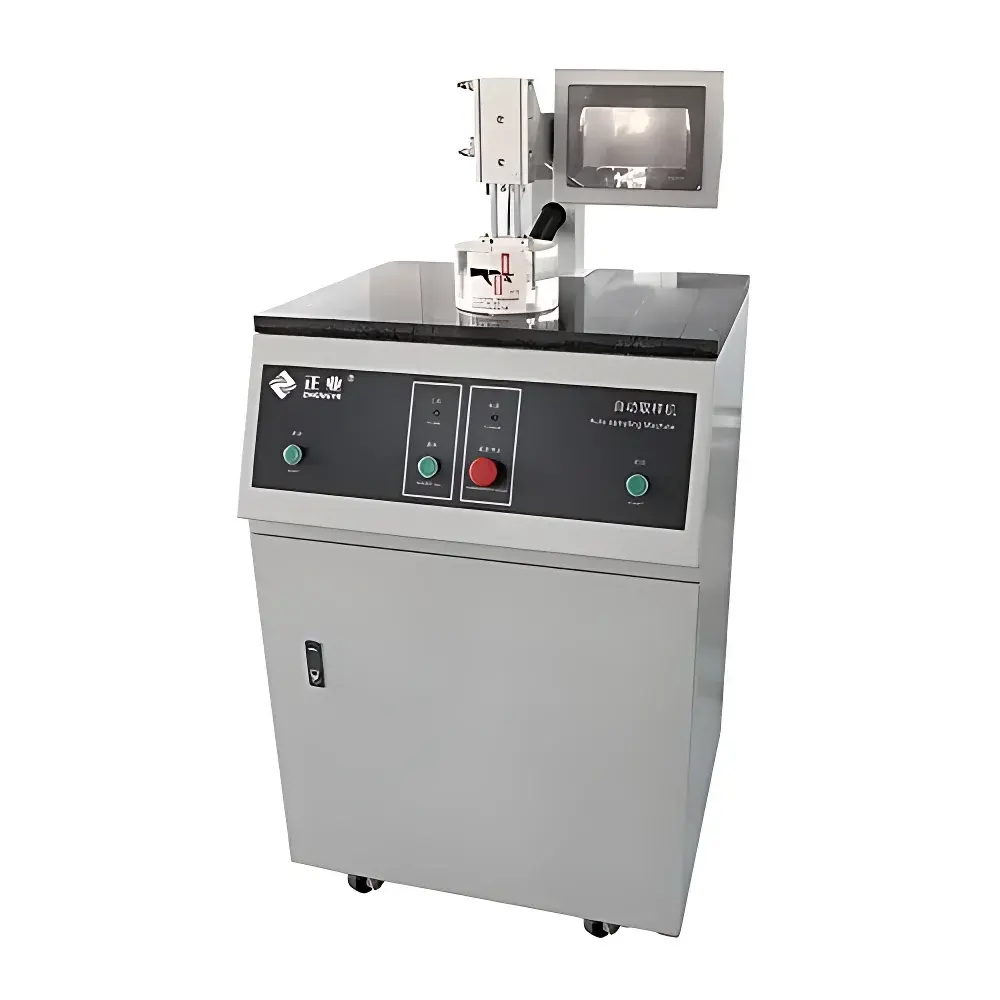
The Zhengye QY22 Automated PCB Microsection Sampling System is an industrial-grade precision sampling platform engineered for the preparation of metallurgical cross-sections from rigid printed circuit boards (PCBs), copper-clad laminates (CCL), and related multilayer substrate materials. It operates on a controlled mechanical micro-machining principle—employing high-accuracy pneumatic actuation combined with a calibrated X-Y linear motion stage—to extract representative, distortion-free specimens for subsequent metallographic mounting, grinding, polishing, and microscopic analysis. Unlike manual sectioning methods that introduce tilt, smearing, or thermal damage, the QY22 ensures orthogonal, planar cuts at user-defined coordinates, preserving interfacial integrity between copper traces, dielectric layers, and via structures. This capability is critical for failure analysis (FA), process validation, and quality assurance in high-reliability electronics manufacturing environments where IPC-A-600, IPC-6012, and MIL-STD-202 compliance are mandatory.
Key Features
- Pneumatically driven precision motion system integrated with a rigid X-Y translation stage, delivering repeatable positioning accuracy within ±5 µm over full travel range
- Optically transparent work chamber with integrated LED illumination and side-view observation port—enabling real-time visual verification of sample alignment and cut initiation without interrupting operation
- Programmable sampling logic via embedded HMI interface; supports coordinate-based batch sampling, multi-point grid patterns, and conditional logic for layer-specific targeting (e.g., surface trace vs. buried via)
- High-speed, low-vibration electric spindle (rated for continuous duty at 30,000 rpm) coupled with diamond-impregnated micro-saw blades optimized for non-ferrous composite substrates
- Dust-suppressed cutting environment achieved through localized vacuum extraction at blade contact point, minimizing airborne particulate generation and eliminating need for external fume hoods
- Structural frame fabricated from stress-relieved aluminum alloy with vibration-damping base mount—designed to maintain dimensional stability during extended operational cycles
Sample Compatibility & Compliance
The QY22 accommodates standard PCB formats up to 300 mm × 300 mm and thicknesses ranging from 0.2 mm to 3.2 mm, including FR-4, polyimide, Rogers high-frequency laminates, and metal-core boards. It supports both single-sided and multilayer constructions with blind/buried vias, HDI architectures, and embedded passive components. All sampling protocols align with ASTM E3–22 (Standard Guide for Preparation of Metallographic Specimens) and IPC-TM-650 2.1.1 (Microsectioning). The system’s mechanical repeatability and documented traceability support GLP-compliant documentation workflows, and its programmable parameters meet audit requirements for ISO 9001:2015 Clause 8.5.1 (Control of Production and Service Provision).
Software & Data Management
The onboard control firmware includes timestamped log generation for every sampling event—including XY coordinates, spindle speed, feed rate, blade wear counter, and operator ID. Exportable CSV logs integrate with LIMS platforms via USB or Ethernet (TCP/IP). While the system does not include proprietary cloud connectivity, its data schema conforms to ASTM E1382–21 (Standard Practice for Digital Recording of Microstructural Data), enabling interoperability with third-party image analysis software (e.g., Olympus Stream, Thermo Scientific AxioVision). Audit trail functionality satisfies FDA 21 CFR Part 11 requirements when deployed in regulated medical device PCB manufacturing facilities.
Applications
- Verification of copper plating uniformity and void content in through-holes and microvias
- Measurement of solder mask thickness, registration accuracy, and undercut profiles
- Assessment of intermetallic compound (IMC) growth at Cu–Sn interfaces after thermal cycling
- Failure root cause identification in delamination, cracking, or conductive anodic filamentation (CAF)
- Process capability studies for lamination pressure/temperature profiles and etch uniformity
- Qualification testing per IPC-6012 Class 2 and Class 3 performance criteria
FAQ
What types of PCB substrates can the QY22 process without chipping or delamination?
The system is validated for FR-4, BT resin, polyimide, ceramic-filled PTFE, and aluminum-backed MCPCBs using optimized spindle speed/feed combinations and blade geometry selection.
Is the sampling location programmable to sub-millimeter precision?
Yes—coordinate input resolution is 1 µm, with mechanical repeatability confirmed at ±3 µm across 1,000 consecutive cycles per ISO 230-2.
Does the system comply with cleanroom-compatible operational standards?
It meets ISO Class 8 (100,000) particulate emission limits when operated with optional HEPA-filtered vacuum module; no oil-lubricated components are present.
Can raw sampling logs be exported for integration into enterprise QA databases?
All operational metadata exports as time-stamped, UTF-8 encoded CSV files compatible with SQL ingestion pipelines and statistical process control (SPC) dashboards.
What maintenance intervals are recommended for sustained metrological reliability?
Blade replacement every 200–300 samples; X-Y stage linear guides require grease replenishment every 6 months under continuous use; annual calibration verification against NIST-traceable gauge blocks is advised.
Related Products