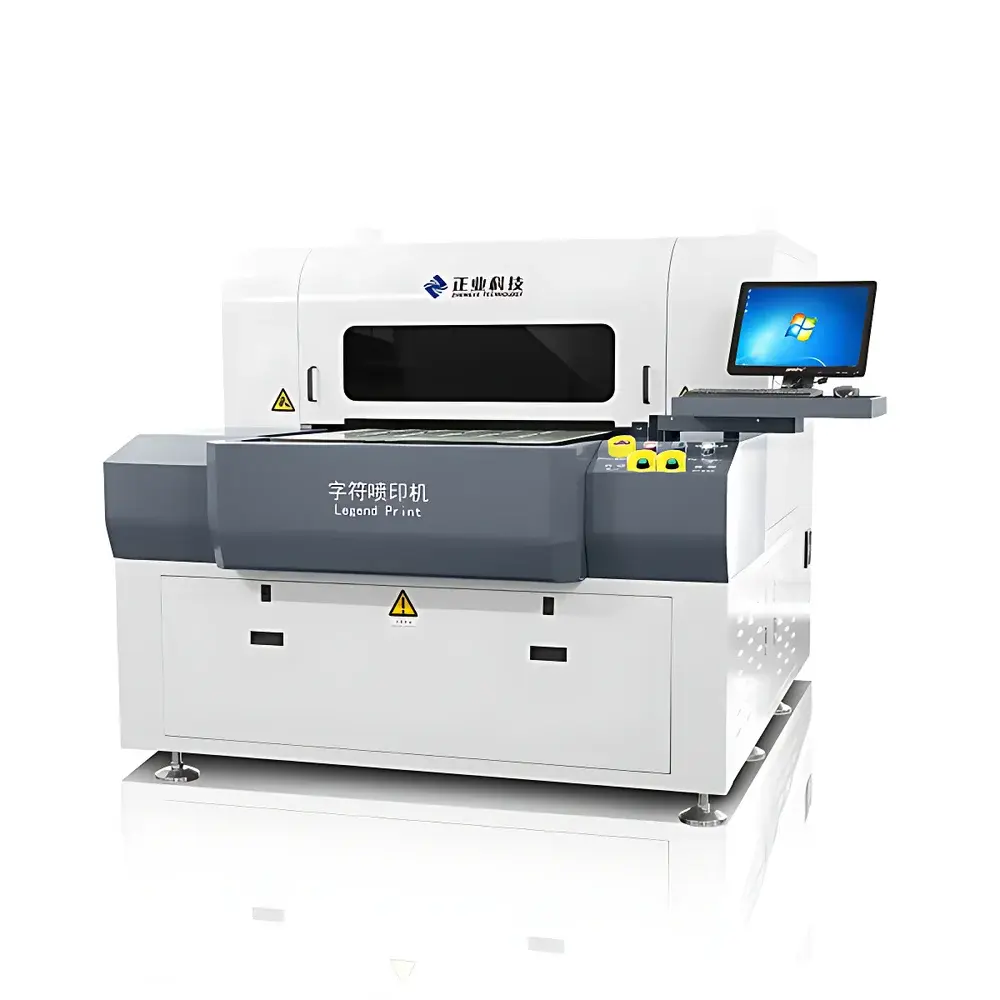
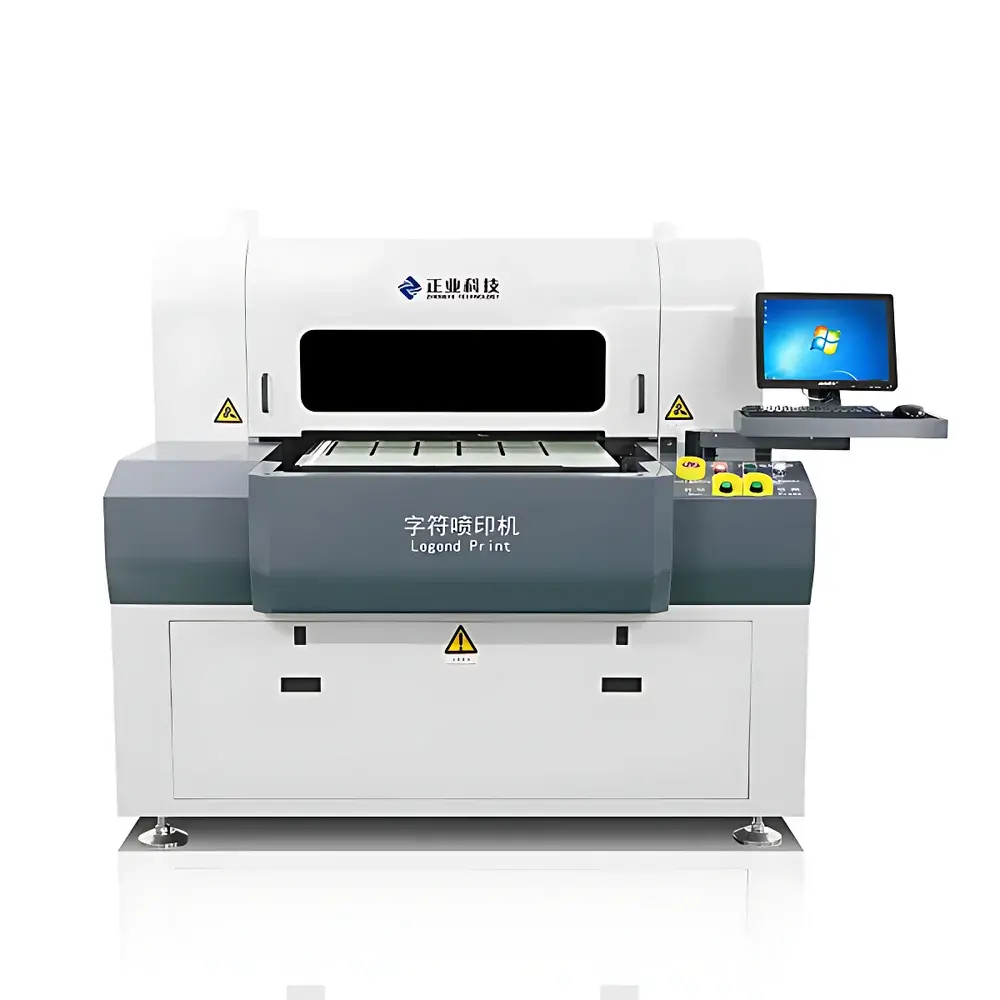
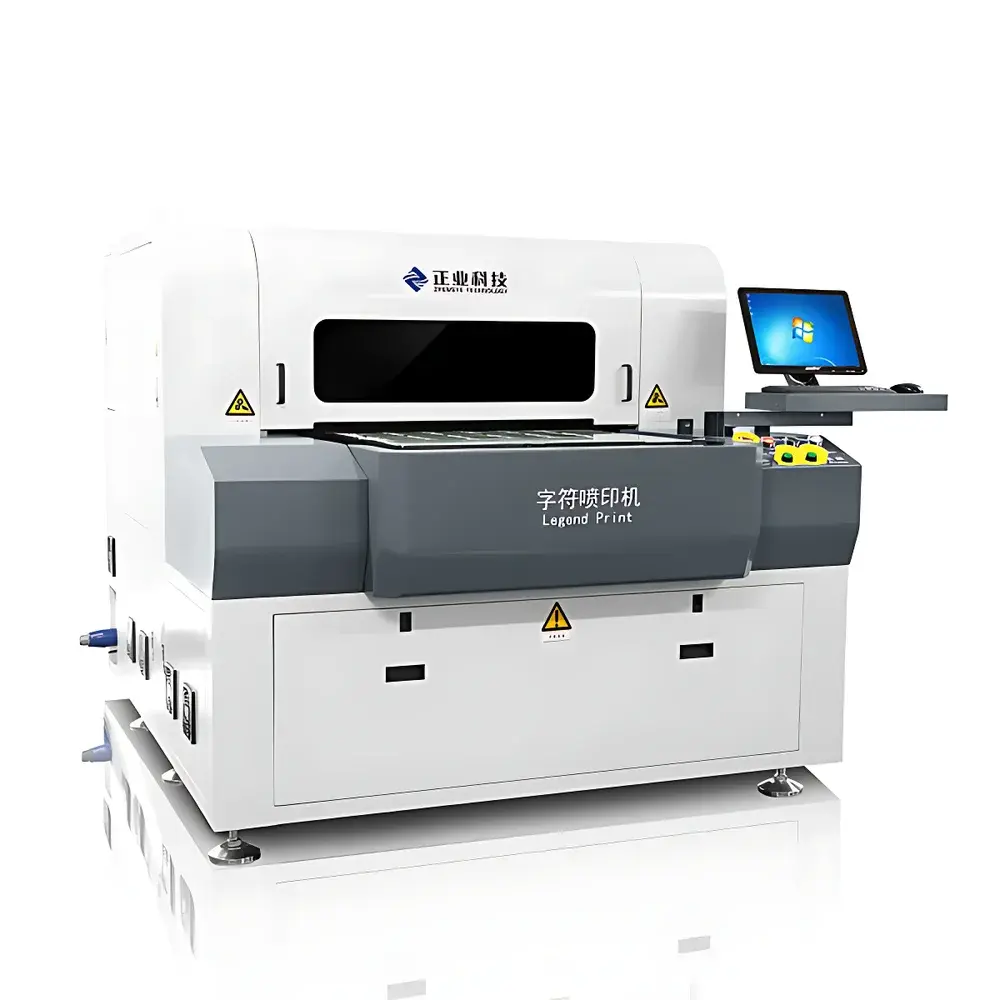
Zhengye PY300 Fully Automated Character Inkjet Printing System
| Brand | Zhengye |
|---|---|
| Origin | Guangdong, China |
| Manufacturer Type | OEM/ODM Manufacturer |
| Country of Origin | China |
| Model | PY300 |
| Pricing | Available Upon Request |
Overview
The Zhengye PY300 Fully Automated Character Inkjet Printing System is an industrial-grade, vision-guided inkjet marking solution engineered for high-precision alphanumeric and symbology printing on rigid printed circuit board (PCB) substrates. Unlike conventional screen-printing methods—prone to stencil wear, ink viscosity drift, and manual alignment variability—the PY300 employs non-contact piezoelectric drop-on-demand (DOD) inkjet technology combined with real-time optical registration and dynamic scaling compensation. This architecture eliminates physical contact between print head and substrate, minimizing risk of surface damage or ink smearing while enabling consistent 6–12 mil (150–300 µm) character resolution across variable board geometries. Designed specifically for PCB fabrication lines operating under IPC-A-600 and IPC-6012 compliance requirements, the system integrates seamlessly into automated SMT and AOI workflows, supporting both single-sided and dual-sided marking via programmable top/bottom flip sequencing.
Key Features
- Integrated vision-based auto-alignment: High-resolution CMOS camera system with sub-pixel edge detection ensures precise registration to fiducial marks or board outlines—even on warped or thermally expanded substrates.
- Dynamic scale compensation algorithm: Compensates for thermal expansion and mechanical stretch in real time using board-level dimensional feedback, maintaining ±15 µm positional repeatability over full production cycles.
- Fully synchronized material handling: Dual-belt conveyor with vacuum-assisted clamping and servo-controlled indexing enables seamless transfer between loading, inspection, printing, and unloading stations without manual intervention.
- Dual-side printing capability: Integrated robotic flip module allows automatic 180° board inversion with <2.5 s cycle time, eliminating need for secondary handling or offline reorientation.
- Modular ink delivery architecture: Supports solvent-based, UV-curable, and lead-free soldermask-compatible inks; ink pressure, temperature, and jetting frequency are independently tunable per nozzle group.
- Industrial control interface: EtherCAT-based motion coordination with PLC-level diagnostics and OPC UA server support for MES integration (e.g., Siemens SIMATIC, Rockwell FactoryTalk).
Sample Compatibility & Compliance
The PY300 accommodates standard FR-4, polyimide, metal-core, and HDI PCBs ranging from 50 × 50 mm to 450 × 600 mm in size and 0.2–6.0 mm in thickness. Board warpage up to 3.0 mm is compensated via multi-point Z-height mapping during pre-scan. All ink chemistries used comply with IPC-4552A (electroless nickel immersion gold), IPC-4556 (immersion silver), and RoHS 2011/65/EU directives. System firmware and log management conform to FDA 21 CFR Part 11 requirements for electronic records and signatures when configured with audit trail and user role-based access control.
Software & Data Management
Controlled by Zhengye’s proprietary PrintMaster v4.2 software suite, the PY300 supports offline job programming via Gerber RS-274X import, DXF vector overlay, and CSV-based variable data injection (e.g., serial numbers, date codes, QR codes). All print parameters—including nozzle voltage profiles, dwell times, and grayscale dithering—are stored in encrypted project files with SHA-256 checksum validation. Full system logging includes timestamped operational events, ink usage metrics, nozzle health diagnostics, and image capture of every printed field. Data export supports CSV, XML, and SQL formats compatible with SAP QM, Oracle Manufacturing Cloud, and custom LIMS platforms.
Applications
- PCB identification marking: Component-side silkscreen replacement for part numbers, revision codes, UL marks, and regulatory symbols.
- Traceability encoding: Dynamic serialization and 2D Data Matrix generation compliant with IPC-2581 and IEC 61340-5-1 ESD labeling standards.
- High-mix low-volume production: Rapid job changeover (<90 s) without hardware reconfiguration—ideal for prototype labs and contract manufacturers.
- Lead-free process compatibility: Verified operation with halogen-free inks meeting J-STD-020C MSL classification requirements.
- Automated line integration: Direct interfacing with AOI systems (e.g., Koh Young, Mirtec) for closed-loop print quality verification and statistical process control (SPC) reporting.
FAQ
What types of PCB substrates can the PY300 handle?
FR-4, polyimide, aluminum-backed MCPCBs, and ultra-thin flex-rigid hybrids—with thicknesses from 0.2 mm to 6.0 mm and maximum bow/twist of 3.0 mm.
Does the system support industry-standard communication protocols?
Yes—EtherCAT for motion control, OPC UA for MES/ERP integration, and Modbus TCP for legacy PLC interoperability.
How is print quality verified in-line?
Optional integrated high-speed line-scan camera captures 100% of printed fields at 60 fps; defect detection uses morphology-based binarization and ISO/IEC 15415-compliant symbol grading.
Is remote monitoring and predictive maintenance supported?
Yes—cloud-enabled telemetry (optional) provides real-time nozzle status, ink level forecasting, and mean time between failures (MTBF) analytics via secure TLS 1.3 connection.
Can the PY300 be validated for regulated manufacturing environments?
Full IQ/OQ documentation package available; qualified for GMP Annex 11 and ISO 13485 medical device PCB production when deployed with 21 CFR Part 11-compliant configuration.