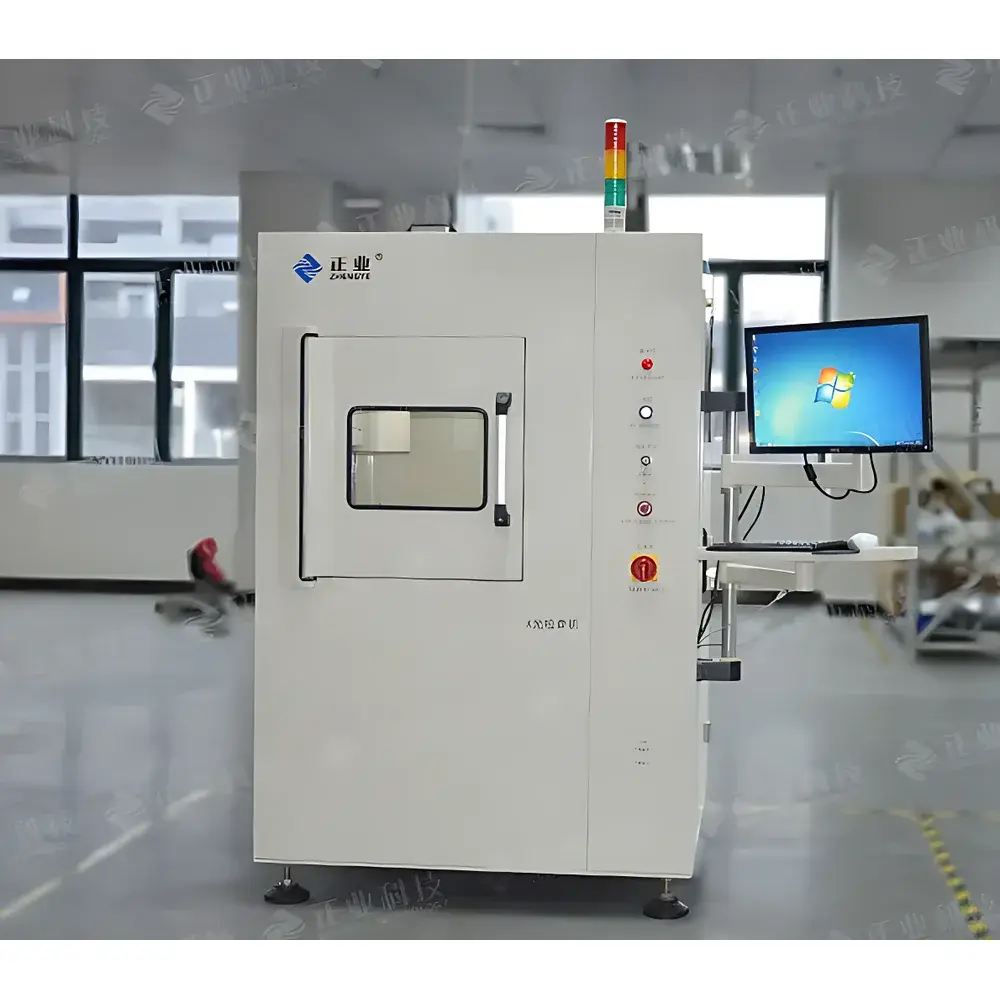
Zhengye XG5010 Industrial X-ray Inspection System for Lithium-ion Power Cell QA
| Brand | Zhengye |
|---|---|
| Origin | Guangdong, China |
| Manufacturer Type | OEM/ODM Manufacturer |
| Country of Origin | China |
| Model | XG5010 |
| X-ray Tube Voltage | 90–130 kV (configurable) |
| X-ray Tube Current | 89–455 µA (configurable) |
| Focal Spot Size | 5–15 µm |
| Cooling Method | Forced Air Cooling |
| Detector Type | Image Intensifier or Flat Panel Detector |
| Field of View | Φ100 mm or 114.9 mm × 64.6 mm (configurable) |
| Detector Resolution | 1392 × 1040 or 1536 × 864 pixels (configurable) |
| Geometric Magnification | 12×–48× |
| Repeatability Accuracy | ±60 µm |
| Inspection Speed | ≥1.5 points/sec (excluding loading/unloading and stage motion) |
| Stage Dimensions | 515 mm × 460 mm |
| Effective Inspection Area | 450 mm × 410 mm |
| Max Load Capacity | ≤5 kg |
| Radiation Safety | ≤1 µSv/hr (compliant with IEC 61331-1 & ISO 4037) |
| Computer | 22" widescreen LCD/touch display, Intel Core i5, 4 GB RAM, 500 GB HDD |
| System Dimensions | 1136 mm × 1076 mm × 1730 mm |
| Weight | ~750 kg |
| Power Supply | AC 220 V, 10 A |
| Operating Environment | 25 °C ±3 °C, RH 50% ±10% |
Overview
The Zhengye XG5010 Industrial X-ray Inspection System is a purpose-built non-destructive testing (NDT) platform engineered for high-precision internal structural evaluation of lithium-ion power cells in production and quality assurance environments. Leveraging transmission X-ray imaging physics—where differential X-ray attenuation reveals variations in material density and thickness—the system enables real-time, high-contrast visualization of electrode alignment, weld integrity, foil wrinkling, foreign particle inclusion, separator displacement, and anode/cathode delamination. Designed to meet the stringent dimensional and defect-detection requirements of automotive-grade and energy storage battery manufacturing, the XG5010 supports inline and offline inspection workflows without sample destruction or process interruption. Its architecture integrates radiation-hardened components, precision mechanical stages, and calibrated detector geometry to ensure metrological traceability and long-term stability under continuous industrial operation.
Key Features
- 2.5D Metrology Engine: Supports calibrated geometric measurements—including linear distance, circle diameter, concentricity of nested electrodes, and point-to-center offset—with sub-pixel interpolation and edge-enhanced detection algorithms.
- CNC Path Programming: Enables repeatable, script-driven inspection sequences; users record motion trajectories via teach-in mode, store multi-step programs, and execute them with positional repeatability ≤±10 µm.
- Smart Navigation Interface: Features a large-scale overview image window (1:1 pixel mapping); click any region to auto-translate and zoom the high-magnification field-of-view to that coordinate with <500 ms latency.
- Real-Time Image Processing: Offers dynamic contrast enhancement, noise suppression (adaptive median filtering), grayscale thresholding, and ROI-based histogram equalization—all applied during acquisition without frame buffering delay.
- Radiation-Safe Enclosure: Complies with IEC 61331-1 Class II shielding standards; lead-equivalent barrier design ensures ambient dose rate ≤1 µSv/hr at 5 cm from cabinet surface under full-power operation.
Sample Compatibility & Compliance
The XG5010 accommodates prismatic, cylindrical, and pouch-type power cells up to 450 mm × 410 mm footprint and 5 kg mass. Its modular detector and collimator configuration allows optimization for varying cell thicknesses—from 10 mm thick LFP prismatic modules to 150 mm tall NMC cylindrical cells—while maintaining spatial resolution down to 5 µm effective pixel pitch at maximum geometric magnification. The system meets ISO 17025-relevant calibration traceability requirements for dimensional metrology when used with certified reference phantoms (e.g., PTB-certified step wedges and line-pair gauges). Radiation safety documentation includes full IEC 61331-1 test reports and third-party dose mapping certificates. For regulated battery production facilities, the system supports audit-ready operation logs aligned with ISO 9001:2015 and IATF 16949 clause 8.5.1.2 on process validation records.
Software & Data Management
The proprietary Zhengye VisionInsight™ software provides a deterministic, deterministic inspection workflow engine compliant with FDA 21 CFR Part 11 Annex 11 principles. It features role-based user access control (administrator, operator, QA reviewer), electronic signature capture, immutable audit trails (timestamped actions, parameter changes, pass/fail decisions), and encrypted SQLite database storage with daily automated backup. Image datasets are saved in DICOM 3.0-compliant format with embedded metadata (kV, µA, exposure time, stage coordinates, measurement annotations). Batch reporting exports PDF/CSV summaries including defect type, location (X/Y/Z in mm), size, confidence score, and SPC-compatible trend charts. Integration with MES/SCADA systems is supported via OPC UA and RESTful API endpoints for automated result injection into enterprise quality databases.
Applications
- Electrode stack misalignment quantification in stacked prismatic cells
- Weld seam continuity and void detection in tab welding zones
- Separator shrinkage or tearing assessment post-formation cycling
- Foreign metallic particle localization and size classification (≥25 µm detectable)
- Can seam integrity verification for cylindrical cell housings
- Post-dry-room moisture-induced foil corrosion pattern analysis
- Pre-shipment FA (failure analysis) correlation between electrical test failures and internal structural anomalies
FAQ
Is the XG5010 certified for use in ISO 13485-certified medical battery production lines?
Yes—the system’s mechanical stability, radiation safety documentation, and software audit trail capabilities align with ISO 13485:2016 clause 7.6 on monitoring and measuring equipment validation.
Can the system be integrated with existing factory automation protocols such as EtherCAT or Profinet?
No native fieldbus integration is provided; however, discrete I/O signals (pass/fail, cycle start/stop, error status) are available via 24 V DC terminals and can be bridged to PLCs using standard relay modules.
What is the recommended calibration interval for metrological accuracy?
Zhengye recommends annual recalibration using NIST-traceable step gauges and line-pair resolution targets, supplemented by daily warm-up and flat-field correction routines.
Does the software support custom defect classification rules beyond built-in templates?
Yes—VisionInsight™ includes a rule editor supporting Boolean logic, grayscale histogram thresholds, and morphological filters to define user-specific defect signatures.
Are service contracts and remote diagnostics available outside mainland China?
Global technical support is offered through authorized regional partners; remote diagnostics require prior customer network security approval and TLS 1.2–enabled VPN tunneling.