
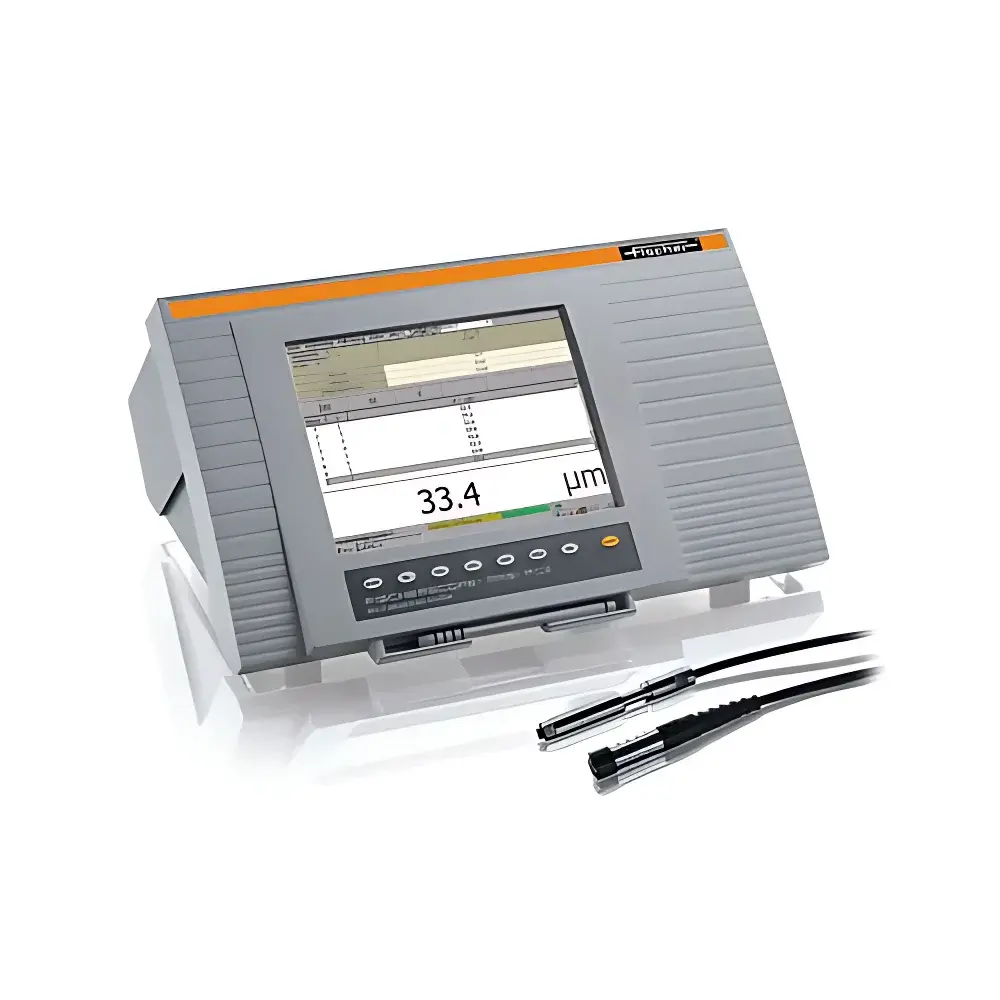
FISCHERSCOPE MMS PC2 BU Coating Thickness Gauge for PCB Copper Plating
| Origin | Germany |
|---|---|
| Manufacturer Type | Authorized Distributor |
| Origin Category | Imported Instrument |
| Model | MMS PC2 BU |
| Price Range | USD 27,000 – 68,000 (based on configuration and probe selection) |
Overview
The FISCHERSCOPE® MMS® PC2 BU is a high-precision, benchtop coating thickness measurement system engineered specifically for quality assurance in printed circuit board (PCB) manufacturing and advanced metallization processes. It employs the four-point micro-resistive (4-point probe) principle—also known as the eddy current–compensated resistance method—to quantitatively determine the thickness of bare copper foils on PCB substrates with exceptional surface sensitivity and layer selectivity. Unlike conventional eddy current or magnetic induction gauges, this system isolates the resistive contribution of the topmost conductive layer, effectively eliminating interference from underlying copper layers, dielectric substrates (e.g., FR-4), or plating undercoats. Its architecture integrates modular electronics, real-time signal conditioning, and calibrated probe physics to deliver traceable, repeatable measurements compliant with IPC-4552A (Electroless Nickel/Immersion Gold – ENIG) and IPC-TM-650 2.2.17 (Copper Foil Thickness Measurement) standards.
Key Features
- Benchtop design with integrated 7-inch full-color TFT touchscreen interface supporting multi-language operation—including English, German, Chinese, and Japanese—enabling intuitive navigation without external peripherals.
- Modular hardware platform: Accepts interchangeable measurement modules including the SR_SCOPE module for resistive-based PCB copper analysis and optional modules for XRF, eddy current, or magnetic induction depending on application scope.
- Dedicated ERCU N1 four-point contact probe: Engineered for non-destructive, localized measurement of bare copper foil thickness (typically 5–120 µm) directly on drilled or uncoated PCB pads and traces; insensitive to backside copper or adjacent metallization.
- Onboard data storage capacity: Up to 1,000 user-defined measurement applications, each capable of storing up to 1,000,000 individual readings with timestamp, location tag, and operator ID metadata.
- Statistical process control (SPC) suite: Real-time calculation of mean, standard deviation, Cp/Cpk, histogram distribution, and X̄-R control charts—all exportable in CSV or PDF format for QA documentation and audit readiness.
- Industrial-grade connectivity: Dual USB 2.0 ports (host/device), RS-232 serial interface (DB9), integrated 10/100 Mbps Ethernet port, and PS/2 support for external keyboard/mouse—enabling seamless integration into factory MES or LIMS environments.
Sample Compatibility & Compliance
The MMS PC2 BU is validated for use on rigid and flex-rigid PCBs with standard substrate materials (FR-4, polyimide, ceramic) and common surface finishes (ENIG, OSP, HASL, immersion silver). It supports measurement on flat, slightly curved, or stepped surfaces where probe contact area remains fully engaged. All measurement algorithms are traceably calibrated against NIST-traceable copper foil standards and certified per ISO/IEC 17025 requirements by accredited calibration laboratories. The system meets electromagnetic compatibility (EMC) standards per EN 61326-1 and safety compliance per EN 61010-1. For regulated environments, firmware version 3.2+ supports audit trail logging, electronic signature workflows, and 21 CFR Part 11–compliant user access controls when deployed with optional validation packages.
Software & Data Management
The instrument operates on Fischer’s proprietary WinFTM® software platform (v4.1 or later), which provides full remote control via LAN or USB, automated report generation (including SPC summaries and measurement trend overlays), and bidirectional data exchange with SQL databases or Excel-based QA dashboards. Raw measurement data includes analog voltage output signals, temperature-compensated resistance values, and geometric correction factors applied in real time. All stored datasets include embedded calibration certificate IDs, probe serial numbers, and environmental sensor logs (ambient temperature/humidity) to satisfy GLP/GMP documentation requirements. Data export formats include .csv, .txt, .pdf, and structured XML for ERP integration.
Applications
- Final inspection of electroplated copper thickness on inner/outer PCB layers prior to etching or solder mask application.
- In-process verification of copper buildup in HDI microvia filling and sequential lamination cycles.
- Process capability studies for acid copper plating baths—correlating thickness uniformity with bath chemistry parameters (Cu²⁺, H₂SO₄, Cl⁻, additives).
- Failure analysis of delamination or blistering incidents by cross-referencing localized thickness deviations with thermal stress profiles.
- Supplier qualification audits requiring quantitative evidence of IPC Class 2 or Class 3 conformance for aerospace and medical PCB assemblies.
FAQ
Can the MMS PC2 BU measure copper thickness through solder mask or silkscreen?
No. The ERCU N1 probe requires direct metallic contact with bare copper; non-conductive coatings must be removed locally prior to measurement.
Is probe recalibration required after every change of substrate material?
No—substrate-independent calibration is achieved via the four-point geometry and built-in reference resistor network; only periodic verification using certified Cu foil standards is recommended per ISO 9001 clause 7.1.5.
Does the system support automated XY-stage integration?
Yes—optional motorized stage controllers (e.g., Fischer XYZ-200) can be synchronized via Ethernet or TTL triggers for high-throughput mapping of large panels.
What is the minimum measurable copper thickness and associated uncertainty?
Typical lower limit: 3 µm (at k=2, expanded uncertainty ±0.15 µm); verified per DIN EN ISO 14644-1 cleanroom-classified lab conditions.
Can historical measurement data be migrated from legacy FISCHER MMS 7/8 systems?
Yes—WinFTM® includes backward-compatible import filters for .dat and .fis file formats generated by earlier MMS generations.



