
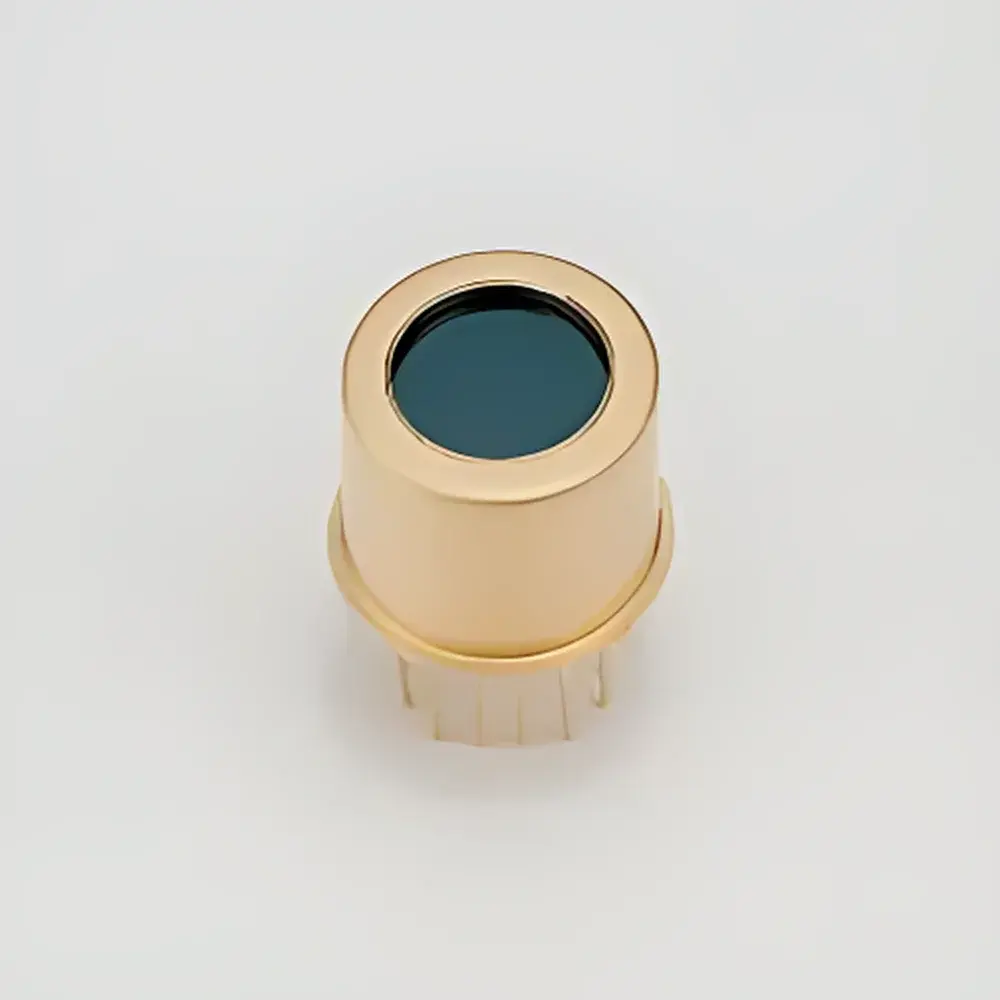
Hamamatsu L12017-1278T-C DFB Pulsed Quantum Cascade Laser
| Brand | Hamamatsu |
|---|---|
| Origin | Japan |
| Manufacturer Type | Original Equipment Manufacturer (OEM) |
| Product Category | Imported Instrument |
| Model | L12017-1278T-C |
| Core Technology | Semiconductor Quantum Cascade Laser |
| Emission Wavelength (Typical) | 7.82 µm |
| Operating Temperature Range | −10 °C to +50 °C |
| Spectral Linewidth (Max) | 0.2 cm⁻¹ |
| Tuning Range (Min) | ±1.0 cm⁻¹ |
| Peak Pulse Output Power (Min) | 50 mW |
| Threshold Current (Max) | 1.5 A |
| Side Mode Suppression Ratio (Min) | 25 dB |
| Package | TO-8 |
| Dimensions | Standard TO-8 footprint (13.0 mm diameter, 4.5 mm height) |
Overview
The Hamamatsu L12017-1278T-C is a distributed feedback (DFB) pulsed quantum cascade laser (QCL) engineered for high-spectral-fidelity mid-infrared (MIR) emission at a nominal wavelength of 7.82 µm. Unlike conventional interband semiconductor lasers, QCLs operate on intersubband transitions within the conduction band of specially designed multi-quantum-well heterostructures—enabling precise, narrow-linewidth, and tunable output in the 4–12 µm atmospheric transmission window. This device leverages unipolar carrier transport and cascaded photon emission per injected electron, delivering inherently high power efficiency and thermal stability under pulsed operation. Its design targets applications requiring molecular fingerprinting with high selectivity and sensitivity—including trace gas detection, industrial process monitoring, and laboratory-based spectroscopic research where spectral resolution and wavelength accuracy are critical.
Key Features
- DFB grating-integrated architecture ensures single-mode emission with <0.2 cm⁻¹ linewidth (FWHM), minimizing spectral broadening during pulsed excitation.
- Thermally stabilized operation across −10 °C to +50 °C enables deployment in field-deployable analyzers and benchtop spectrometers without active cryogenic cooling.
- Pulsed output mode (nanosecond-scale pulses) mitigates thermal rollover and supports time-resolved absorption measurements with high peak power (>50 mW) and low duty cycle.
- Wavelength tunability of ±1.0 cm⁻¹ via temperature and current modulation allows scanning across rovibrational absorption lines of target molecules such as CH₄, N₂O, CO, NO₂, and VOCs.
- High side-mode suppression ratio (>25 dB) guarantees robust rejection of parasitic longitudinal modes—critical for quantitative multi-species analysis in complex gas matrices.
- Hermetically sealed TO-8 metal package provides mechanical robustness, electromagnetic shielding, and compatibility with standard optical mounts and thermoelectric coolers (TECs).
Sample Compatibility & Compliance
The L12017-1278T-C is optimized for use in direct absorption spectroscopy (DAS), wavelength-modulation spectroscopy (WMS), and photoacoustic spectroscopy (PAS) configurations. It interfaces seamlessly with multipass gas cells (e.g., Herriott or White cells), open-path sampling systems, and flow-through chambers for real-time monitoring of gaseous samples. The device complies with IEC 60825-1:2014 for Class 1M laser safety when integrated into fully enclosed instruments; external optical paths require appropriate interlocks and labeling per ANSI Z136.1. Its performance characteristics align with ASTM E2960–14 (Standard Practice for In Situ Monitoring of Gaseous Emissions Using Tunable Diode and Quantum Cascade Lasers) and support GLP/GMP-compliant validation protocols when paired with calibrated reference cells and NIST-traceable wavelength standards.
Software & Data Management
Hamamatsu provides comprehensive driver firmware and SDKs compatible with Windows/Linux platforms, supporting USB and analog TTL control interfaces for pulse triggering, current ramping, and temperature setpoint management. Integration with third-party spectroscopic software (e.g., LabVIEW, MATLAB, Python-based PyVISA frameworks) is enabled via SCPI-like command sets. All operational parameters—including drive current, heat sink temperature, pulse repetition rate, and monitored photodiode feedback—are logged with timestamped metadata. When deployed in regulated environments, the system supports audit-trail generation and electronic signature workflows compliant with FDA 21 CFR Part 11 requirements—provided the host acquisition software implements appropriate user access controls and data integrity safeguards.
Applications
- Trace-level detection of greenhouse gases (e.g., nitrous oxide, methane) in ambient air and stack emissions.
- In-line monitoring of volatile organic compounds (VOCs) in semiconductor fabrication cleanrooms and pharmaceutical drying processes.
- Isotopic ratio analysis (e.g., ¹³CO₂/¹²CO₂) using high-resolution line-shape fitting in dual-laser differential absorption setups.
- Explosives and chemical warfare agent detection via photoacoustic signal amplification in compact handheld sensors.
- Fundamental studies of molecular relaxation dynamics and collisional broadening coefficients in controlled pressure environments.
FAQ
What is the recommended driver configuration for stable pulsed operation?
A fast-switching, low-noise current source with <10 ns rise time and programmable pulse width (50–500 ns) is required. Hamamatsu recommends the C11181 series pulsed laser drivers with integrated TEC control.
Can this QCL be operated in continuous-wave (CW) mode?
No—the L12017-1278T-C is specifically designed and characterized for pulsed operation only. CW operation is not supported and may result in irreversible facet damage.
Is wavelength calibration traceable to NIST standards?
Yes—when used with a calibrated etalon or HCN reference cell, the DFB tuning response can be mapped to absolute wavenumber with ±0.01 cm⁻¹ uncertainty under controlled thermal conditions.
What optical coupling options are available for fiber integration?
Free-space collimation is standard; fiber coupling requires an AR-coated ZnSe aspheric lens and a hollow-core photonic bandgap fiber (e.g., NKT Photonics HC-800) optimized for 7–8 µm transmission.
Does Hamamatsu provide aging data or lifetime specifications?
Accelerated life testing indicates >10,000 hours MTTF under rated pulse conditions (200 kHz, 10% duty cycle, 25 °C heatsink temperature), per Hamamatsu reliability report R-QCL-2023-089.



