
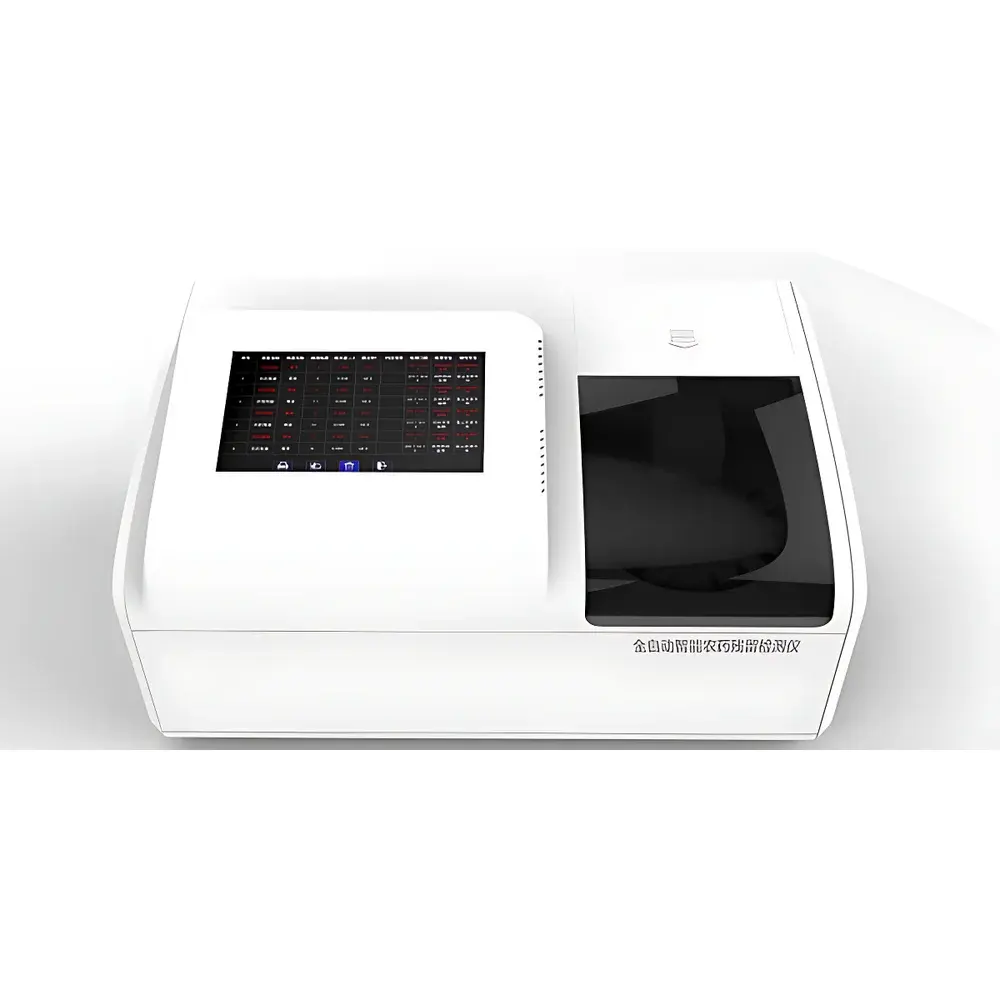
Ruixin CNY-16ZD Fully Automated Intelligent Pesticide Residue Analyzer
| Brand | Ruixin |
|---|---|
| Origin | Shanghai, China |
| Manufacturer Type | Authorized Distributor |
| Country of Origin | China |
| Model | CNY-16ZD |
| Price Range | USD 7,000–14,000 (FOB) |
| Function Type | Multi-analyte Detection Platform |
| Sample Applicability | Broad-spectrum for fruits, vegetables, and aqueous extracts |
| Wavelength Range | 380–680 nm (Primary Detection at 412 nm) |
| Assay Time per Sample Batch | ≤3 min |
| Photometric Repeatability | ≤0.3% CV |
| Detection Channels | 16 independent optical channels |
| Incubation Temperature Control | 37.0 °C ±0.5 °C |
| Operating System | Android-based embedded UI |
| Display | 7-inch capacitive color touchscreen |
| Data Storage Capacity | ≥10,000 assay records (1,000 visible on-screen) |
| Connectivity | Wi-Fi, dual USB 2.0 ports, RJ45 Ethernet |
| Power Supply | AC 220 V / DC 12 V |
| Net Weight | 7 kg |
Overview
The Ruixin CNY-16ZD Fully Automated Intelligent Pesticide Residue Analyzer is a dedicated benchtop instrument engineered for high-throughput, standardized screening of organophosphorus and carbamate pesticide residues in fresh produce and food extracts. It implements the internationally recognized acetylcholinesterase (AChE) inhibition principle—aligned with GB/T 5009.199, AOAC Official Method 2007.01, and equivalent ISO 15190-compliant enzymatic assay protocols. Unlike manual or semi-automated spectrophotometric systems, the CNY-16ZD integrates fluidic handling, precise thermal regulation, kinetic timing, and photometric quantification into a single compact platform. Its core architecture eliminates manual pipetting, reagent carryover, and inter-sample variability by executing all steps—including reagent dispensing (three independent reagents), sample mixing, temperature-controlled incubation (37.0 °C ±0.5 °C), and endpoint absorbance measurement at 412 nm—in sequence without operator intervention. Designed for compliance-driven environments, it supports audit-ready operation under GLP-aligned workflows.
Key Features
- Fully automated assay execution: Reagent addition, vortex-assisted mixing, timed incubation, and photometric readout are executed autonomously per batch.
- 16-channel parallel detection architecture enables simultaneous analysis of up to 16 samples—significantly increasing laboratory throughput while maintaining inter-channel calibration stability.
- Embedded Android OS with 7-inch capacitive touchscreen delivers intuitive, icon-driven navigation; all operational steps are visualized via real-time schematic diagrams to minimize training time and procedural errors.
- Integrated thermal block ensures uniform and stable incubation across all wells at 37.0 °C ±0.5 °C—critical for reproducible enzyme kinetics and compliance with AChE inhibition standard curves.
- No-fluidic-cross-contamination design: Three independent reagent dispensers operate without shared tubing or wash cycles, eliminating carryover risk between assays.
- Built-in thermal printer generates compliant, timestamped reports with sample ID, operator code, detection value (% inhibition), pass/fail flag, and reference control status—all in a single printout.
- Dual connectivity options (Wi-Fi + Ethernet) enable secure, encrypted data transmission to LIMS or third-party regulatory dashboards—fully compatible with FDA 21 CFR Part 11–ready audit trail configurations when deployed with validated software extensions.
Sample Compatibility & Compliance
The CNY-16ZD accepts homogenized aqueous extracts prepared from leafy greens, root vegetables, fruits, and herbs using standardized extraction protocols (e.g., QuEChERS-compatible dilutions or AOAC 2007.01 homogenization buffers). It accommodates standard 1-cm pathlength cuvettes or disposable plastic microcuvettes, ensuring compatibility with existing labware inventories. All optical measurements conform to Beer–Lambert law linearity validation requirements within the 380–680 nm spectral range, with primary quantification optimized at 412 nm—the characteristic absorption peak of the yellow-colored 5-thio-2-nitrobenzoic acid (TNB) product generated in Ellman’s reaction. The system meets technical prerequisites for use in ISO/IEC 17025-accredited food testing laboratories performing rapid screening prior to confirmatory GC-MS or LC-MS/MS analysis.
Software & Data Management
The embedded firmware supports structured data capture with mandatory fields: sample ID, batch number, analyst ID, date/time stamp, environmental temperature/humidity (via optional external sensor input), and raw absorbance values for both test and control wells. Internal storage retains ≥10,000 complete assay records, each including full kinetic trace metadata where enabled. Data export is supported via USB flash drive (CSV/Excel format) or network upload (SFTP or HTTPS POST). When integrated with Ruixin’s optional RUINEX-Link middleware, the device transmits results directly to national food safety surveillance platforms (e.g., China’s NIFDC Food Safety Monitoring System) or enterprise-grade LIMS—supporting configurable field mapping, digital signature enforcement, and electronic record retention aligned with 21 CFR Part 11 Subpart B requirements.
Applications
- Routine surveillance testing in municipal food safety inspection centers and provincial CDC laboratories.
- On-site screening at wholesale markets, supermarket quality assurance labs, and institutional catering facilities (e.g., school cafeterias, hospital kitchens).
- Pre-harvest field testing by agricultural cooperatives and certification bodies verifying GAP/GHP compliance.
- Method validation support in contract testing laboratories conducting AOAC PT programs or ISO 17025 method verification studies for rapid pesticide screening.
- Educational use in university food science curricula for teaching enzymatic inhibition principles and analytical validation concepts (LOD, LOQ, precision, robustness).
FAQ
Does the CNY-16ZD require daily calibration with certified reference standards?
No routine daily calibration is required; however, a two-point photometric verification (blank and 100% transmittance) is recommended before each operational shift. Full system performance verification using AChE activity standards should be performed weekly or per ISO/IEC 17025 internal QA schedule.
Can the instrument detect pesticides beyond organophosphates and carbamates?
No—it is specifically validated for acetylcholinesterase-inhibiting compounds. Non-AChE inhibitors (e.g., pyrethroids, neonicotinoids, glyphosate) require orthogonal methods such as ELISA or chromatography.
Is the 412 nm wavelength fixed, or can users configure alternate wavelengths?
The optical module is factory-optimized for 412 nm detection. While the broadband photodiode array covers 380–680 nm, spectral selection is hardware-gated and not user-reconfigurable in standard configuration.
What maintenance is required beyond routine cleaning of the cuvette holder and touch screen?
No consumable parts (e.g., lamps, filters, pumps) require scheduled replacement. Annual verification of thermal block uniformity and photometric linearity by an authorized service technician is recommended for ISO 17025 compliance.
How does the system handle outlier detection during multi-channel runs?
The firmware applies Grubbs’ test (α = 0.05) to replicate measurements within a batch and flags statistically deviant channels for review—without auto-exclusion—preserving raw data integrity for audit purposes.




