
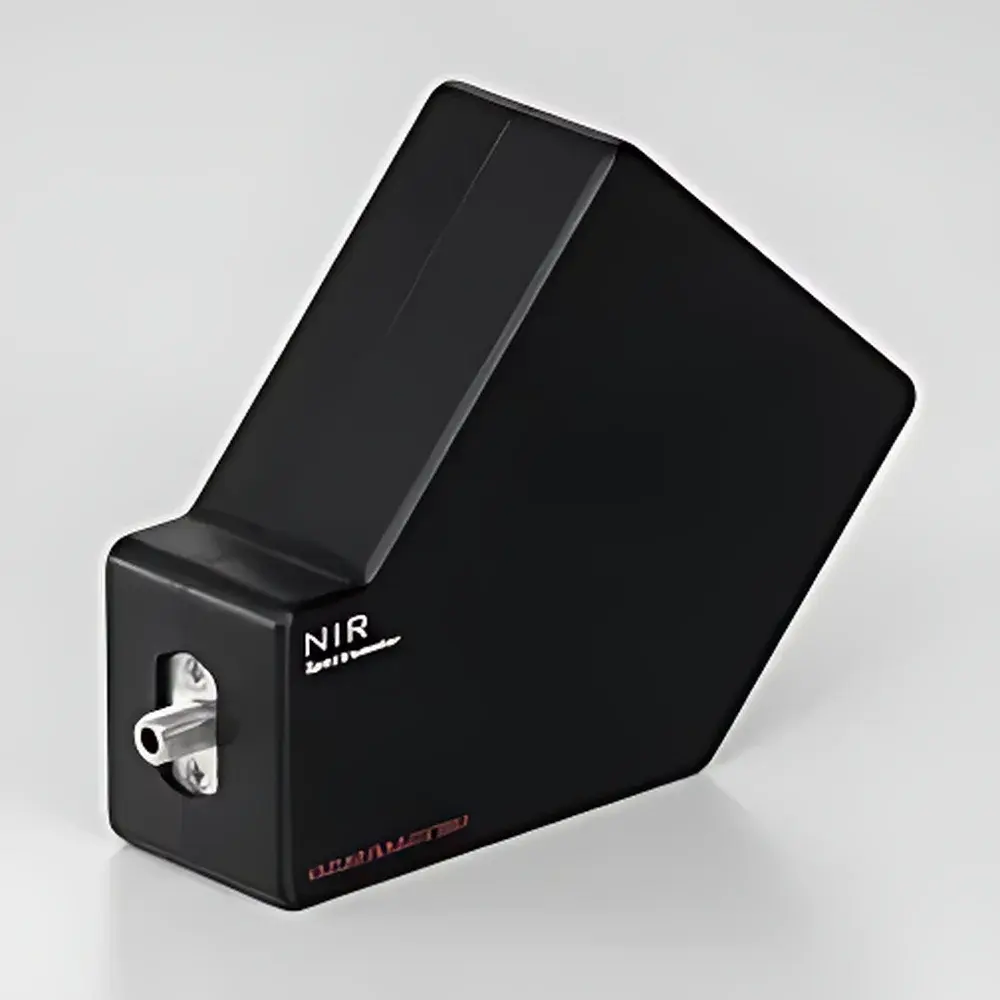
Hamamatsu TM RC TG MS Series Miniature Fiber Optic Spectrometer
| Brand | Hamamatsu |
|---|---|
| Origin | Japan |
| Manufacturer Type | Original Equipment Manufacturer (OEM) |
| Import Status | Imported |
| Model Series | TM / RC / TG / MS |
| Detector Type | InGaAs |
| Spectral Range | 200–2550 nm (model-dependent) |
| Optical Resolution (FWHM) | 1–20 nm (model-dependent) |
| Cooling | Thermoelectric (TE) or uncooled |
| Dynamic Range | >5,000:1 (typical, model- and integration-time-dependent) |
| Signal-to-Noise Ratio | Up to 10,000:1 (peak, with TE cooling and optimal integration) |
| Stray Light | <0.05% (typical, at 600 nm relative to peak) |
Overview
The Hamamatsu TM RC TG MS Series Miniature Fiber Optic Spectrometer is an integrated opto-electronic measurement platform engineered for high-fidelity spectral analysis in space-constrained and field-deployable applications. Based on a compact Czerny–Turner or crossed-beam optical architecture, each unit integrates a precision diffraction grating, optimized collimating/focusing optics, a monolithic image sensor (CMOS or InGaAs), and embedded signal-conditioning electronics into a mechanically robust, thermally stable housing. Light enters via standard SMA-905 fiber optic coupling, undergoes dispersion across the detector array, and is digitized in real time using on-board 16-bit ADCs. Data is streamed to host PCs via high-speed USB 2.0 or USB 3.0 interfaces, enabling seamless integration into automated analytical workflows, OEM instrumentation, and embedded monitoring systems. Designed for long-term stability and low thermal drift, these spectrometers operate reliably across ambient temperatures from 5 °C to 40 °C, with select TE-cooled variants maintaining dark current below 100 e⁻/pixel/s at –10 °C sensor temperature.
Key Features
- Modular spectral coverage spanning UV-VIS-NIR-SWIR (200–2550 nm), segmented across four dedicated series: TM (UV-VIS), RC (VIS-NIR), TG (NIR-SWIR), and MS (broadband VIS)
- High optical resolution options: FWHM values ranging from 1 nm (C9404CAH, C10082CAH) to 20 nm (C11118GA), calibrated per ISO 14788 and traceable to NIST-standard tungsten-halogen and deuterium sources
- Detector flexibility: Back-thinned CMOS for UV-VIS sensitivity (200–800 nm); extended-range InGaAs arrays (900–2200 nm and 900–2550 nm) with linear response and <0.5% nonlinearity up to 95% full scale
- OEM-ready design: Compact footprint (typically ≤ 85 × 60 × 30 mm), low power consumption (<1.5 W uncooled; <3.2 W with TE cooling), and TTL-compatible trigger I/O for synchronization with lasers, LEDs, or process controllers
- Thermal management options: Passive stabilization for laboratory use; Peltier-based TE cooling (–10 °C ΔT below ambient) on select TG-series models to suppress dark noise and enable sub-second integration in low-light NIR/SWIR measurements
Sample Compatibility & Compliance
These spectrometers are compatible with standard 200 µm, 400 µm, and 600 µm core diameter silica optical fibers (numerical aperture ≤ 0.22). They support transmission, reflectance, fluorescence, absorbance, and Raman-shifted configurations when paired with appropriate light sources and sampling accessories (e.g., cuvette holders, integrating spheres, or fiber-optic probes). All units comply with IEC 61326-1:2013 for electromagnetic compatibility (EMC) in laboratory and industrial environments and meet RoHS 2015/863/EU and REACH SVHC requirements. Firmware supports configurable integration times (1 ms to 65 s), automatic dark/baseline correction, and pixel binning — features essential for GLP-compliant data acquisition in regulated QC labs. While not pre-certified for FDA 21 CFR Part 11, the SDK enables implementation of audit trails, electronic signatures, and data integrity controls required for GMP-aligned validation protocols.
Software & Data Management
Hamamatsu provides the proprietary SpectraSmart™ software suite (Windows/macOS/Linux), offering real-time spectral visualization, multi-curve overlay, peak identification (with customizable threshold and width filters), and export to CSV, ASCII, or HDF5 formats. A comprehensive C/C++, Python (PyHamamatsu), and LabVIEW SDK is included, supporting low-level register access, synchronous multi-device triggering, and integration into custom LIMS or SCADA platforms. Raw spectra include embedded metadata (wavelength calibration coefficients, detector gain/offset, temperature, integration time), ensuring traceability and reproducibility. Time-stamped spectral logging (≥100 spectra/s sustained) is supported for kinetic studies, while batch processing tools enable post-acquisition baseline correction, Savitzky–Golay smoothing, and derivative spectroscopy for quantitative analysis.
Applications
- Real-time process monitoring in pharmaceutical manufacturing (e.g., API crystallization endpoint detection, blend uniformity verification)
- In-line quality control of thin-film coatings, solar cell layers, and semiconductor wafers via reflectance/ellipsometry coupling
- Portable environmental sensing: dissolved organic matter (DOM) profiling in water, NO₂/SO₂ gas absorption spectroscopy using LED-based absorption cells
- Biomedical research: label-free tissue oximetry, carotenoid quantification in skin, and fluorescence lifetime estimation in microplate assays
- OEM integration into handheld analyzers, agricultural sensors (e.g., grain protein/nitrogen prediction), and educational lab kits requiring rugged, USB-powered spectral engines
FAQ
What spectral calibration standards are used for factory calibration?
All units are calibrated using NIST-traceable tungsten-halogen (VIS-NIR) and deuterium (UV) lamps, with wavelength accuracy certified to ±0.2 nm (RMS) across the specified range.
Can multiple spectrometers be synchronized for multi-channel measurements?
Yes — hardware trigger input/output pins support master-slave daisy-chaining with jitter <1 µs, enabling phase-coherent acquisition across up to 8 devices via a single USB host controller.
Is spectral recalibration required after mechanical shock or thermal cycling?
No routine recalibration is needed; optical alignment is permanently fixed using epoxy-free kinematic mounts and verified per MIL-STD-810G shock/vibration testing. Wavelength drift remains <0.1 nm over 1,000 thermal cycles (5–40 °C).
Does the SDK support real-time spectral processing on embedded ARM platforms?
Yes — lightweight C libraries are provided for Linux-on-ARM (e.g., Raspberry Pi, NVIDIA Jetson), including FFT, peak search, and polynomial fitting functions optimized for NEON SIMD acceleration.
How is stray light performance characterized and validated?
Stray light is measured per ASTM E275-20 using a 5 nm bandwidth monochromator and calibrated neutral density filters; reported values reflect worst-case conditions at 600 nm relative to 400 nm peak intensity.
Related Products




