
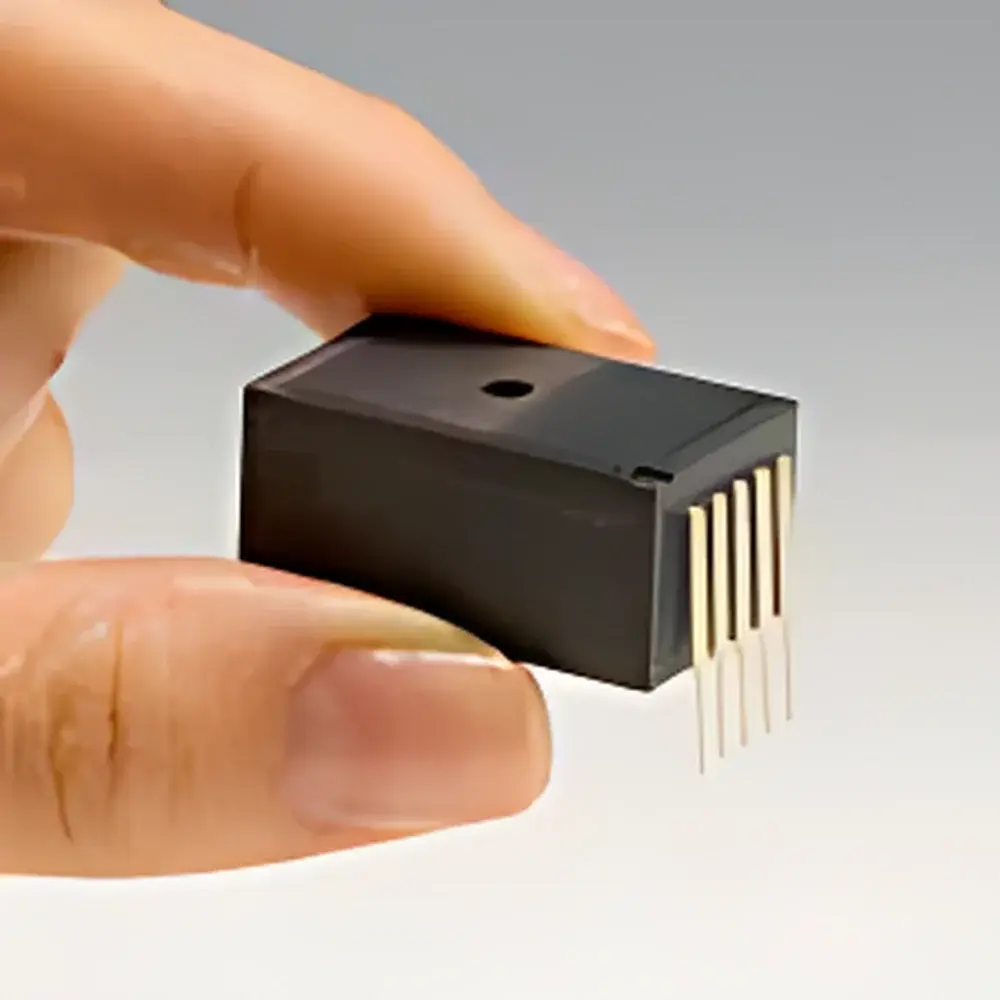
Hamamatsu C11482GA TG-Series Miniature Fiber Optic Spectrometer
| Brand | Hamamatsu |
|---|---|
| Origin | Japan |
| Manufacturer Type | Original Equipment Manufacturer (OEM) |
| Import Status | Imported |
| Model | C11482GA |
| Spectral Range | 900–1700 nm |
| Detector Type | InGaAs linear array |
| Pixel Count | 512 pixels |
| Spectral Resolution (FWHM, max) | 7 nm |
| A/D Resolution | 16 bits |
| Cooling | Uncooled |
| Interface | USB 2.0 |
| Grating Type | Quartz transmission grating |
| Power Supply | Bus-powered via USB |
| Wavelength Calibration | Factory-stored in onboard memory |
| Dimensions | Compact housing (exact mm dimensions available in datasheet) |
Overview
The Hamamatsu C11482GA TG-Series Miniature Fiber Optic Spectrometer is a compact, OEM-optimized near-infrared (NIR) spectrometer engineered for high-fidelity spectral acquisition in resource-constrained or embedded environments. Based on the principle of dispersive spectroscopy, it utilizes a quartz transmission diffraction grating to spatially separate incident light across a 512-pixel InGaAs linear photodiode array. Light delivered via optical fiber is collimated, diffracted, and focused onto the detector, where photon flux is converted into digital signals via a 16-bit analog-to-digital converter. Its uncooled InGaAs sensor enables stable operation from 900 nm to 1700 nm — a spectral window critical for organic bond vibration analysis (e.g., C–H, O–H, N–H overtones), moisture quantification, polymer identification, and agricultural quality assessment. Designed without active thermoelectric cooling, the instrument prioritizes low power consumption (<500 mW), mechanical robustness, and plug-and-play integration — making it suitable for portable analyzers, inline process monitors, and distributed sensing nodes.
Key Features
- Integrated quartz transmission grating delivering high optical throughput and wavelength stability across the NIR band
- 512-pixel uncooled InGaAs linear array with 16-bit digitization for enhanced dynamic fidelity and low-noise spectral reconstruction
- USB 2.0 interface with bus-powered operation — no external power supply required; supports hot-plug functionality and deterministic latency
- Factory-wavelength calibration stored in non-volatile memory ensures traceable spectral accuracy without user recalibration
- Compact, rigid aluminum-alloy housing optimized for OEM integration — footprint compatible with standard optical breadboards and industrial mounting rails
- Designed for continuous duty cycle under ambient temperatures ranging from 5 °C to 40 °C, with humidity tolerance up to 80% RH (non-condensing)
Sample Compatibility & Compliance
The C11482GA interfaces exclusively with fiber-coupled illumination and collection optics (standard SMA 905 connectors). It accepts input from multimode fibers (core diameters 50–400 µm) and is compatible with common NIR light sources including tungsten-halogen lamps, superluminescent LEDs (SLEDs), and tunable laser diodes. While the spectrometer itself does not perform sample preparation, its optical architecture supports reflectance, transmittance, and absorbance configurations when integrated into validated measurement cells or flow cuvettes. The device complies with IEC 61326-1 (EMC for laboratory equipment) and meets RoHS 2 and REACH material restrictions. For regulated environments, raw spectral data output adheres to ASTM E131-22 (Standard Terminology Relating to Molecular Spectroscopy) and supports traceability when paired with calibrated reference standards (e.g., NIST-traceable ceramic reflectance tiles).
Software & Data Management
Hamamatsu provides the proprietary “SpectraAssist” SDK (Windows/Linux/macOS), which delivers low-level register access, real-time spectrum streaming (>100 spectra/sec at full resolution), and hardware-synchronized triggering via TTL I/O. The SDK includes C/C++, Python (PyHamamatsu), and LabVIEW VIs, enabling seamless integration into custom QA/QC applications or Industry 4.0 data pipelines. All acquired spectra are timestamped and include embedded metadata (integration time, pixel binning mode, gain setting). Export formats include CSV, HDF5, and vendor-neutral JCAMP-DX — facilitating import into chemometric platforms such as MATLAB, Unscrambler X, or Python-based scikit-learn workflows. Audit trails, electronic signatures, and 21 CFR Part 11 compliance are achievable through third-party LIMS or ELN systems interfacing via RESTful API extensions.
Applications
- Real-time monitoring of chemical composition in pharmaceutical tablet coating processes (e.g., API concentration, film thickness uniformity)
- In-field soil nutrient analysis (organic carbon, nitrogen content) using diffuse reflectance spectroscopy
- Quality control of petroleum derivatives (e.g., diesel cetane number estimation, biodiesel blend ratio verification)
- Non-destructive fruit ripeness grading via water-soluble solids (Brix) prediction models trained on 1100–1650 nm bands
- Gas leak detection in industrial settings using tunable diode laser absorption spectroscopy (TDLAS) backend processing
- Embedded spectral engines for handheld NIR analyzers used in food authenticity screening (e.g., honey adulteration, olive oil purity)
FAQ
What is the typical integration time range supported by the C11482GA?
Integration times are software-configurable from 1 ms to 10 s, with automatic exposure control available via SDK for adaptive signal optimization.
Does the spectrometer support external triggering?
Yes — TTL-compatible trigger input (rising-edge sensitive) allows synchronization with pulsed light sources or motion stages.
Can the device operate in vacuum or high-vibration environments?
The unit is rated for ambient laboratory and light industrial use only; vacuum operation is not supported due to thermal management constraints and outgassing limitations of internal adhesives.
Is spectral calibration data accessible for custom algorithm development?
Yes — wavelength coefficients (polynomial order ≥3) and pixel-to-wavelength mapping tables are programmatically retrievable via SDK for offline spectral correction and multivariate model porting.
How is long-term wavelength stability maintained without active cooling?
Thermal drift is mitigated through passive thermal mass design, low-CTE optical mounts, and factory calibration at three temperature points (15 °C, 25 °C, 35 °C), enabling interpolation-based compensation in host software.




