
CIT-4200 Safety Interlock System
| Brand | Sichuan Xinxianda |
|---|---|
| Origin | Sichuan, China |
| Manufacturer Type | Authorized Distributor |
| Origin Category | Domestic (China) |
| Model | CIT-4200 |
| Pricing | Upon Request |
Overview
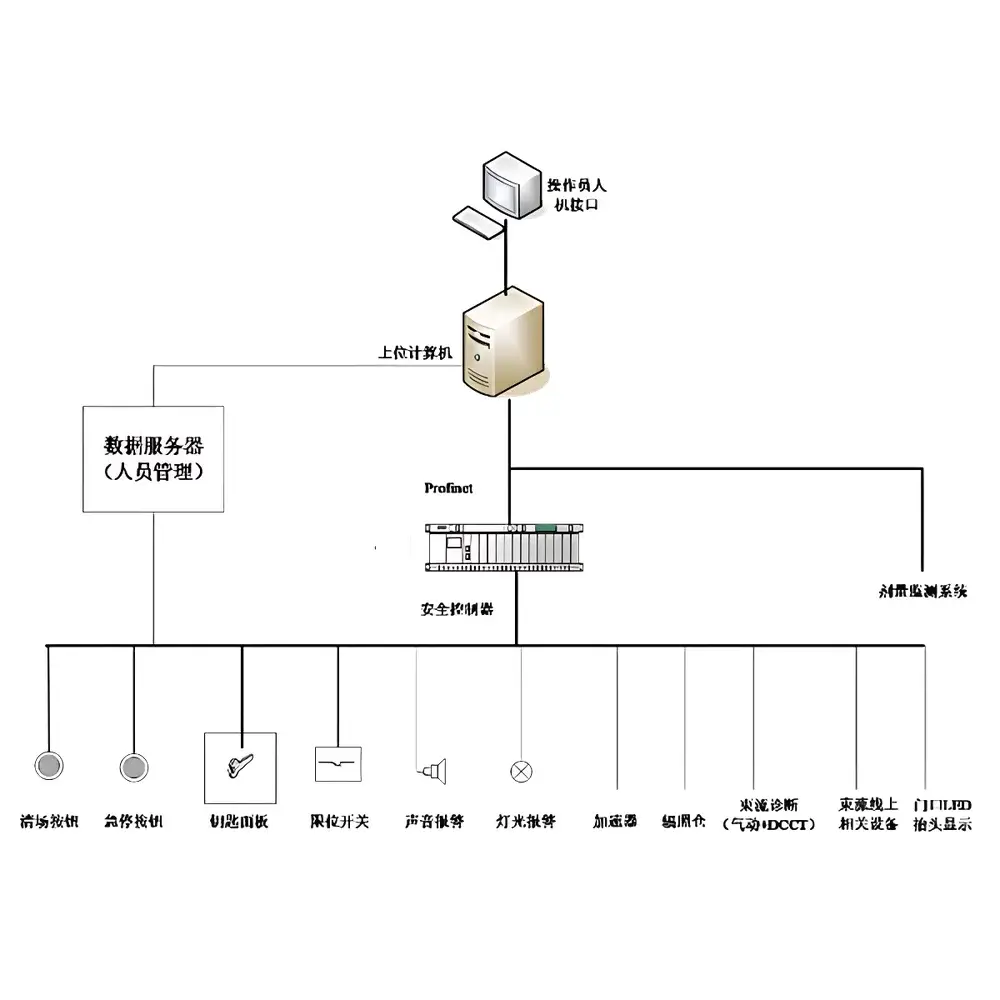
The CIT-4200 Safety Interlock System is an engineered hardware-software integrated solution designed for radiation safety management in particle accelerator facilities—particularly cyclotron-based radioisotope production and biomedical research installations. It operates on a fail-safe, redundant architecture grounded in IEC 61508 (Functional Safety of Electrical/Electronic/Programmable Electronic Safety-related Systems) and aligned with IAEA Safety Standards Series No. SSG-46 (Radiation Protection and Safety of Radiation Sources). The system implements a deterministic, real-time safety logic chain across three hierarchical layers: field-level sensors and actuators (e.g., door switches, radiation monitors, beam shutter controls), a certified programmable logic controller (PLC) serving as the Safety Logic Solver (SLS), and a supervisory layer comprising front-end HMI stations and a central database server for audit logging and event reconstruction. Its primary functional objective is to enforce strict access control and beam enablement constraints: personnel entry into high-radiation zones—including the cyclotron vault, beamline corridors, and target rooms—is physically prohibited unless all predefined safety conditions are simultaneously satisfied (e.g., beam off, radiation levels below 0.5 µSv/h, all access doors interlocked and closed).
Key Features
- Triple-layer architecture compliant with ISA-84.00.01 / IEC 61511 (Safety Instrumented Systems for the Process Industry)
- Dual-channel, SIL 2-certified PLC controller with hot-standby redundancy and automatic fault detection
- Real-time integration with ionization chamber-based area radiation monitors (range: 0.01–100 mSv/h) and neutron detectors (thermal/fast spectrum)
- Hardwired emergency stop circuits meeting EN 60204-1 requirements, independent of software control paths
- Beam gate interlock interface supporting both analog (4–20 mA) and digital (dry contact) signal protocols per IEEE 352-2017
- Automatic dose-rate trending and alarm escalation (pre-alarm → warning → forced beam shutdown → access lockdown)
- Event-driven audit trail with timestamped, tamper-resistant logs stored on encrypted database server (ISO/IEC 27001-compliant storage)
Sample Compatibility & Compliance
The CIT-4200 is specifically engineered for integration with 10–30 MeV proton cyclotrons and associated beam transport lines. It supports compatibility with common radiation detection platforms including Thermo Fisher RadEye G series, Mirion DMC 3000, and Canberra MicroNomad systems via Modbus TCP or RS-485. All safety-critical components undergo traceable calibration against national standards (CNAS-accredited laboratories per GB/T 27025). The system satisfies regulatory requirements for nuclear medicine facility licensing in China (HJ 1189–2021) and provides documentation packages suitable for international regulatory review—including Design Verification Reports (DVR), Failure Modes and Effects Analysis (FMEA), and Hardware Fault Tolerance (HFT) calculations. While not certified for US NRC or EURATOM direct acceptance, its architecture aligns with 10 CFR 20.1101 (Occupational Dose Limits) and Directive 2013/59/Euratom principles.
Software & Data Management
The supervisory software suite runs on Windows Server LTSB with role-based access control (RBAC) and full 21 CFR Part 11 compliance: electronic signatures, audit trails with immutable timestamps, and operator action logging (login/logout, parameter changes, override authorizations). Historical radiation data, interlock status transitions, and beam-on/off events are archived in SQL Server with automated weekly backups and optional异地 (offsite) replication. Reporting modules generate ISO 17025-compliant test certificates for periodic safety validation, and export structured CSV/Excel files for third-party analysis tools. All firmware and configuration files are digitally signed to prevent unauthorized modification; version control is enforced through SHA-256 hash verification at boot time.
Applications
- Radiopharmaceutical production facilities using cyclotron-generated isotopes (e.g., 18F, 11C, 13N, 15O)
- University and national laboratory accelerator research centers requiring ALARA-conformant personnel protection
- Hospital-based PET radiotracer synthesis labs operating under provincial health commission oversight
- Pre-commissioning safety validation and periodic requalification testing per GBZ 125–2022
- Integration with Facility Management Systems (FMS) for centralized radiation safety dashboarding
FAQ
Does the CIT-4200 meet international nuclear safety standards such as IEC 61508 or IAEA SSG-46?
Yes—the system’s safety architecture, component selection, and lifecycle documentation follow IEC 61508 Part 3 (hardware/software safety integrity design) and implement functional safety requirements consistent with IAEA SSG-46 Annex III (Interlock System Design Principles).
Can the system be integrated with existing radiation monitoring equipment from other vendors?
Yes—it supports standard industrial communication protocols including Modbus RTU/TCP, Profibus DP, and OPC UA, enabling interoperability with major radiation detector manufacturers.
Is remote diagnostics and firmware update supported without compromising safety integrity?
Remote diagnostics are permitted only via authenticated, encrypted VPN tunnels with dual-factor authentication; firmware updates require local physical access and mandatory pre-update safety verification checks logged in the audit trail.
What is the mean time to recovery (MTTR) after a safety trip event?
The system achieves MTTR ≤ 90 seconds for non-hardware-failure events, verified by factory acceptance testing (FAT) per IEC 62061 Annex F; hardware redundancy ensures continuity of safety function during PLC module replacement.
How is compliance with GLP/GMP documentation requirements addressed?
All operational logs, calibration records, and validation reports are generated in PDF/A-1b format with embedded digital signatures, satisfying long-term archival and regulatory inspection requirements under GLP (OECD 1998) and GMP (ICH Q7) frameworks.
Related Products







