
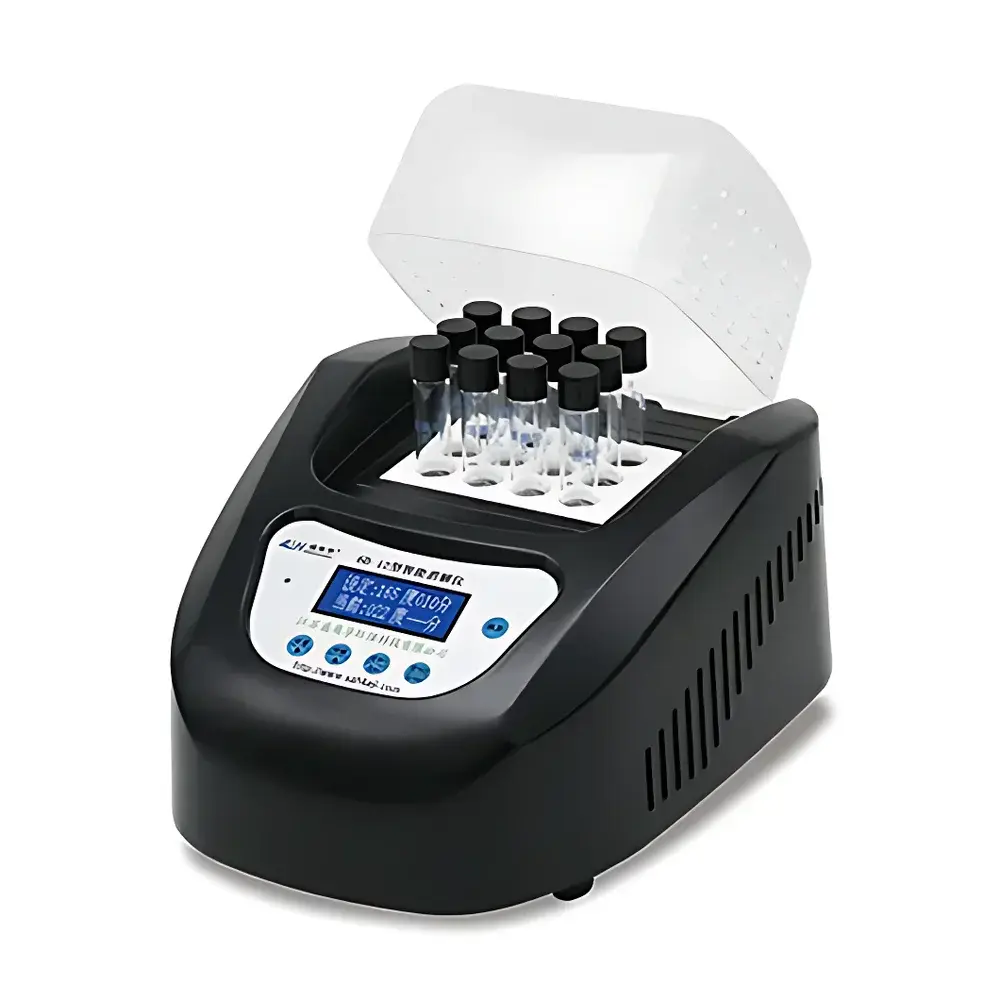
ShengAohua 6B-12(V9) COD Digestion Block
| Brand | ShengAohua |
|---|---|
| Origin | Jiangsu, China |
| Manufacturer Type | Direct Manufacturer |
| Model | 6B-12(V9) |
| Digestion Method | Rapid Closed-Tube Digestion |
| Heating Module | Single Aluminum Alloy Heating Block |
| Batch Capacity | 12 samples |
| Temperature Range | Ambient to 200 °C |
| Temperature Accuracy | ±0.5 °C |
| Sample Vial Capacity | 15 mL |
| Timer Accuracy | ±0.1 s |
| Timer Range | 1–199 min |
| Ramp Time to Setpoint | ≤10 min |
| Operating Ambient Temperature | −5 °C to 45 °C |
| Power Supply | AC 220 V / 50 Hz |
Overview
The ShengAohua 6B-12(V9) COD Digestion Block is a benchtop thermal digestion system engineered for standardized, high-reproducibility chemical oxidation of water and wastewater samples prior to spectrophotometric or titrimetric COD (Chemical Oxygen Demand) determination. It operates on the principle of closed-tube rapid digestion—applying precisely controlled conductive heating to pre-dosed reaction mixtures (e.g., K2Cr2O7/H2SO4) under reflux conditions—to accelerate oxidation kinetics while minimizing reagent loss, cross-contamination, and operator exposure. Designed in compliance with core methodology requirements of ISO 6060, APHA Standard Methods 5220D (Closed Reflux, Colorimetric), and HJ 828–2017 (China’s standard method for COD determination), the unit delivers thermally stable, traceable digestion profiles essential for regulatory reporting and inter-laboratory comparability.
Key Features
- Single high-density aluminum alloy heating block with uniform thermal distribution across all 12 positions—ensuring <±0.5 °C spatial temperature consistency at setpoints up to 200 °C.
- Four independent programmable timer keys enabling concurrent execution of multiple digestion protocols (e.g., COD at 165 °C/10 min, total phosphorus at 120 °C/30 min) without manual intervention.
- Six factory-preset digestion curves stored in non-volatile memory—including optimized profiles for COD, total nitrogen, total phosphorus, copper, and hexavalent chromium—each fully editable and savable as user-defined methods.
- Real-time digital display with Chinese-language blue-backlit LCD interface—showing set temperature, actual block temperature, remaining time, and active program ID for unambiguous operational feedback.
- Integrated overtemperature protection circuitry that automatically de-energizes the heater if block temperature exceeds the safety threshold by >2 °C, preventing tube rupture and ensuring personnel and equipment safety.
- Corrosion-resistant, heat-stable polymer housing conforming to IP20 environmental rating—designed for long-term use in humid, chemically aggressive lab environments typical of municipal and industrial wastewater testing facilities.
Sample Compatibility & Compliance
The 6B-12(V9) accommodates standard 15 mL borosilicate glass digestion tubes (e.g., ASTM D1252-compliant tapered vials) and supports digestion protocols for multiple parameters beyond COD—including total phosphorus (ISO 6878), total nitrogen (ISO 11905-2), copper (EPA 200.7), and hexavalent chromium (EPA 7196A). Its thermal stability and timer precision meet the performance criteria outlined in ISO/IEC 17025:2017 for calibration traceability of digestion steps in accredited environmental testing laboratories. While not a standalone analytical instrument, it functions as a critical pre-analytical module compliant with GLP documentation requirements when paired with validated spectrophotometers or titrators.
Software & Data Management
This model operates via embedded firmware with no external PC dependency. All parameter settings—including temperature (1 °C increments), timer duration (1 min increments), and curve selection—are entered via membrane keypad and retained after power cycling. Audit trail functionality is limited to visual confirmation of active settings during operation; for full 21 CFR Part 11 compliance, integration with LIMS or third-party data acquisition software requires optional RS-232 output (available upon request with firmware upgrade). Method validation records—including temperature uniformity mapping and timer accuracy verification—should be performed annually per laboratory quality management system (QMS) requirements.
Applications
- Routine COD analysis in municipal wastewater treatment plants (WWTPs) and industrial effluent monitoring programs.
- Multi-parameter environmental screening in regulatory labs performing simultaneous COD, TP, and TN determinations on the same sample batch.
- Method development and validation studies requiring precise thermal control over narrow time–temperature windows (e.g., optimization of dichromate oxidation efficiency).
- Educational use in university environmental engineering and analytical chemistry laboratories—supporting hands-on training in standardized wet-chemistry techniques per APHA and ISO curricula.
- Field-deployable backup digestion in mobile environmental labs where space, power, and maintenance simplicity are prioritized.
FAQ
What digestion standards does the 6B-12(V9) support?
It is configured to meet ISO 6060, APHA 5220D, and HJ 828–2017 requirements for closed-reflux COD digestion, and can be adapted for other EPA and ISO digestion methods through user-defined temperature/time profiles.
Can the unit be used for total nitrogen digestion?
Yes—its 200 °C maximum temperature and programmable timers allow implementation of alkaline persulfate digestion (e.g., ISO 11905-2) when paired with appropriate reagents and vials.
Is calibration traceability provided with the instrument?
The unit ships with a factory temperature verification report (NIST-traceable reference thermometer used); users must perform periodic in-house calibration using certified RTDs or thermocouples per their internal SOPs.
Does it require ventilation or fume hood installation?
While the closed-tube design minimizes vapor release, digestion of high-chloride or high-organic samples may generate acidic condensate; placement within a ventilated enclosure or fume hood is recommended for continuous operation.
What maintenance is required for long-term reliability?
Annual cleaning of heating block grooves with non-abrasive tools, inspection of keypad responsiveness, and verification of timer accuracy using a calibrated stopwatch constitute routine maintenance—no consumables or proprietary parts are required.







