
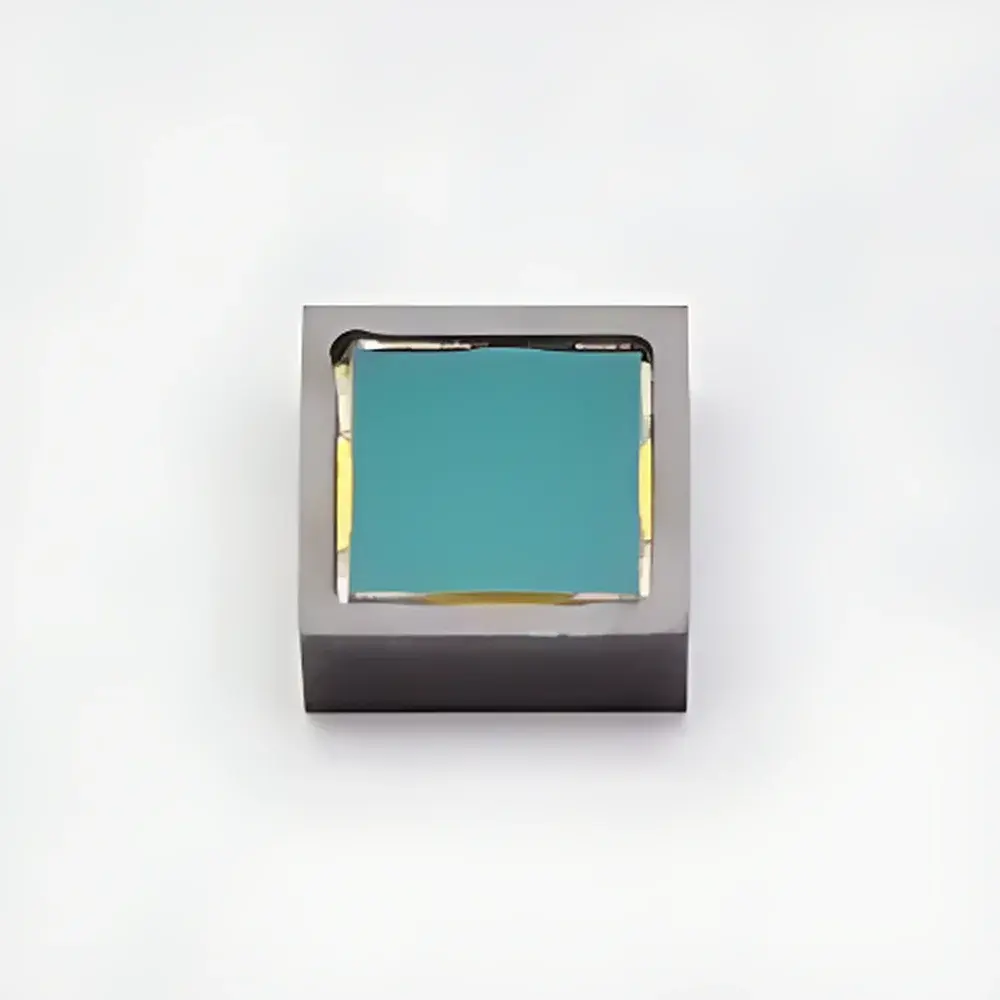
Hamamatsu Mid-Infrared LED L13201-0430C
| Brand | Hamamatsu |
|---|---|
| Origin | Japan |
| Manufacturer Type | Original Equipment Manufacturer (OEM) |
| Product Origin | Imported |
| Model | L13201-0430C |
| Light Source Type | Mid-Infrared LED |
| Illumination Mode | External Illumination |
| Package | Ceramic, Surface-Mount Device (SMD) |
| Peak Emission Wavelength (Min/Typ/Max) | 4100 / 4300 / 4400 nm |
| Spectral FWHM (Typ.) | 700 nm |
| Radiant Flux (Typ.) | 0.3 mW |
| Forward Voltage (Typ.) | 1.6 V |
| Operating Temperature | Ta = 25 °C (unless specified) |
Overview
The Hamamatsu Mid-Infrared LED L13201-0430C is a high-performance, surface-mount ceramic-packaged light source engineered for stable and efficient emission in the mid-infrared spectral region. Operating on electroluminescent principles, this device emits broadband radiation centered at 4300 nm (4.3 µm), with a full-width-at-half-maximum (FWHM) of approximately 700 nm—spanning a usable spectral range from ~3.95 µm to ~4.65 µm. Unlike thermal emitters or quantum cascade lasers, this LED leverages optimized III–V semiconductor heterostructures to deliver rapid modulation response (sub-microsecond rise/fall times), low thermal load, and exceptional long-term stability under continuous or pulsed DC operation. Its compact SMD footprint (3.2 × 3.2 × 1.4 mm) enables direct integration into miniaturized optical modules, gas sensing platforms, and portable FTIR or NDIR subsystems where space, power efficiency, and mechanical robustness are critical design constraints.
Key Features
- Mid-infrared emission centered at 4300 nm with broad spectral coverage (FWHM ≈ 700 nm), ideal for absorption spectroscopy of fundamental vibrational bands of gases such as CO, CO₂, CH₄, NO, and hydrocarbons
- Ceramic surface-mount package offering superior thermal dissipation, hermetic reliability, and compatibility with standard reflow soldering processes (JEDEC J-STD-020 compliant)
- Low forward voltage (1.6 V typ.) and low power consumption (< 50 mW at rated drive current), minimizing self-heating and enabling battery-operated instrumentation
- High modulation bandwidth (> 1 MHz) supporting synchronous detection schemes and lock-in amplification for enhanced signal-to-noise ratio in low-light applications
- Stable radiometric output over time (ΔL < ±3% after 10,000 hours at IF = 100 mA, Tc = 60 °C), validated per JEDEC JESD22-A108 accelerated life testing protocols
Sample Compatibility & Compliance
The L13201-0430C is designed for use with standard infrared optics including chalcogenide (e.g., AMTIR-1), ZnSe, and CaF₂ lenses and windows. Its external illumination configuration allows flexible beam shaping via collimators, fiber coupling (with IR-transmissive fibers such as fluoride or hollow-core photonic bandgap fibers), and integration into multi-channel gas cells. The device complies with RoHS Directive 2011/65/EU and REACH Regulation (EC) No. 1907/2006. While not intrinsically certified for hazardous locations, it meets IEC 62471:2006 photobiological safety requirements for LED light sources (Risk Group 1 – exempt). For regulatory documentation, Hamamatsu provides traceable calibration reports (NIST-traceable reference detectors) and material declarations upon request.
Software & Data Management
As a passive optical component, the L13201-0430C does not incorporate embedded firmware or digital interfaces. However, its electrical characteristics—including forward voltage, radiant flux vs. drive current, and thermal derating curves—are fully documented in Hamamatsu’s publicly available datasheet (Document No. S13201-0430C-DATA-EN, Rev. C). Integration into automated test systems is supported via analog current drivers (e.g., Keithley 2450 SourceMeter™ or Thorlabs LDCxx series) with programmable sweep and logging capabilities. When deployed in spectrometer-based analyzers, its output is typically referenced against blackbody or calibrated photodiode standards during system-level validation—ensuring traceability aligned with ISO/IEC 17025:2017 metrological requirements.
Applications
- Non-dispersive infrared (NDIR) gas analyzers for industrial process monitoring and environmental emissions compliance (e.g., EPA Method 21, EN 14792)
- Portable breath analyzers targeting acetone (diabetes monitoring) and ethanol (law enforcement screening)
- Lab-on-a-chip infrared absorption sensors for liquid-phase chemical identification (e.g., aqueous organic solvents, pharmaceutical excipients)
- Benchtop FTIR accessory illumination for reflectance or transmission measurements of thin films and polymers
- Calibration reference source for MCT and InSb detector linearity verification across the 4–5 µm atmospheric window
FAQ
What is the maximum recommended continuous forward current for the L13201-0430C?
The absolute maximum DC forward current is 150 mA; however, Hamamatsu recommends operating at ≤100 mA for optimal lifetime and spectral stability.
Can this LED be pulse-driven to extend operational lifetime?
Yes—pulse operation (duty cycle ≤ 10%, frequency ≤ 10 kHz) reduces average junction temperature and improves radiant flux consistency over extended periods.
Is the emission spectrum temperature-dependent?
Yes: peak wavelength exhibits a redshift of ~0.3 nm/°C, and radiant flux decreases by ~0.5%/°C above 25 °C ambient; thermal management is therefore essential for quantitative applications.
Does Hamamatsu provide spectral irradiance calibration data?
Yes—NIST-traceable spectral radiant intensity data (in W/sr/nm) is available in the product’s calibration certificate (optional add-on at time of order).
What mounting considerations apply for thermal management?
A minimum 10 mm² copper pour with ≥2 thermal vias per mm² is recommended beneath the SMD pad to maintain case temperature below 70 °C under full drive conditions.



