
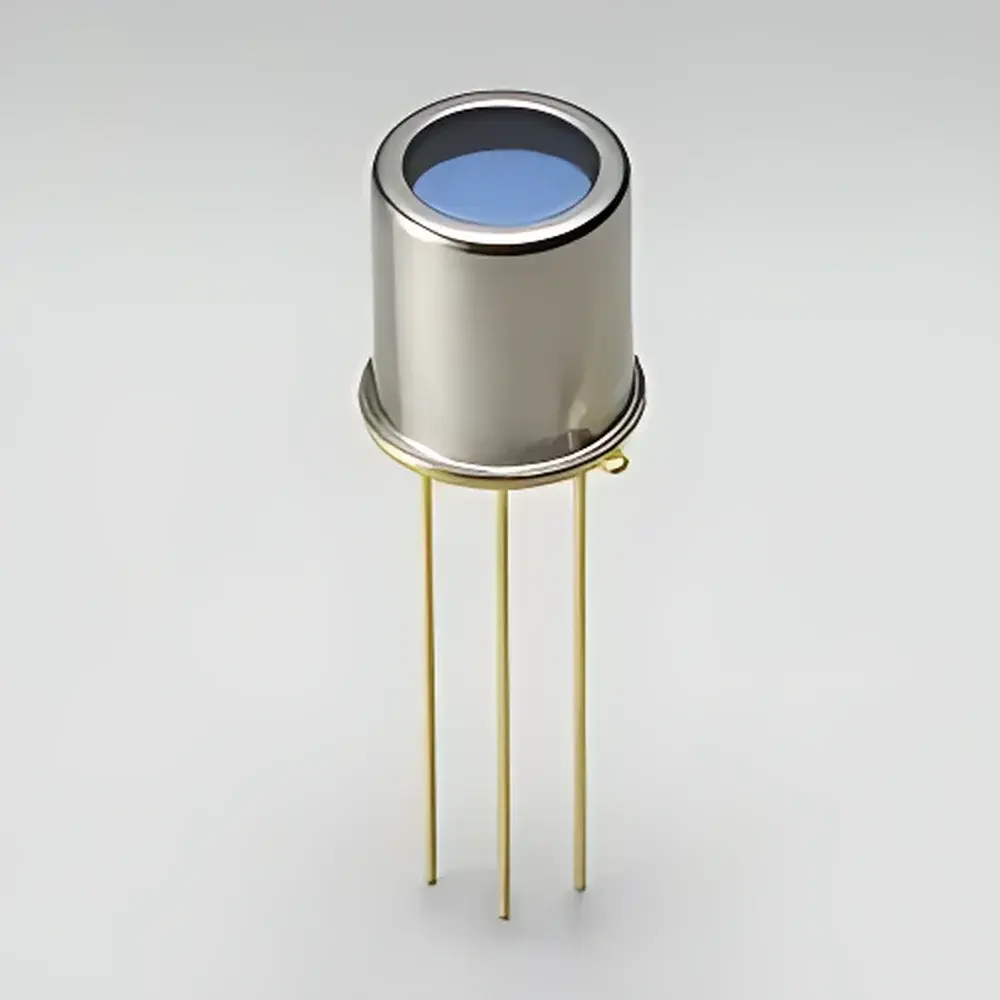
Hamamatsu Silicon Photodiode S12742-254 with Integrated Interference Filter
| Brand | Hamamatsu |
|---|---|
| Origin | Japan |
| Manufacturer Type | Original Equipment Manufacturer (OEM) |
| Import Status | Imported |
| Model | S12742-254 |
| Component Category | Optical Element |
| Spectral Bandwidth (FWHM) | 10 nm |
| Peak Wavelength (Typ.) | 254 nm |
| Active Area | 3.6 × 3.6 mm² |
| Cooling Method | Non-cooled |
| Package Type | Metal |
| Max Reverse Voltage | 5 V |
| Spectral Response Range | 252–256 nm |
| Photosensitivity (Typ.) | 0.018 A/W @ 254 nm |
| Max Dark Current | 25 pA @ VR = 10 mV |
| Rise Time (Typ.) | 1 μs |
| Junction Capacitance (Typ.) | 500 pF @ VR = 0 V, f = 10 kHz |
Overview
The Hamamatsu S12742-254 is a high-stability, metal-packaged silicon photodiode engineered for precision ultraviolet (UV) radiometric detection at 254 nm. It integrates a hard-coated, narrowband interference filter directly onto the device window, resulting in an exceptionally narrow full-width-at-half-maximum (FWHM) spectral bandwidth of 10 nm—centered at 254 nm. This design eliminates the need for external bandpass filters and significantly suppresses out-of-band radiation, including ambient visible light and near-UV stray photons. The detector operates on the principle of photon-induced electron-hole pair generation in crystalline silicon, with quantum efficiency optimized specifically for low-intensity 254 nm irradiance measurement. Its non-cooled architecture ensures stable operation under standard laboratory conditions (Ta = 25 °C), making it suitable for integration into compact, power-constrained optical systems such as benchtop UV spectrophotometers, ozone concentration analyzers, germicidal lamp output monitors, and UV-curable resin dosimetry platforms.
Key Features
- Metal-can hermetic packaging provides long-term stability, moisture resistance, and mechanical robustness—critical for repeated thermal cycling and cleanroom-compatible assembly.
- Integrated dielectric interference filter eliminates alignment sensitivity and optical path drift associated with discrete filter mounting, improving system-level reproducibility.
- Active area of 3.6 × 3.6 mm² supports moderate optical flux collection while maintaining fast temporal response (typical rise time: 1 µs) and low junction capacitance (500 pF).
- Low dark current (≤25 pA at 10 mV reverse bias) enables high signal-to-noise ratio (SNR) measurements in low-light UV applications, such as fluorescence background subtraction or weak emission line detection.
- Specified maximum reverse voltage of 5 V allows safe operation in transimpedance amplifier (TIA) circuits without risk of avalanche breakdown under typical biasing configurations.
- OEM-ready form factor with standardized pinout and footprint facilitates drop-in replacement or custom PCB integration in analytical instrumentation.
Sample Compatibility & Compliance
The S12742-254 is compatible with collimated or focused 254 nm beams from low-pressure mercury lamps, deuterium arc sources, and UV LEDs. Its spectral rejection ratio exceeds 10⁴ outside the 252–256 nm band, ensuring immunity to common interference wavelengths such as 365 nm (Hg line), 405 nm (violet LED), and broadband ambient illumination. While not certified to a specific regulatory standard as a standalone component, the device meets key material and performance criteria referenced in ISO/IEC 17025-accredited UV radiometry workflows and aligns with spectral responsivity traceability requirements outlined in NIST SP 250-89. When embedded in final instruments, it supports compliance with IEC 61000-4-3 (radiated immunity) and RoHS Directive 2011/65/EU for hazardous substances.
Software & Data Management
As a passive analog sensor, the S12742-254 does not include embedded firmware or digital interfaces. However, its linear photocurrent output (0.018 A/W at 254 nm) is fully compatible with industry-standard analog signal conditioning architectures—including programmable gain transimpedance amplifiers, lock-in amplifiers, and 24-bit sigma-delta ADC modules. When integrated into systems compliant with FDA 21 CFR Part 11, its raw output can be logged with electronic audit trails, timestamping, and user-access controls via host DAQ software (e.g., LabVIEW, MATLAB Data Acquisition Toolbox, or custom Qt-based applications). Calibration coefficients (responsivity, linearity deviation, temperature coefficient) are provided in Hamamatsu’s official datasheet (PN: S12742-254-DATA-EN) and may be imported into calibration management databases supporting ISO/IEC 17025 documentation requirements.
Applications
- UV-C intensity monitoring in disinfection validation systems (e.g., water, air, and surface sterilization equipment operating at 254 nm).
- Real-time dose control in UV-curing processes for adhesives, coatings, and dental composites.
- Reference detector in double-beam UV-Vis spectrophotometers requiring stable 254 nm channel normalization.
- Gas-phase ozone (O₃) quantification via UV absorption spectroscopy at 254 nm (Beer–Lambert law implementation).
- Fluorescence excitation source monitoring in life science instruments, where 254 nm is used for nucleic acid visualization.
- OEM integration into portable UV radiometers compliant with CIE S 026/E:2019 photobiological safety standards.
FAQ
Can the peak wavelength be customized beyond 254 nm?
Yes. Hamamatsu offers variant configurations—including S12742-340 (340 nm), S12742-560 (560 nm), and S12742-650 (650 nm)—with corresponding interference filters and responsivity optimization. Custom center wavelengths are available upon request with minimum order quantities.
Is this photodiode suitable for pulsed UV laser detection?
It is appropriate for nanosecond-to-millisecond pulse widths due to its 1 µs rise time; however, for sub-nanosecond lasers or high-repetition-rate (>100 kHz) applications, consider Hamamatsu’s ultrafast Si PIN diodes (e.g., S5973 series) with lower junction capacitance.
What is the recommended load resistance for optimal SNR in DC measurement mode?
For best trade-off between bandwidth and noise floor, use a transimpedance amplifier with feedback resistance between 10 kΩ and 1 MΩ, depending on expected photocurrent range (typically 10 pA to 1 µA). Avoid resistive loads >10 MΩ unless cooled or shielded against microphonic pickup.
Does the metal package provide electromagnetic shielding?
Yes—the TO-5 metal can provides inherent RF shielding up to ~1 GHz, reducing susceptibility to EMI in electrically noisy environments such as industrial PLC-controlled UV chambers.
How does temperature affect responsivity and dark current?
Photosensitivity decreases by approximately –0.1%/°C near 254 nm; dark current doubles every ~6–7 °C rise. For high-precision applications, active temperature stabilization or software-based compensation using on-board thermistor data is recommended.




