
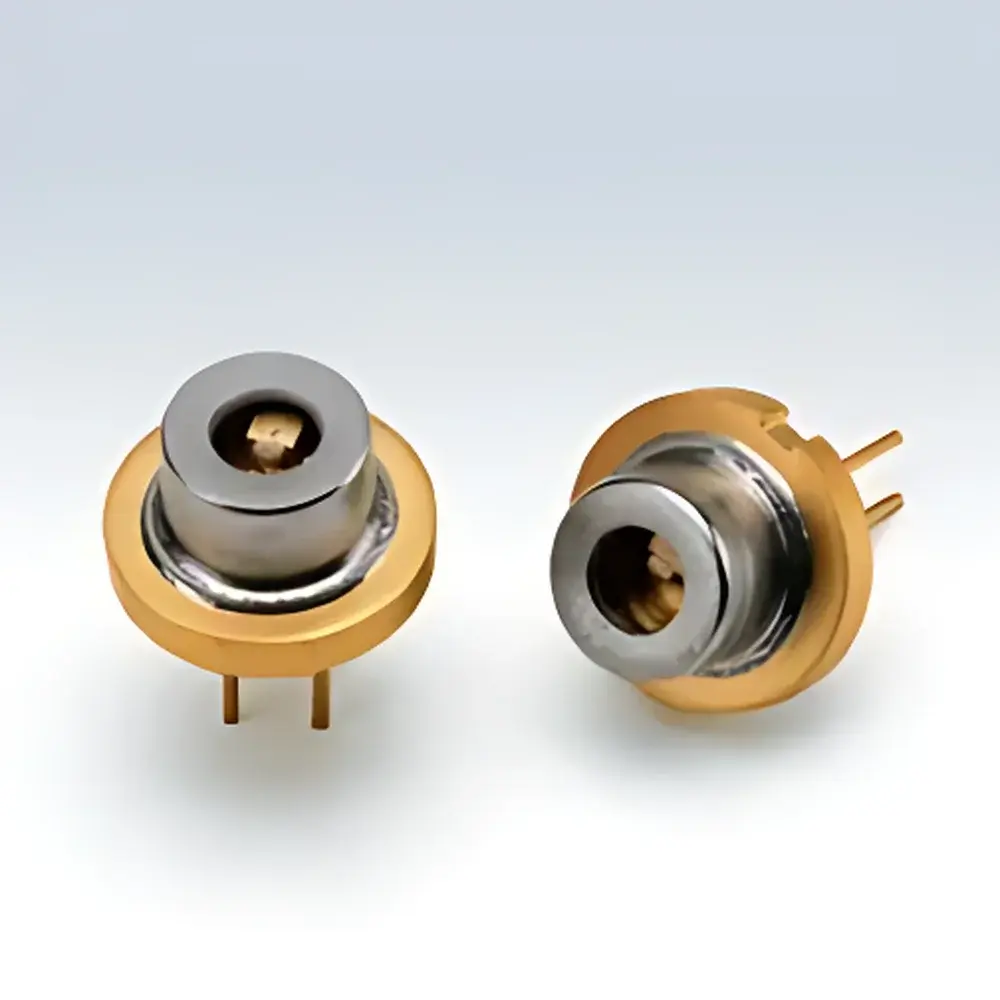
Hamamatsu SLD Superluminescent Diode Series (L8414-41 & L11607-04)
| Brand | Hamamatsu |
|---|---|
| Origin | Japan |
| Manufacturer Type | Original Equipment Manufacturer (OEM) |
| Product Category | Imported Optical Source |
| Model | SLD |
| Light Source Type | Superluminescent Diode (SLD) |
| Illumination Mode | External Illumination |
| Radiant Flux (L8414-41) | 3 mW |
| Radiant Flux (L11607-04) | 30 mW |
| Center Emission Wavelength (L8414-41, typ.) | 830 nm |
| Center Emission Wavelength (L11607-04, typ.) | 875 nm |
| Spectral FWHM (L8414-41, typ.) | 15 nm |
| Spectral FWHM (L11607-04, typ.) | 10 nm |
| Coherence Length (L8414-41, typ.) | 50 µm |
| Coherence Length (L11607-04, typ.) | 28 µm |
| Operating Temperature Range (L8414-41) | −10 to +70 °C |
| Operating Temperature Range (L11607-04) | −10 to +50 °C |
| Storage Temperature Range | −20 to +80 °C |
| Forward Voltage (L8414-41, typ.) | 2.0 V |
| Forward Voltage (L11607-04, typ.) | 1.8 V |
| Operating Current (L8414-41, typ.) | 0.1 A |
| Operating Current (L11607-04, typ.) | 0.11 A |
| Emission Width | 5 µm |
| Beam Divergence (Parallel, typ.) | 10°–23° |
| Beam Divergence (Perpendicular, typ.) | 35° |
| Monitor Photodiode Current (typ.) | 0.16 mA |
| Package | 9.0 mm CD |
Overview
The Hamamatsu SLD Superluminescent Diode Series—including the L8414-41 (830 nm, 3 mW) and L11607-04 (875 nm, 30 mW)—represents a class of broadband semiconductor light sources engineered for applications requiring high spatial brightness combined with low temporal coherence. Unlike conventional laser diodes (LDs), which emit narrow-linewidth, highly coherent light prone to speckle noise and interference artifacts, SLDs operate under amplified spontaneous emission (ASE) principles—producing spectrally broadened output while retaining near-diffraction-limited beam quality and directional collimation. This physical operating regime yields coherence lengths in the range of 28–50 µm, making these devices ideal for optical coherence tomography (OCT), fiber-optic gyroscopes, white-light interferometry, and precision metrology where phase stability must be balanced against minimal coherence-induced artifacts.
Key Features
- High radiant flux with spectrally stable ASE output—3 mW (L8414-41) and 30 mW (L11607-04) typical radiometric power into free space or fiber-coupled configurations
- Center wavelengths optimized for near-infrared biological transparency windows: 830 nm (shallow tissue penetration) and 875 nm (enhanced depth resolution in scattering media)
- Narrow spectral bandwidths (FWHM 10–15 nm) enabling axial resolution of ~15–25 µm in OCT systems without sacrificing signal-to-noise ratio
- Hermetically sealed 9.0 mm CD metal-can package with integrated monitor photodiode for real-time intensity feedback and closed-loop power stabilization
- Low divergence asymmetric beam profile—10°–23° (parallel) × 35° (perpendicular)—designed for efficient coupling into single-mode or polarization-maintaining fibers using standard aspheric optics
- Robust thermal design supporting continuous-wave operation across industrial-grade temperature ranges (−10 °C to +50/70 °C depending on model)
Sample Compatibility & Compliance
These SLD modules are compatible with standard 5 µm emitting aperture geometries and integrate seamlessly into OEM optical subassemblies used in medical imaging platforms, industrial inspection tools, and academic research setups. The devices comply with IEC 60825-1:2014 Class 1 or Class 3R laser safety requirements when properly housed and collimated. All units meet RoHS Directive 2011/65/EU and REACH Regulation (EC) No. 1907/2006 for hazardous substance restrictions. While not certified to ISO 13485 or FDA 21 CFR Part 820 out-of-the-box, the Hamamatsu SLD series is widely deployed in Class IIa/IIb medical devices undergoing full regulatory validation per EN 62304 and IEC 62366-1. Traceable calibration data—including spectral centroid drift (< ±0.2 nm/°C), power stability (< ±2% over 8 h at constant current), and coherence length verification—is available upon request for GLP/GMP-aligned qualification protocols.
Software & Data Management
Hamamatsu provides comprehensive driver support through its C-based SDK (SLD Control Library v3.2+), compatible with Windows and Linux environments. The library enables precise current control (0–150 mA resolution), temperature monitoring via internal thermistor, and real-time photodiode signal acquisition at up to 10 kHz sampling rate. Integration with LabVIEW, MATLAB, and Python (via ctypes bindings) is documented and validated. For traceability-critical applications, the SDK supports timestamped logging with metadata tagging (e.g., ambient temperature, drive current, PD response), satisfying audit requirements aligned with FDA 21 CFR Part 11 for electronic records and signatures when deployed within validated instrument control architectures.
Applications
- Optical Coherence Tomography (OCT): Axial resolution enhancement in ophthalmic, dermatological, and endoscopic OCT systems leveraging low-coherence interferometry
- Fiber Optic Sensing: High-stability broadband source for distributed strain/temperature sensing in FBG and interferometric sensor arrays
- Interferometric Metrology: Reference arm illumination in white-light scanning interferometers for surface topography and thin-film thickness measurement
- Biophotonics Research: Low-speckle illumination for confocal microscopy, flow cytometry, and fluorescence lifetime imaging (FLIM) excitation synchronization
- Calibration Standards: Stable spectral reference for spectrometer linearity verification and wavelength calibration across NIR bands
FAQ
What distinguishes an SLD from a laser diode or LED?
An SLD operates in the amplified spontaneous emission regime—offering higher brightness than LEDs and broader spectral bandwidth than LDs. This results in milliwatt-level output power with coherence lengths below 100 µm, eliminating speckle while preserving directionality and coupling efficiency.
Can these SLDs be fiber-pigtailed?
Yes—both models are routinely coupled to SMF-28 or PM980 fiber using AR-coated aspheric lenses. Hamamatsu offers optional FC/PC or FC/APC pigtailed variants (e.g., L8414-41FC); free-space versions require external collimation optics.
Is temperature stabilization required for stable output?
While operational over −10 to +70 °C, optimal spectral stability and power repeatability are achieved with active TEC control maintaining junction temperature within ±0.1 °C—particularly critical for OCT axial resolution consistency.
How is coherence length calculated from spectral FWHM?
Using the approximate relation Lc ≈ 0.44·λ²/Δλ, where λ is center wavelength (nm) and Δλ is FWHM (nm). For L8414-41: 0.44 × (830)2/15 ≈ 20,300 nm = 20.3 µm; measured values (50 µm) account for non-Gaussian spectral shape and instrument convolution effects.
Are these SLDs compliant with laser safety standards?
When operated within specified electrical and thermal limits and mounted in fully enclosed housings with appropriate beam termination, they meet IEC 60825-1 Class 1 requirements. Unenclosed use may classify them as Class 3R—requiring interlocks and labeling per local regulations.




