
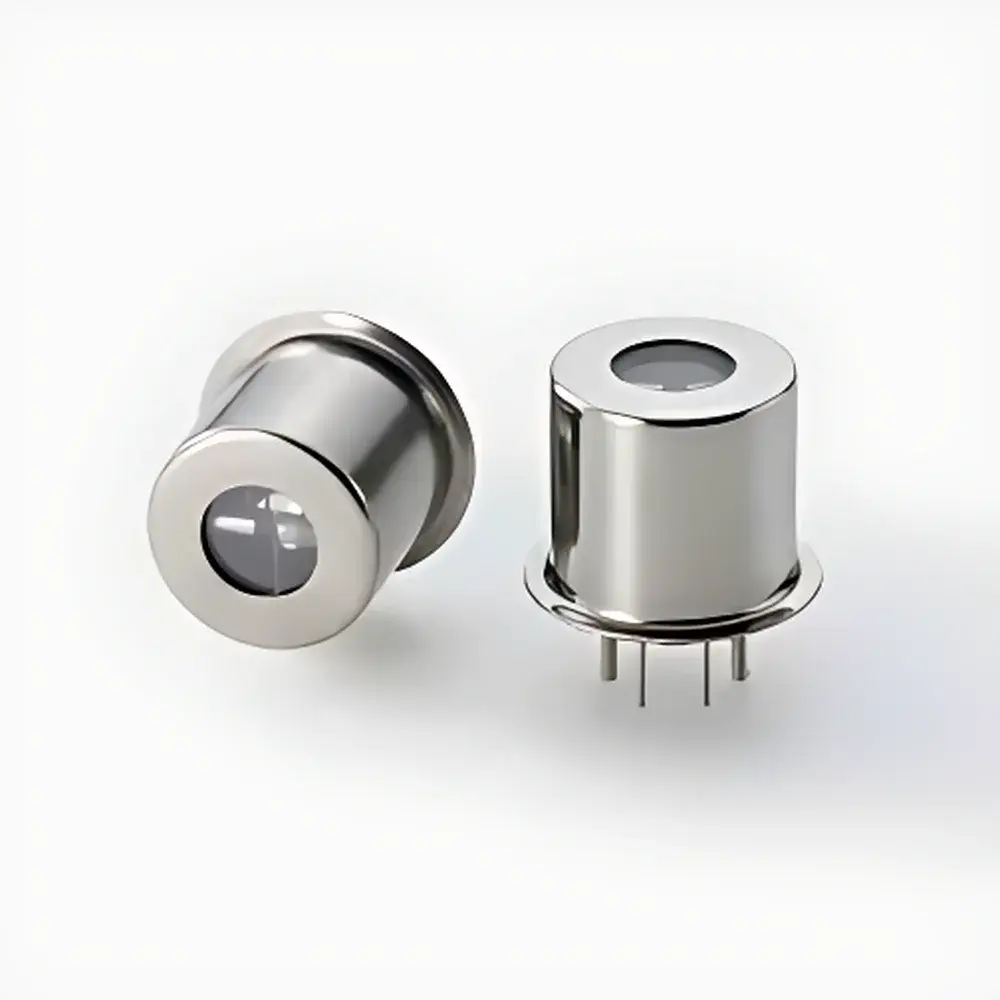
Hamamatsu L11946 / L11966 / L11947 / L11967 / L11948 / L11968 / L14692 20 W Pulsed Xenon Lamp Modules
| Brand | Hamamatsu |
|---|---|
| Origin | Japan |
| Manufacturer Type | Original Equipment Manufacturer (OEM) |
| Import Status | Imported |
| Lamp Type | Pulsed Xenon Light Source |
| Illumination Mode | External Illumination |
| Spectral Range (MgF₂ Window) | 160–7500 nm |
| Arc Size | 1.5 mm or 3.0 mm |
| Max Repetition Rate | 1000 Hz |
| Typical Output Stability | 1.0% CV, 4.5% p-p |
| Guaranteed Lifetime | 1×10⁸–1×10⁹ flashes |
| Trigger Voltage | 5–7 kV p-p |
| Operating Temperature | +5 to +40 °C |
| Cooling | Passive (No Active Cooling Required) |
Overview
The Hamamatsu L11946, L11966, L11947, L11967, L11948, L11968, and L14692 series are high-intensity, externally triggered pulsed xenon lamp modules engineered for precision optical instrumentation requiring broad-spectrum, high-stability flash illumination. These 20 W average-power lamps utilize a sealed metal-can construction with optional MgF₂, sapphire, UV-glass, or borosilicate windows—enabling spectral coverage from deep ultraviolet (160 nm) through near-infrared (7500 nm), depending on window material selection. The lamps operate on a capacitor discharge principle: a high-voltage main discharge (300–1000 V, recommended 700–1000 V) across a defined arc gap generates intense, short-duration (sub-millisecond) broadband pulses. This pulsed architecture minimizes thermal load and enables precise temporal control—critical for time-resolved spectroscopy, synchronous detection, and high-speed imaging applications. Unlike continuous-wave sources, these xenon flash lamps deliver exceptional peak irradiance while maintaining low average power dissipation, eliminating the need for active cooling under standard operating conditions.
Key Features
- Metal-can hermetic packaging ensures long-term vacuum integrity and mechanical robustness in demanding laboratory and industrial environments.
- Selectable window materials—including MgF₂ (160–7500 nm), sapphire (190–5000 nm), UV-grade fused silica (185–2500 nm), and borosilicate glass (240–2500 nm)—allow optimization for specific spectral transmission requirements.
- Two arc geometries available: compact 1.5 mm and high-energy 3.0 mm arcs, supporting trade-offs between spatial coherence and total radiant flux.
- High repetition capability up to 1000 Hz, with stable operation recommended at ≥10 Hz for optimal photometric reproducibility.
- Exceptional output stability: ≤1.0% coefficient of variation (CV) and ≤4.5% peak-to-peak (p-p) fluctuation under standardized 20 W operation (1000 V, 1.0 µF, 40 Hz).
- Guaranteed operational lifetime of 1×10⁸ to 1×10⁹ flashes—verified using Hamamatsu S1336-8BQ silicon photodiodes—defined as the point where integrated 190–1100 nm output declines to 50% of initial value or stability exceeds specification limits.
- Trigger-compatible with Hamamatsu E10977/E10978 external trigger units; supports TTL- or HV-triggered synchronization with data acquisition systems and gated detectors.
Sample Compatibility & Compliance
These xenon flash modules are designed for integration into OEM analytical platforms compliant with international standards for optical safety, electromagnetic compatibility (EMC), and laboratory equipment qualification. Their spectral breadth and pulse fidelity support methodologies referenced in ASTM E308 (computing colorimetric data), ISO 13406-2 (display measurement), USP (UV-Vis spectrophotometer qualification), and IEC 61000-4-3 (radiated immunity). As non-laser light sources, they fall outside FDA 21 CFR Part 1040 laser product regulations but require appropriate housing per IEC 62471 (Photobiological Safety of Lamps) when deployed in open-beam configurations. No hazardous substances are used in manufacturing; RoHS 3 and REACH compliance is maintained across all variants.
Software & Data Management
While the lamps themselves are hardware-only components, their integration into automated systems benefits from traceable calibration and audit-ready operation. When paired with Hamamatsu’s C13600-series power supplies or third-party programmable HV pulsers, users can log trigger timing, discharge voltage, capacitance, repetition rate, and cumulative flash count via RS-232, USB, or analog monitoring outputs. For GLP/GMP-regulated environments (e.g., pharmaceutical QC labs performing HPLC-UV or blood analyzers), full audit trails—including timestamped flash energy calculations (E = ½·C·V²) and average power derivation (P = E × f)—can be embedded into LIMS or instrument control software. Firmware-upgradable controllers support 21 CFR Part 11-compliant electronic signatures when configured with appropriate access controls and event logging.
Applications
- UV-Vis-NIR Spectrophotometry: Reference-grade pulsed source for benchtop and portable absorption/reflectance systems, especially where lamp aging and thermal drift must be minimized.
- HPLC & Flow Cell Detection: High-duty-cycle excitation for fluorescence and absorbance detectors requiring microsecond-level synchronization with elution peaks.
- Multiplexed Microplate Readers (MTP): Uniform illumination across 96-/384-well formats for kinetic ELISA, calcium flux assays, and luciferase reporter studies.
- Imaging Flow Cytometry: Stroboscopic illumination synchronized with CMOS sensor readout to freeze fast-moving cells without motion blur.
- Industrial Inspection: High-contrast transient illumination for semiconductor wafer defect mapping, food surface contaminant detection, and gemstone inclusion analysis.
- Gas & Water Quality Monitoring: Dual-wavelength absorption measurements (e.g., NO₂ at 400 nm, O₃ at 254 nm) in environmental analyzers leveraging spectral versatility.
- Color Measurement & Matching: CIE-compliant spectral power distribution enables accurate ΔE computation in paint, textile, and display manufacturing QA.
FAQ
What is the difference between standard and high-output models?
High-output variants (e.g., L11946 vs. L11936) incorporate an integrated elliptical reflector to increase radiant flux by up to 1.5× at the target plane—without altering electrical input or spectral output.
Can these lamps be operated continuously (CW mode)?
No. These are strictly pulsed devices. Continuous operation would exceed thermal design limits and void warranty; average power is sustained only via controlled flashing.
How is spectral output verified and calibrated?
Hamamatsu provides NIST-traceable relative spectral irradiance data per batch. Users may perform in situ calibration using a calibrated spectroradiometer (e.g., Ocean Insight QE Pro) and reference detector.
Are replacement triggers or power supplies available?
Yes—E10977 (low-jitter) and E10978 (high-energy) trigger units are sold separately; compatible HV power supplies include C13600 series and third-party models meeting 5–7 kV p-p trigger spec.
What maintenance is required?
None beyond periodic visual inspection of window cleanliness and electrical contact integrity. No consumables or alignment procedures are needed during rated lifetime.




